A banking core for a neobank, built from scratch
How to read this
The document consists of this section and fifteen numbered sections. This section states the decision and its rationale; each numbered section describes one part of the bank and records the subordinate decisions within it.
- Readers seeking an overview should read this section and the summary and diagrams of the system map.
- Engineers new to banking should read section 02, then the ledger and payments, on which the remaining components depend.
- Compliance and risk staff should read the licence and regulatory obligations, then customer due diligence, fraud and credit risk, security and privacy.
- Founders, product managers and those deciding on funding or staffing should read this section, the summary at the top of every section, the delivery plan and operating the bank.
- Terms are defined in the glossary.
Decisions are numbered by section, so that D04.3 is the third decision in section 04. Every section ends with its sources. A section whose design depends on confirmation by a third party lists those points, before the sources, in a table headed Assumptions and dependencies, which names the confirming party, the milestone and the fallback.
Three tags indicate the confidence of a statement. "(as reported)" marks a statement found only in a law firm's or vendor's summary rather than in the legal text. "(unconfirmed)" marks a working assumption pending confirmation by a named party, listed under Assumptions and dependencies in its section. "(planning assumption)" marks a figure used for planning until the business plan replaces it.
The build proceeds in two phases: Phase 0, the foundations built before any customer is onboarded, and Phase 1, the remainder of the launch product. Other sections use "Phase 1" for the launch product as a whole. Phase 2 and Phase 3 follow launch.
The following terms are used throughout the document:
| Term | Meaning |
|---|---|
| Block, service | An independently deployable component of the system. Its name is written as ledger. |
| Money path | The steps that must complete while a customer or a card terminal awaits a response. |
| Event | A message a service publishes after the fact to notify other services of what has occurred. |
| Hold | An amount reserved on an account but not yet transferred. |
| Millisecond (ms) | A thousandth of a second. |
| 99th percentile | The duration within which 99 of every 100 requests complete. |
| Idempotency key | A unique identifier on a request, which ensures that a repeated submission has the same effect as a single one. |
| State machine | A record that is always in one named state, such as "sent" or "settled", and changes only through permitted transitions. |
| Adapter | An in-house component that is the sole interface to one external supplier. |
| Four-eyes | A control requiring approval by two different people. |
| Target | A figure chosen as an engineering objective. Figures derived from law carry a link to the legal text. |
Context and problem
A bank maintains an authoritative record of its obligations to customers, executes transfers against that record on instruction, and demonstrates to its supervisor that the record is accurate and that its customers are who they claim to be. The banking core is the software that maintains this record and enforces the controls around it.
The assumed bank is new, operates without branches, and serves individuals and small businesses in one home market: either the European Union in euro under a Lithuanian licence, or the United Kingdom in sterling under a UK authorisation. The jurisdiction shapes the design in three respects, and the section on jurisdiction profiles below summarises what each profile selects.
- Licence type. Under the Lithuanian profile, Lithuania offers a specialised bank licence (as reported), which requires less initial capital than a full banking licence and confers the same core powers: deposits, payments and lending. Under the UK profile, a bank is authorised by the Prudential Regulation Authority (PRA) with the consent of the Financial Conduct Authority (FCA), and a new bank may enter through mobilisation, an authorisation with restrictions, including a cap on total deposits, which according to the regulator's guidance should take no longer than 12 months (Bank of England: mobilisation[11]). The default in both profiles is to apply for the bank licence directly. The bank obtains an electronic money institution (EMI) licence first only if three conditions, set out in section 01, are met by the end of Phase 0. Because the two licences differ in the legal location of customer funds and in the permission to lend, the system is designed to operate under either.
- Payment system access. Under the Lithuanian profile, CENTROlink, operated by the Bank of Lithuania, gives its participants access to all euro payments in Europe, including instant payments. A bank may participate directly. Whether an EMI may participate directly or requires a sponsoring participant depends on rules that changed in November 2026; the design assumes direct participation, with connection through a sponsoring participant as the fallback (unconfirmed; section 04). In both cases payments are processed by the bank's own gateway without a correspondent bank. Under the UK profile, the instant rail is Faster Payments, operated by Pay.UK and available at all hours throughout the year. A directly connected non-settling participant operates its own technical connection, while a sponsoring settling participant authorises each debit and credit in near real time and settles on its behalf (Faster Payments System Principles[15]); payments are therefore also processed by the bank's own gateway, with settlement dependent on the sponsor until the bank holds its own settlement account.
- Regulatory obligations. Under the Lithuanian profile, a euro-area bank must send and receive instant payments at all hours and verify the payee's name before a transfer. It must screen every customer against sanctions lists daily, maintain operational resilience under the EU's Digital Operational Resilience Act (DORA), and protect personal data. Under the UK profile, a Faster Payments participant must receive and respond to payments at all hours, a participant with its own sort code must offer Confirmation of Payee from the day after it joins, at least when a payee is created or its identifiers change, customers are screened against the UK Sanctions List, and operational resilience follows the PRA's and FCA's rules on important business services and impact tolerances. Mandatory reimbursement of authorised push payment (APP) fraud on Faster Payments and on CHAPS, the Bank of England's high-value payment system, also applies, with the cost shared equally between the sending and the receiving firm (Payment Systems Regulator PS25/5[18]). In both profiles these obligations determine the first version, because they cannot be retrofitted.
This document determines which components are built, in which blocks and in what order, and which are procured.
Jurisdiction profiles
The architecture consists of a jurisdiction-neutral core and a jurisdiction profile. The profile is configuration together with a small set of adapters and modules, selected by the setting jurisdiction.profile with the values lt and uk. It sits beside the setting licence.mode (emi or bank), which has the same meaning in both profiles. This document does not choose between the two jurisdictions; it shows that the same core serves either and records what differs.
| Aspect | Lithuanian profile | UK profile |
|---|---|---|
| Supervisors | Bank of Lithuania; ECB for the bank licence | PRA and FCA for a bank; FCA for an EMI |
| Licence modes | emi: electronic money institution; bank: specialised bank | emi: FCA-authorised EMI; bank: PRA-authorised bank, entered through mobilisation (authorisation with restrictions) |
| Currency and account identifier | EUR; Lithuanian IBAN | GBP; sort code and 8-digit account number, with a UK IBAN derived for cross-border use |
| Instant rail and gateway block | Instant Credit Transfer of the Single Euro Payments Area (SEPA) through CENTROlink; sepa-gateway | Faster Payments; fps-gateway |
| Batch and other rails | SEPA Credit Transfer; SEPA Direct Debit (Phase 2) | Inbound Bacs Direct Credits and paying-side Bacs Direct Debit through the sponsor (Phase 1); origination of Bacs Direct Credits (Phase 2); CHAPS through the sponsor, direct in Phase 3 |
| Payee name check | Verification of payee | Confirmation of Payee |
| Customer money | emi: safeguarding under Lithuanian law; bank: Lithuanian deposit insurance | emi: safeguarding under the FCA regime; bank: Financial Services Compensation Scheme (FSCS) protection and the Single Customer View file |
| Operational resilience | DORA | PRA and FCA operational resilience and outsourcing rules |
| AML reporting and sanctions | Lithuanian financial intelligence unit (FIU); EU and UN lists | National Crime Agency (suspicious activity reports); UK Sanctions List (published by the Foreign, Commonwealth and Development Office; financial sanctions enforced by the Office of Financial Sanctions Implementation, OFSI) and UN lists |
| Data protection | GDPR | UK GDPR and Data Protection Act 2018 |
| Conduct and fraud reimbursement | PSD2 as transposed and EU consumer law; PSD2 liability rules | Payment Services Regulations 2017, FCA Consumer Duty, the FCA's Banking Conduct of Business sourcebook (BCOBS) and complaints rules (DISP); mandatory APP fraud reimbursement for Faster Payments and CHAPS |
| Cloud regions | Frankfurt primary, Ireland recovery | London primary, Ireland recovery, subject to the supervisor's view of a recovery region outside the UK |
| Governance regime | Bank of Lithuania fit-and-proper assessment | Senior Managers and Certification Regime |
One licensed legal entity runs under exactly one profile, in its own deployment with its own ledger, databases, keys and cloud accounts. A group that serves both markets therefore runs two entities and two deployments of the same code.
No passporting applies between the two jurisdictions. A Lithuanian licence passports across the European Economic Area (EEA) but not to the United Kingdom, where passporting ended in both directions on 31 December 2020 (FCA: regimes for EEA firms[8]). A UK authorisation covers the United Kingdom only and gives no access to the EEA (FCA: considerations after the transition period[9]). Section 01 sets out the licence routes in each jurisdiction.
What drives the decision
- Correctness of balances. An incorrect balance is the failure a bank cannot tolerate, and every design choice is assessed against this criterion first.
- Evidence on demand. A supervisor, an auditor or a customer may require proof of any outcome, and the system must already hold that evidence without manual assembly.
- Continuous availability. Instant payments and card purchases arrive at any time of day, so the system has no nightly maintenance window.
- Team size. A new bank cannot employ hundreds of engineers, and the design must be operable by a team of a few dozen.
- Regulatory change. Payment rules, anti-money-laundering rules and the licence itself will change during the build in either jurisdiction, so dates, thresholds and jurisdiction-specific rules are held as configuration in the jurisdiction profile.
- Two jurisdictions on one core. The same code must serve a Lithuanian or a UK entity, so every difference between the jurisdictions is confined to the profile's configuration, adapters and modules, and the core contains no jurisdiction-specific logic.
- Control of customer experience and unit cost. Control over the customer experience and the cost of each payment is the reason for establishing a new bank.
- Exit from suppliers. Under the Lithuanian profile, the Digital Operational Resilience Act requires documented and tested exit strategies for technology services supporting critical or important functions (DORA, Article 28[2]). Under the UK profile, the PRA's supervisory statement SS2/21 governs outsourcing and third-party risk management (PRA SS2/21[20]). In both profiles the bank applies the DORA exit standard to every supplier.
Options considered
| Option | Description | Assessment |
|---|---|---|
| A. Rent everything (banking-as-a-service) | A licensed partner holds customer funds and operates the core; the bank builds an application on the partner's interface. | Fastest start, but the partner sets the price of every payment, the product limits and the incident response. It does not address the question posed, which assumes the bank's own licence. |
| B. Buy a core banking product | A vendor's ledger and product engine are licensed, and channels and integrations are built around them. | A proven ledger from the outset, but fees scale with the customer base and the vendor's data model and release schedule become constraints on the bank. Holds, value dates, licence modes, payments, risk, compliance and reconciliation would still be built around it. Not yet priced: see 03. |
| C. Build everything | Every component is built in-house, including card processing and identity-document verification. | Maximum control, but card processing requires scheme certification and specialised hardware, and document verification is a distinct research field. Neither provides competitive differentiation. |
| D. Build the core, buy the commodity (chosen) | The ledger, accounts, payments, risk decisions, compliance tooling and all channels are built in-house. Functions identical across banks are procured, each behind an adapter. | Control where it determines the product and the cost of each payment, and a smaller build elsewhere. Cost: a larger initial build than A or B and full responsibility for the ledger. |
The decision
Decision: option D, comprising the following eleven points.
- Build the core, procure the commodity. The book of record and every component that determines the movement of money are built in-house. Identity verification, sanctions data, card processing, hardware security modules, message delivery, helpdesk and accounting software are procured, and each remains replaceable. See 13.
- Single book of record. A double-entry ledger, in which every movement is recorded as a debit and an equal credit so that the books always balance, is the sole authority on balances. Every balance held elsewhere is a derived copy that can be rebuilt. See 03.
- Service decomposition. The system comprises about twenty services, each owning its data, which no other service may read. See 02.
- Synchronous calls limited to the money path. Only payments and card purchases require a synchronous response, in which one service calls another and must receive an answer within a deadline. All other services are notified afterwards by events and may lag by a few seconds. Section 02 lists each synchronous call, its deadline and its failure handling.
- Risk decisions on the money path. Every outgoing payment and card purchase receives a fraud and limits decision before funds move, whereas anti-money-laundering monitoring runs afterwards from the events. See 07 and 06.
- Direct access to European payments. Under the Lithuanian profile, euro transfers run under SEPA, the Single Euro Payments Area. As a bank, the institution joins CENTROlink as a direct participant and uses its message standard. Under an EMI licence a sponsor may be required, and
sepa-gatewayisolates the rest of the system from that difference. Under the UK profile, sterling transfers run on Faster Payments. The bank launches as a directly connected non-settling participant, with its own connection available at all hours and settlement through a sponsoring settling participant, and moves to settling participation with its own settlement account at the Bank of England in Phase 2 (planning assumption). Until then the sponsor authorises each payment in near real time and charges a fee, a dependency that direct participation under the Lithuanian profile avoids.fps-gatewaytakes the place ofsepa-gatewayand maps the internal payment model to the Faster Payments message format, which is not ISO 20022. The payments hub, the payment states and the reservation rules are identical in both profiles. Cards run on one international scheme through a procured issuer processor, while the authorisation decision remains with the bank. See 04 and 05. - Established, widely used technology. The platform uses one programming language (Rust), one database (PostgreSQL), a durable message log that consumers read at their own pace, and a managed container platform, all with one cloud provider in two regions: Frankfurt as primary and Ireland for recovery under the Lithuanian profile, and London as primary and Ireland for recovery under the UK profile (subject to the supervisor's acceptance of a recovery region outside the UK). Native mobile applications, a web application and a staff console complete the channels (09). Section 10 names the products and the rationale.
- Explicit state machines for long-running processes. Account opening, payments and card disputes are each stored as a sequence of named states that can be resumed, inspected and audited. See 10.
- Zero-trust network model. Network location confers no trust, and every service authenticates on every call. Staff have no standing access to production data, sensitive staff actions require four-eyes approval, and keys remain within hardware security modules. See 11.
- Personal data vault. Personal data is held in one vault, and other services refer to a customer only by an identifier. Retention and erasure are executed automatically by the system. See 12.
- Licence mode as configuration. Switching between EMI and bank modes changes configuration and a small number of modules, and leaves the architecture unchanged. The EMI-only modules, such as safeguarding reconciliation and EMI reporting, are designed in Phase 0 and built only if the EMI route is chosen. The jurisdiction profile (
jurisdiction.profile,ltoruk) is selected in the same way and is fixed for each licensed entity; both licence modes exist in both profiles. Under the UK profile, mobilisation is held as limits configuration (licence.restrictions), including the GBP 50,000 cap on total deposits, enforced byaccountsandrisk, and the bank mode adds the FSCS Single Customer View file. See 01 and 08.
The design is held to the following targets, which apply unchanged in both profiles:
- Availability: the money path is available 99.95% of each month.
- Data loss: no confirmed transaction is lost within the primary region, and at most one minute of data is lost across regions.
- Recovery: service is restored within two hours of the loss of the primary region.
- Incoming instant payment: answered within 2 s at the 99th percentile, with a hard deadline of 4 s; under the Lithuanian profile the credit is posted on receipt of CENTROlink's settlement confirmation (target: within 1 s of it). Under the UK profile the credit is posted when the bank accepts the payment, with the same target (planning assumption), and scheme time limits for Faster Payments are given in section 04.
- Load (peak target in year three): 200 money-path requests per second in total (payments and card authorisations), corresponding to about 1,000 posting rows per second. Section 13 derives the figure.
A declared loss of the primary region is measured against the two-hour recovery target rather than the monthly availability target; every other outage counts against the 99.95%. Section 10 describes how both are met.
The operating functions around the software, including desks, rotas, controls and governance, are described in section 14.
The system on one page
The diagram shows the groups of blocks and the direction of the principal calls. Section 02 names every block.
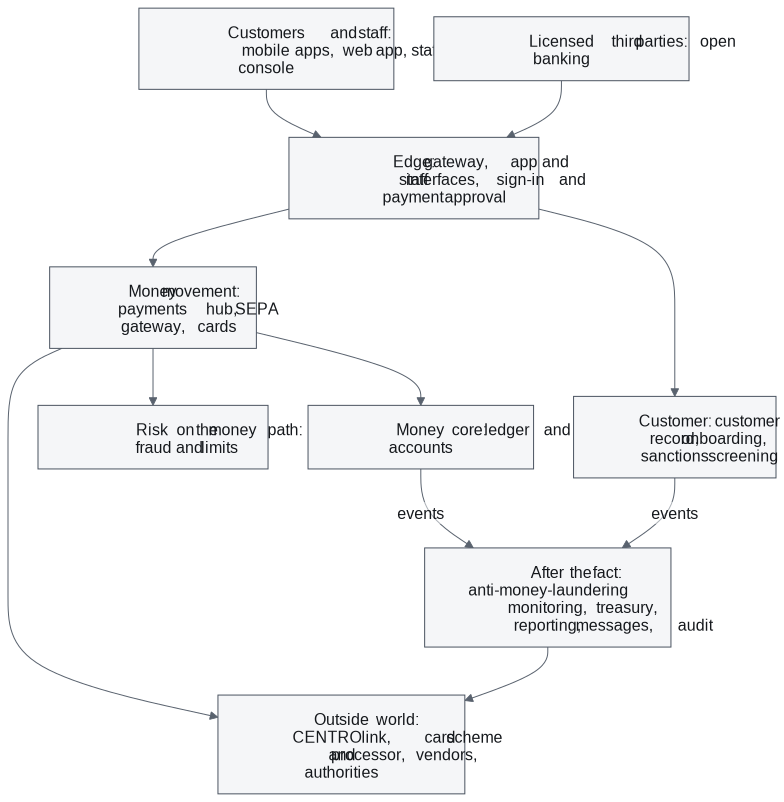
The diagram shows the Lithuanian profile; under the UK profile fps-gateway and Faster Payments take the places of sepa-gateway and CENTROlink.
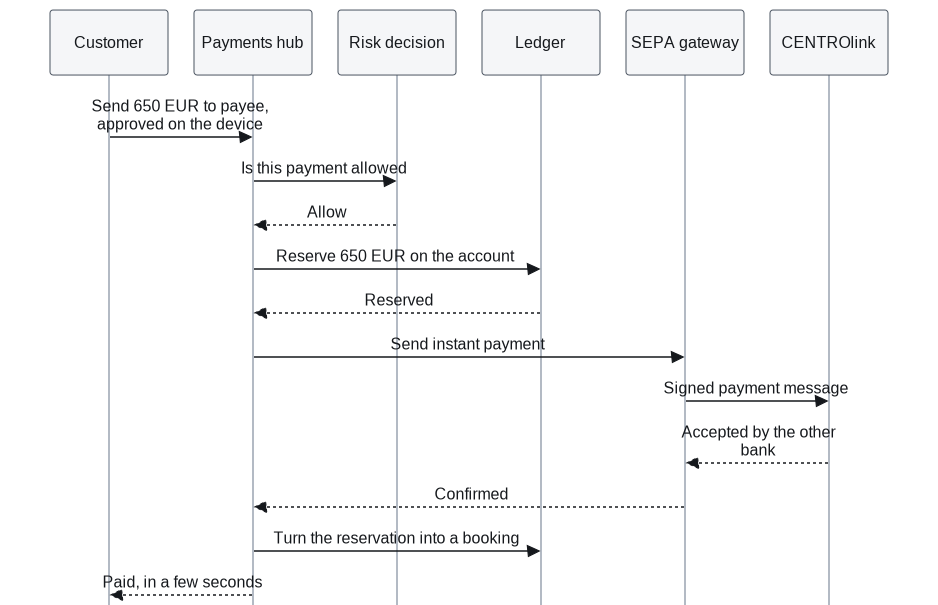
The design is dimensioned around the outgoing instant payment. Example: a customer sends EUR 650.00 to a payee who holds an account at a bank in another euro-area country. Amounts are shown in euro; under the UK profile the same example applies in sterling.
Benefits and costs
| Benefit | Cost |
|---|---|
| A ledger whose rules are fully understood and demonstrably correct | Full responsibility for its correctness, with no vendor accountable |
| Payments at CENTROlink's published tariff without an intermediary margin, and incident response under the bank's own control; under the UK profile the same applies from Phase 2, whereas in Phase 1 a sponsor settles and authorises each payment for a fee | A direct connection that must be staffed and monitored at all hours throughout the year; under the UK profile, also dependence on the sponsor for Faster Payments settlement until Phase 2 and for Bacs, including the Direct Debits that the launch account honours as paying bank |
| A product constrained by the bank's own roadmap rather than a vendor's | A forecast of about 19 to 36 months from funding to public launch, most likely a little over two years, under the Lithuanian profile, and about 22 to 40 months, most likely about 30, under the UK profile, where the forecast assumes that Faster Payments onboarding is completed by the date of authorisation (planning assumptions, section 13) |
| Replaceable suppliers, as the resilience rules require | An adapter to build and test for each supplier |
| A single service template that a small team can operate | Reduced freedom for individual teams to choose their own tools |
| Evidence produced as the system operates | More initial design effort in audit, reconciliation and data lineage than a prototype would require |
The licence, rather than the build, is the likely critical path in both profiles. Under the Lithuanian profile the licence decision is expected 12 to 24 months after filing (planning assumption; reported cases range from 9 to 24 months). Under the UK profile the statutory decision period for a bank is six months from a complete application and 12 months from receipt of an incomplete one (PRA authorisations performance report[12]), the assessment stage typically takes 8 to 12 months after submission (as reported, BDO[14]), and mobilisation follows before the restrictions are lifted. The cost from funding to public launch, before regulatory capital, is EUR 10 to 18 million under the Lithuanian profile and GBP 12 to 20 million under the UK profile (planning assumptions). The UK range covers a public launch up to about month 34; the latest forecast of 40 months would require about GBP 24 to 26 million (planning assumption). Section 13 breaks down these figures.
Direct participation in the payment system is decided on grounds of control; the saving on payment tariffs forms no part of that case and is not counted in the cost envelope, and the business plan quantifies it against the cost of continuous staffing and the liquidity held in buffers (section 13).
Three outcomes would be regretted: starting the book of record late, connecting to real banks and suppliers before simulators of them are available for testing, and allowing a second record of balances to develop alongside the ledger. The delivery plan is sequenced to prevent all three.
Findings carried over from earlier experiments
This document follows from its authors' earlier libraries for money, a ledger, payments, cards and customer due diligence, written first in OCaml and later in Rust. Although they were experiments rather than a bank, several of their principles are retained unchanged.
- Integer monetary amounts. An amount is an integer count of the currency's minor unit, such as cents, bound to its currency, and the system rejects arithmetic across currencies such as euro and dollars.
- Reservation before movement. A card payment first places a hold in the ledger, which may be increased, captured in part or in full, released or left to expire. Every outgoing payment begins in the same way.
- Idempotent writes. Every write carries an idempotency key, and a repeated key returns the result originally booked. Only booked results are stored under the key, so a retry after a refusal is evaluated anew.
- Corrections as new entries. Ledger entries are immutable, and the chain of entries is hashed so that tampering is detectable.
- Completion only on confirmation. A payment is complete only when the counterparty confirms it. In the absence of a response its status is "not confirmed yet", and it is not reported as failed without evidence.
- Complete rule evaluation. Every fraud rule is evaluated and every rule that fires is recorded, so that any decision can be replayed from the stored facts. If a customer's risk band is unknown, the transaction is blocked and the rules are still applied.
- Common supplier contract. Each class of supplier sits behind one contract verified by one test suite, with a simulated supplier that behaves like the real one.
- Classification-driven disclosure. The classification of data determines what a customer may see about an investigation, independently of any individual screen's logic.
Rust replaces OCaml for the build because the modelling style carries over and a single widely used language and toolchain is easier to recruit for, build and operate. Section 10 gives the detail.
Sections
| Section | Scope |
|---|---|
| 01. The licence and the rules that shape the system | Licence options in Lithuania and the United Kingdom, passporting, and each obligation mapped to the block it requires |
| 02. The system map | Every block, data ownership, inter-block communication, time budgets |
| 03. Ledger and accounts | Double entry, reservations, products, interest, the daily close |
| 04. Payments | SEPA, instant payments, verification of payee, the payments hub, CENTROlink; Faster Payments, Bacs, CHAPS and Confirmation of Payee under the UK profile |
| 05. Cards | Issuing, authorisation, clearing, disputes, wallets |
| 06. Knowing the customer | Onboarding, sanctions screening, monitoring, case management, reports |
| 07. Fraud, limits and credit risk | Real-time decisions, rules and models, later lending |
| 08. Treasury, reconciliation and reporting | Location of funds, reconciliation of the books with external records, regulatory reports |
| 09. Apps, web, back office and open banking | Customer and staff channels, sign-in and payment approval |
| 10. Platform, data and operations | Cloud, databases, events, the data platform, resilience, delivery |
| 11. Security | Threats, identity, keys, four-eyes controls, detection and response |
| 12. Privacy and data protection | The personal data vault, retention and erasure, data subject rights |
| 13. Delivery plan | Phases, exit criteria, timeline and cost forecasts for each profile, team, buy versus build, risks |
| 14. Running the bank | The operating day, desks and on-call, governance, life events, wind-down |
| 15. Glossary | All terms and abbreviations |
Sources
- Instant Payments Regulation (EU) 2024/886
- Digital Operational Resilience Act, Regulation (EU) 2022/2554
- CENTROlink operating rules, Bank of Lithuania (2023 text)
- Monzo: tolerating full cloud outages with Stand-in
- Starling Bank: resilient banking systems
- Stripe: Ledger, a system for tracking and validating money movement
- TigerBeetle: two-phase transfers
- FCA: regimes for EEA firms that passported into the UK
- FCA: considerations for firms after the transition period
- Bank of England: new bank authorisation process
- Bank of England: mobilisation
- PRA Authorisations Performance Report 2025/26 Q4
- PRA Authorisations Performance Report 2026/27 Q2
- BDO: UK bank authorisation guide (as reported)
- Pay.UK: Faster Payments System Principles v11, January 2026
- Payment Systems Regulator: Specific Direction 17 on Confirmation of Payee, consolidated October 2026
- Payment Systems Regulator: APP fraud reimbursement protections
- Payment Systems Regulator: PS25/5, APP scams reimbursement, consolidated policy statement
- PRA SS1/21: operational resilience
- PRA SS2/21: outsourcing and third-party risk management
- UK Sanctions List as the single source of designations