13. Delivery plan: phases, team, buy versus build
Purpose and scope
The other sections of this document specify what is built; this section specifies the order of delivery, the team, the cost and the procured components. A bank is ready to operate only when the supervisor is satisfied that its software, staff and procedures together can run it safely.
Example: under the Lithuanian profile, before the first invited customer can send EUR 20.00 to another person, the licence must be granted, CENTROlink must have accepted the bank's test messages, a card processor must have certified the bank, and an analyst must be trained to account for that payment to an auditor three years later. Software is estimated at roughly half of the work; the remainder consists of runbooks, drills, reconciliation (matching the bank's books against external records), training, vendor contracts and written evidence, and a plan that estimates software alone understates the schedule accordingly. Amounts are shown in euro; under the UK profile the same example applies in sterling, with authorisation by the PRA and completed Faster Payments onboarding in place of the licence and CENTROlink admission.
Cost envelope (planning assumptions)
These figures are order-of-magnitude assumptions, not quotations, and the business plan will replace them because most of the cost is unsourced. The cost drivers, in descending order, are engineers and the staff required by the licence; capital; card programme and processor fees; cloud and security tooling; per-customer vendor checks; and customer support once customers are onboarded.
| Item | Planning assumption |
|---|---|
| Engineering | About 15 people in Phase 0 and about 35 at public launch, at EUR 100,000 to 130,000 a year each, fully loaded |
| Other staff | About 8, growing to about 28 (Team shape), at EUR 60,000 to 90,000 a year each, fully loaded |
| Suppliers, cloud, audit, legal and licence fees | EUR 1.5 to 3 million a year from the start of Phase 1 |
| Total from funding to public launch | EUR 10 to 18 million, before regulatory capital |
| Total to break-even | Not estimated; requires the business plan |
The table above applies to the Lithuanian profile. The UK profile assumes the same head counts at sterling cost levels:
| Item | Planning assumption, UK profile |
|---|---|
| Engineering | About 15 people in Phase 0 and about 35 at public launch, at GBP 110,000 to 150,000 a year each, fully loaded |
| Other staff | About 8, growing to about 28 (Team shape), at GBP 65,000 to 100,000 a year each, fully loaded |
| Suppliers, cloud, audit, legal and regulatory fees | GBP 1.5 to 3 million a year from the start of Phase 1 |
| Total from funding to public launch | GBP 12 to 20 million, before regulatory capital |
| Total to break-even | Not estimated; requires the business plan |
The UK range corresponds to a public launch between the earliest forecast and about four months after the likely forecast, with the full pre-launch team carried through mobilisation while deposits are capped. Each further month at launch staffing costs about GBP 0.6 to 0.9 million, so the latest forecast of 40 months requires about GBP 24 to 26 million before regulatory capital (planning assumptions). The supplier line includes the scheme's charges for a direct Faster Payments participant, listed at GBP 11,138 a month for telecommunications and GBP 1,011 a month for the service desk (Faster Payments System Principles[28], section 12), and the sponsor's fee, which is a commercial term of the sponsor contract and is assumed to fall within the supplier line (planning assumption; Payments). Card scheme collateral (Cards) and, on the EMI route, the firm's own money held with the Faster Payments sponsor in addition to the safeguarded pool (Treasury, finance and reporting) are outside the envelope and are sized with the capital plan. Paying-side Bacs Direct Debit (Payments, D04.8) is inside the Phase 1 scope, and the envelope and the forecast are assumed to cover it without change (planning assumption).
Direct participation in CENTROlink is decided on grounds of control over the instant payment time budget, the prefunded account and incident response (Payments, D04.1), and the saving from paying the published tariff without an intermediary's margin forms no part of that case and is not counted in the envelope. The round-the-clock rota is staffed from the head counts under Team shape, and the funds held in liquidity buffers are sized with the capital plan (Treasury, finance and reporting). Residual risk: the tariff saving may be smaller than the cost of the rota and the buffers, which the business plan quantifies.
Regulatory capital is additional to these figures. The legal minimum is EUR 1 million for a specialised bank (as reported, Sorainen[12]) or EUR 350,000 for an electronic money institution (EMI) (EMD2 Art 4[1]). The amount required at authorisation is the amount that, after accumulated losses, keeps the bank in continuous compliance with the initial, risk-based and leverage-based capital requirements and the large exposure limits over the first 36 months of operations, under both a baseline scenario and a severe but plausible stress scenario. The portion that covers the first 12 months must be paid up before the licence is granted, and the portion that covers the second and third years must come from funding sources that are promptly available (ECB Guide to licence applications[11], section 5.3). The supervisor's add-on and the buffers are sized in the capital plan (Treasury, finance and reporting). This amount, which exceeds the legal minimum, is the second-largest cost.
Under the UK profile the base capital requirement is likewise a floor (the licence section), and the capital actually required is set by the prudential regime described in Treasury, finance and reporting.
Components
Delivery comprises four workstreams that progress together: the licence process, the system (the blocks in the system map), the team and the vendors.
The default route is a direct application for the specialised bank licence. The EMI route is taken first only if the three conditions of D01.1 in the licence section are met by the end of Phase 0. Modules required only by an EMI, such as safeguarding reconciliation and the EMI report set, are designed in Phase 0 and built only if the EMI route is chosen. On that route the stages below are executed twice, once for the EMI licence and again for the upgrade, which requires a full-copy migration rehearsal; the in-house ledger, which holds the complete history from the first day, reduces the complexity of that migration.
Under the UK profile the default route is an application, through the New Bank Start-up Unit operated jointly by the PRA and the Financial Conduct Authority (FCA), for authorisation as a bank entered through mobilisation, which is authorisation with restrictions (New bank authorisation process[13]). The PRA is the lead authority for the deposit-taking permission and cannot grant it without FCA consent (Financial Services and Markets Act 2000, section 55F[18]). The FCA EMI route is taken first only under the same three conditions of D01.1, and the same consequences for the stages and the migration rehearsal follow.
The diagram shows the bank route, from preparation of the application to public launch.
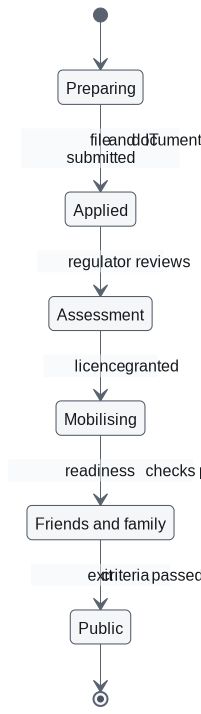
Mobilisation consists of meeting any conditions attached to the licence and rehearsing with real counterparties. The licensing decision includes the assessment of the fitness and propriety of every member of the management body and, where national law so provides, of the key function holders, and the application must identify at least two persons who will effectively direct the business (ECB Guide to licence applications[11], section 5.4). The bank therefore names the members of the management body and the heads of the control functions in the application and has them in post before the licence decision, as the head counts at application under Team shape provide. Cost: their salaries are carried from the application onwards. The friends and family stage is an initial launch to a small group of invited customers under tight limits. Under the UK profile mobilisation is the period of authorisation with restrictions, subject to the mobilisation deposit cap (the licence section), and the friends and family stage takes place inside it (Mobilisation[14]).
Known timing facts under the Lithuanian profile:
- The licence decision is expected 12 to 24 months after filing (planning assumption; reported cases range from 9 to 24 months) (sources in D01.1 in the licence section).
- The Bank of Lithuania assesses a bank application and proposes a draft decision to the European Central Bank (ECB), which takes the decision (SSM Regulation Art 14; the licence section).
- The Bank of Lithuania decides on CENTROlink admission within 15 business days of receiving a complete file (CENTROlink Operating Rules §22[7]). Completing the file takes the longest, covering the BIC, IBAN range, TARGET access, certificates, connectivity tests and AML and fraud controls, and its duration is a planning assumption.
- All other durations, including the length of mobilisation and the launch dates, are planning assumptions and are labelled as such.
Known timing facts under the UK profile:
- The statutory decision period is six months from a complete application and 12 months from receipt of an incomplete one (PRA Authorisations Performance Report[15]). The PRA already measures itself against four and ten months, the periods that the Financial Services and Markets Bill would make statutory; the Bill completed its Lords stages on 15 September 2026 and was in Commons committee in November 2026, so the six- and twelve-month periods remain the law (Financial Services and Markets Bill[17]).
- The assessment stage typically takes 8 to 12 months after submission, in addition to the pre-application stage (as reported, BDO[20]).
- Mobilisation "should take no longer than 12 months", which is regulator guidance rather than statute (Mobilisation[14]); one recent digital entrant spent about 18 to 20 months in mobilisation (as reported, City AM[21]).
- The average time spent in mobilisation was eight months according to a PRA seminar of October 2019 (seminar slides[19]), which is the basis of the likely case. The latest case assumes 10 months and is exceeded if mobilisation runs to the 12-month guidance or beyond.
- Pay.UK states 9 to 12 months end to end for Faster Payments onboarding (Faster Payments System Principles[28]).
- All other durations are planning assumptions.
The application is prepared in parallel with Phase 0. DORA[4] requires a register of ICT third-party contracts (Art 28(3)) and exit strategies (Art 28(8)). ICT suppliers fall under DORA, whereas other outsourcing falls under the EBA guidelines on third-party risk management, which replace the 2019 outsourcing guidelines (as reported). The supervisor's further expectations for these documents are treated in Platform and data. Preparing the system description for the regulator is a delivery task with a named owner. Under the UK profile the corresponding documents address the PRA and FCA operational resilience and outsourcing rules, whose transitional period ended on 31 March 2025 and which therefore apply to a new bank from authorisation (Platform and data).
Outside tests and approvals
A large part of the lead time depends on the schedules of other organisations, which simulators cannot shorten. Except where a row states a published figure, none of the lead times below is sourced; each is a planning assumption, and the assumptions on which the forecast depends are listed under Assumptions and dependencies. A scheme rule change whose effective date falls within the build period is entered as a dated item in this table and in the compliance register.
| Item | Needs first | Gates |
|---|---|---|
| Bank of Lithuania readiness review of IT, outsourcing and security documents | A written system description | The licence |
| CENTROlink admission, certificates, connectivity and conformance tests | Licence or sponsor agreement, BIC, IBAN range | Friends and family launch |
| SEPA scheme adherence for credit transfers, instant credit transfers and verification of payee | Licence | Friends and family launch |
| Card scheme membership and processor certification, including 3-D Secure | Processor contract | Cards |
| Apple Pay and Google Pay approvals | Scheme and processor | Wallets |
| Open banking interface test (see Channels) | Licence | Friends and family launch |
| PCI DSS (the card industry's data security standard) validation of the processor connection | Processor | Cards |
| Penetration test | Build frozen for the test | Friends and family launch |
| Two safeguarding accounts and an operating account at a credit institution (EMI route only) | EMI licence application | EMI launch; such accounts are frequently difficult to open, see the licence section D01.5 |
| UK profile: PRA and FCA assessment, including the IT, outsourcing and operational resilience documents | Pre-application feedback from the New Bank Start-up Unit; a written system description | Authorisation with restrictions |
| UK profile: Faster Payments onboarding as a directly connected non-settling participant, including connection, assurance and attestation; Pay.UK states 9 to 12 months end to end | Authorisation as a payment service provider, a sponsor settlement participant agreement, a unique sort code with its entries in the industry sort code directory (EISCD), own gateway or an accredited technical aggregator | Friends and family launch |
| UK profile: network circuits to the Faster Payments central infrastructure at two sites, scheme cryptography, and compliance with Pay.UK's Cloud Risk Policy and Cloud Code of Conduct for a gateway hosted in a public cloud | Sponsor agreement; hosting design | Faster Payments certification testing |
| UK profile: Confirmation of Payee participation, sending and responding, directly or through an accredited aggregator | Sort code and Faster Payments onboarding | Friends and family launch |
| UK profile: registration with Pay.UK's Reimbursement Claims Management System for authorised push payment (APP) fraud claims (lead time a planning assumption) | Faster Payments onboarding | Friends and family launch |
| UK profile: indirect Bacs access through the sponsor for inbound Direct Credits and paying-side Direct Debit, including Bacs file testing with the sponsor and the sort code's Bacs entries in the EISCD (lead time a planning assumption) | Sponsor agreement; sort code | Friends and family launch |
| UK profile: CHAPS through the sponsor | Sponsor agreement | Friends and family launch |
| UK profile: registration of the bank's BIC with Swift, whose first four characters form the bank code of the UK IBAN (Payments) | Authorisation | CHAPS through the sponsor and cross-border payments |
| UK profile: card scheme principal membership, applied for during mobilisation, with a BIN sponsor (a scheme member that issues cards on the bank's behalf) as the fallback for the friends and family stage (planning assumption; Cards), and processor certification including 3-D Secure | Processor contract; scheme collateral | Cards |
| UK profile: Open Banking Directory enrolment (lead time a planning assumption); interface specification and testing facility published at launch, and a fallback interface within six months of launch unless the FCA grants an exemption (FCA PS21/19[27], paragraphs 1.33 to 1.36) | openbanking on the simulator | Public launch |
UK profile, bank: production of the Single Customer View file of the Financial Services Compensation Scheme (FSCS) within 24 hours | The depositor view | Friends and family launch |
| UK profile, EMI route: safeguarding account at a commercial bank | EMI application | EMI launch |
How it works
The build order
Blocks depend on one another, and building them out of sequence results in rework. The diagram shows the dependencies that determine the build order.
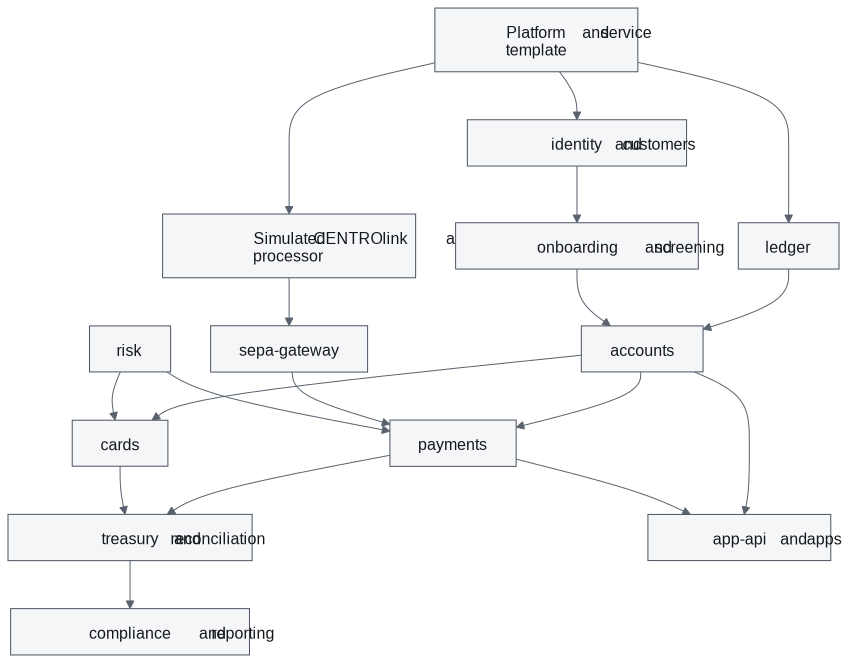
The diagram shows the Lithuanian profile; under the UK profile fps-gateway and Faster Payments take the places of sepa-gateway and CENTROlink.
The platform is delivered first because every service depends on it. The ledger follows, because no function that moves money can be tested without it. treasury and compliance are built after money movement is in place but are designed in Phase 0, because reconciliation is the control that verifies the correctness of the other blocks.
Under the UK profile the order is the same, and five items enter it. The Confirmation of Payee adapter behind the payee-check contract is built with the rail gateway. The APP fraud reimbursement case type and its ledger accounts (Fraud, risk and lending) are built with risk before payments is released. The mobilisation limits in licence.restrictions are built with accounts and risk. Under bank, the FSCS Single Customer View file is produced from the depositor view built by accounts (Treasury, finance and reporting). Paying-side Bacs Direct Debit is built after the rail gateway, on the same hub, ledger and case tool: the Bacs adapter, the Direct Debit Instruction register, the decision to pay or return unpaid, the app screens, and the Direct Debit Guarantee refund case type with its ledger account (Payments, D04.8).
Reducing dependence on external parties during delivery
Each external counterparty is represented by a simulator, a test component that exchanges the same messages and exhibits the same failure modes as the real counterparty. A contract test suite runs unchanged against both the simulator and the real vendor, and the real connection is adopted only when both pass.
The diagram shows the progression from simulator to production.
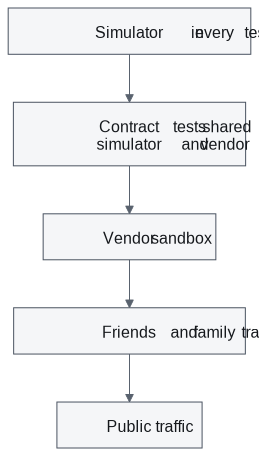
The CENTROlink simulator covers ISO 20022 messages, settlement files, the 10 second instant payment rule, late and duplicate messages, and an underfunded liquidity account. The card processor simulator covers authorisation, advice, clearing, reversal and timeouts. The identity, screening and messaging vendors are represented by simpler simulators. Each simulator can be configured to drop a message, respond twice, respond late or return a rejection reason.
Under the UK profile a Faster Payments simulator takes the place of the CENTROlink simulator. It covers ISO 8583-based messages; the responses unqualified accept, qualified accept and reject with a reason code; return payments; the sponsor's authorisation of each debit and credit in near real time, including refusal and a slow response; and the 15-second limit within which the sender must inform an attended customer of the fate of a single immediate payment, which is unchanged where a directly connected non-settling participant is in the chain (Faster Payments System Principles[28]). The per-hop response limits and the timeout behaviour of the central infrastructure are set in restricted scheme specifications (Payments) and are configured in the simulator when those specifications are received. A Confirmation of Payee simulator returns the outcomes match, close match, no match and unavailable. A Bacs file simulator stands for the sponsor's Bacs channel: it delivers Direct Credits and Direct Debits over the three-day cycle, lodges, amends and cancels Direct Debit Instructions, receives unpaid returns and indemnity claims, and produces late, missing and repeated files. Its file and message formats are configured when the sponsor's and the scheme's specifications are received (Payments).
United Kingdom profile
| Aspect | Lithuanian profile | UK profile |
|---|---|---|
| Default route | Specialised bank licence; EMI first only under the three conditions of D01.1 | PRA bank authorisation entered through mobilisation; FCA EMI first only under the same three conditions |
| Cost from funding to public launch, before regulatory capital | EUR 10 to 18 million | GBP 12 to 20 million |
| Public launch, months from funding (earliest / likely / latest) | 19 / 27 / 36 | 22 / 30 / 40 |
| Pace-setting events | The licence decision | The PRA decision and the length of mobilisation |
| Friends and family stage | After the licence decision, under limits set in risk and accounts | Inside mobilisation, under the mobilisation deposit cap (the licence section) |
| Instant rail onboarding | CENTROlink admission; decision within 15 business days of a complete file, preparation time a planning assumption | Faster Payments as a directly connected non-settling participant; lead time published by Pay.UK |
| Procured access components | Card processor | Card processor, sponsor settlement participant, Confirmation of Payee aggregator |
| Senior roles | Bank of Lithuania fit-and-proper assessment | Senior Managers and Certification Regime |
The UK profile changes the external schedule and some procured components, whereas the engineering plan is unchanged. The UK cost envelope and forecast are given beside the Lithuanian figures under Cost envelope and The phases and their exit criteria, and are planning assumptions. Paying-side Bacs Direct Debit is inside the Phase 1 scope and inside both figures (planning assumption).
Design and components. The build order is the same, with fps-gateway in the position of sepa-gateway and a Faster Payments simulator in the position of the CENTROlink simulator, with a Bacs file simulator beside it. The Confirmation of Payee adapter, the APP fraud reimbursement case type, paying-side Bacs Direct Debit, the mobilisation limits and, under bank, the Single Customer View file enter Phase 1. Mobilisation is modelled as licence.restrictions, so the friends and family stage of D13.3 uses its existing mechanism with a limit set by the supervisor.
Schedule. The critical path runs through the PRA's decision and then through mobilisation, whose length is guidance rather than statute. Faster Payments onboarding is the longest published external lead time in either profile, and it must be complete before the friends and family stage. The forecast assumes that connection and certification testing are completed before authorisation, so that only go-live follows it (planning assumption; Assumptions and dependencies); the note under the UK forecast table states the effect if they are not.
Failure handling. Four delivery risks specific to the UK profile, including dependence on the sponsor settlement participant, are recorded after the main risk table.
Unchanged. Decisions D13.1 and D13.5, the throughput derivation, the time budgets, the head counts, the go or no-go procedure and the order of the cut line apply to both profiles; the UK cut line carries one further item, which is cut last.
Key design decisions
D13.1 The ledger and the platform come first
Decision: Phase 0 builds the platform, the service template, the ledger, accounts, identity and customers before any payment rail, card function or app.
Rationale: Every other block records money movements through the ledger. Ledger defects are the most expensive to correct, because posted history cannot be edited. Nubank reports that property-based tests over random event sequences detected production ledger defects (InfoQ[10]).
Alternative considered: Starting with the customer app. Rejected because an app built on a mock backend produces demonstrations, and the backend is subsequently shaped around the app's assumptions.
Cost: For several months the visible output consists mainly of tests and simulators.
D13.2 Simulators for every outside party before real connections
Decision: Each external counterparty (CENTROlink, card processor, identity vendor, screening vendor, messaging provider) has a simulator and a shared contract test suite before engineering work on the real connection begins.
Rationale: Real connections require certificates and onboarding, which take weeks. Simulators allow engineering to proceed in parallel and reproduce on demand the failures that real counterparties cannot supply.
UK profile: The counterparties with simulators are the Faster Payments central infrastructure, the sponsor settlement participant, the sponsor's Bacs channel, the Confirmation of Payee service, the card processor and the identity, screening and messaging vendors. Because Faster Payments onboarding is the longest external lead time, the simulator and the contract tests carry most of the payments engineering until onboarding is complete.
Alternative considered: Vendor sandboxes only. Rejected because sandboxes are slow, support a limited set of failure modes and are at times unavailable.
Cost: Simulators are maintained code, and a simulator that diverges from the real counterparty gives false assurance; contract tests therefore run against both.
D13.3 Launch narrow with tight limits, then grow by a gate
Decision: The friends and family stage comes first, and the public launch follows only after the exit criteria are passed.
- The friends and family stage has a small customer count.
risksets low payment limits, and the product terms inaccountsset a low maximum balance. - A credit above the balance cap is still accepted, because the payments section permits rejection only for its listed reasons. An
accountsjob returns the excess to the payer and notifies the customer. - After launch, a daily admission cap in
onboardingcontrols growth. The head of compliance, the head of operations and the risk owner raise the cap only when analyst capacity, operations desk queues and fraud losses are within their limits.
Rationale: The first real customers expose defects that testing missed. Under tight limits the cost of a defect remains small and does not become a regulatory incident.
UK profile: The friends and family stage takes place inside mobilisation, during which total deposits are limited to GBP 50,000 (Mobilisation[14]). licence.restrictions holds the cap and derives from it a per-customer balance limit and a maximum number of invited customers, as the licence section sets out. An inbound Faster Payment that would breach the customer's limit is rejected at the accept step, whereas a credit that cannot be rejected in real time, such as a Bacs credit, a card refund or interest, is accepted and the excess is returned the same day by the same accounts job. The application for the variation of permission that lifts the restriction must be submitted at least three months before the end of the 12-month mobilisation period; the public launch still requires the exit criteria below, and the admission cap then controls growth as described above.
Alternative considered: Opening to the public at licence grant. Rejected because all weaknesses would emerge simultaneously at full scale.
Cost: Slower initial growth. Changes to limits and caps require recorded approval from compliance and risk.
D13.4 Every bought component has a written exit path
Decision: For each vendor behind an adapter, a short written plan is maintained that states the response if the vendor fails or withdraws, the time required to switch, and the data that must be exportable. The DORA register in Platform and data lists the vendors.
Rationale: DORA requires documented and tested exit strategies for ICT services supporting critical or important functions (Art 28(8)). A vendor failure in the launch week must be handled as a planned switch rather than as a crisis.
UK profile: The same exit plans serve the PRA and FCA outsourcing and third-party risk rules, and the supplier register in Platform and data also supports the annual register of material third-party arrangements required under the rules that apply from 18 March 2027, before the earliest forecast authorisation (FCA PS26/2[25], PRA PS7/26[26]). The sponsor settlement participant and the Confirmation of Payee aggregator are added to the components with a written exit path.
Alternative considered: Relying on contract terms alone. Rejected because a contract confers a right to terminate but provides no operational means of migrating.
Cost: Maintaining a second option in a ready state requires effort. The adapters in the system map make exits feasible.
D13.5 Exit criteria are measurable tests, not dates
Decision: Each phase ends when named tests have passed and been recorded. Dates are forecasts, shown in the table below, and do not override the criteria.
Rationale: Allowing a date to relax the criteria is a common cause of unsafe system launches in banking. A test result is binary and can be verified by an auditor.
Alternative considered: Fixed launch dates with scope reductions. Rejected for the money path: scope may be reduced (see the cut line below), whereas the correctness of money movements may not.
Cost: The launch date may slip, in which case the regulator and investors are informed early.
The phases and their exit criteria
The forecast counts months from funding, and all figures are planning assumptions. The licence, rather than the build, is expected to determine the overall schedule.
| Milestone | Earliest | Likely | Latest | What sets the pace |
|---|---|---|---|---|
| Licence application filed | 4 | 6 | 8 | Key hires, business plan, capital plan |
| Phase 0 exit (foundations) | 6 | 8 | 10 | Ledger and simulators |
| Launch product built and tested | 14 | 18 | 22 | Team size, scope cut line |
| Licence decision | 16 | 24 | 32 | The supervisor (12 to 24 months after filing) |
| Friends and family starts | 16 | 24 | 32 | The later of build completion and licence |
| Public launch | 19 | 27 | 36 | The launch events below, each observed once |
The table above applies to the Lithuanian profile. Under the UK profile the supervisor's decision and the length of mobilisation set the pace:
| Milestone, UK profile | Earliest | Likely | Latest | What sets the pace |
|---|---|---|---|---|
| Application submitted | 6 | 8 | 10 | Pre-application stage with the New Bank Start-up Unit, key hires, business plan, capital plan |
| Phase 0 exit (foundations) | 6 | 8 | 10 | Ledger and simulators |
| Launch product built and tested | 14 | 18 | 22 | Team size, scope cut line, Faster Payments onboarding |
| Authorisation with restrictions (start of mobilisation) | 16 | 22 | 30 | The PRA with FCA consent; statutory period of six months from a complete application and 12 months from an incomplete one |
| Friends and family, inside mobilisation | 16 | 22 | 30 | The latest of build completion, authorisation and completed Faster Payments onboarding; total deposits limited to GBP 50,000 |
| Restrictions lifted and public launch | 22 | 30 | 40 | Length of mobilisation (guidance of no more than 12 months) and the launch events below |
The friends and family dates assume that Pay.UK, the sponsor and the card scheme allow connection and certification testing to be completed before authorisation, under a sponsor agreement signed in Phase 0, so that only go-live follows authorisation (planning assumption; see Assumptions and dependencies). Authorisation as a payment service provider is a condition of becoming a participant (Faster Payments System Principles[28], section 4), and the Principles do not state the point in onboarding at which it must be held. If onboarding can begin only at authorisation, the friends and family stage starts one onboarding period after authorisation and every later milestone moves by the same interval. The interval between authorisation and public launch follows the eight-month average stated above, and each month of mobilisation beyond the forecast moves public launch by one month.
Phase 0: foundations
Phase 0 builds the platform in the primary region, the deployment pipeline, observability and the service template, which provides tracing, idempotency, the transactional outbox and mutual TLS in one place. It then delivers ledger, accounts, identity, customers and the simulators. In parallel, the licence application is written, vendors are selected, the first policies are drafted, the licence route is decided (D01.1), and a vendor core is priced against the money-core squad (Ledger and accounts, D03.1). treasury reconciliation is also designed in this phase and runs against simulator files from the start of Phase 1.
Exit criteria (target tests):
- The ledger passes a test of at least one million random operations in which every entry balances per currency; no ordinary account falls below zero except through a forced entry with a reason code; held funds never exceed the balance; and replaying the journal reproduces every balance.
- A repeated request with the same idempotency key is never booked twice under forced retries and crashes.
- A new service progresses from the template to staging through the pipeline within one working day.
- A simulated instant payment meets the time budget of the payments section while the simulator exhibits each failure mode listed above: the bank's processing steps before hand-over to the rail gateway (
sepa-gateway, orfps-gatewayunder the UK profile) take 250 ms at the 99th percentile, with a hard stop at 1 second. - All secrets, keys and infrastructure are defined as code, and the environment can be rebuilt from scratch.
Under the UK profile two assumptions on which the gateway design and the forecast depend are confirmed with the parties concerned by Phase 0 exit: that a bank in mobilisation has no Bank of England settlement account at launch, which is the basis of the sponsor model (Payments, D04.1), and that Faster Payments connection and certification testing may be completed before authorisation (Assumptions and dependencies).
Phase 1: launch scope
Under the Lithuanian profile, Phase 1 delivers a current account with a Lithuanian IBAN; SEPA credit transfers, including instant credit transfers, with verification of payee; a debit card and savings pots; onboarding with screening; risk, compliance, treasury and basic reporting; and the customer apps and back-office console. Instant payments, verification of payee and daily sanctions screening are mandatory for a euro-area bank under current law (Regulation 2024/886[3]). The worked examples for Phase 1 concern individual retail customers, including payments between two customers of the bank.
Under the UK profile, Phase 1 delivers a current account identified by sort code and 8-digit account number; Faster Payments as a directly connected non-settling participant, with Confirmation of Payee; inbound Bacs Direct Credit, paying-side Bacs Direct Debit and CHAPS through the sponsor; a debit card and savings pots; handling of APP fraud reimbursement claims; under bank, the Single Customer View file; and the same onboarding, risk, compliance, treasury, reporting, apps and console. The Payment Systems Regulator's Specific Direction 17 applies to a new participant from the day after it joins Faster Payments or CHAPS with its own sort code, so Confirmation of Payee, sending and responding, is live at launch; since 22 October 2026 the direction has no expiry date (Specific Direction 17[31]). Reimbursement of APP fraud is mandatory for Faster Payments and CHAPS (Payment Systems Regulator[32]). Paying-side Bacs Direct Debit is part of the launch product, so that the account can serve as a main account: the bank pays or returns unpaid the Direct Debits presented against customer accounts, customers view and cancel their instructions in the app, and Direct Debit Guarantee refunds are handled as cases (Payments, D04.8). Origination of Direct Debits for business customers is outside Phase 1 and Phase 2.
Exit criteria for friends and family:
- The money path meets its time budgets for one hour at the year-three peak target of 200 money-path requests per second in total (payments and card authorisations), equivalent to about 1,000 posting rows per second. This is demonstrated before the first customer is onboarded, so that the first day of operation is not the first test at that load.
- A region failover drill in staging passes, with at most one minute of data lost across regions, service restored within two hours (the Overview recovery target), and a test message to the instant rail signed and sent from the recovery region.
- A simulated weekend with TARGET closed completes without exhausting the instant payment position, using the buffer funded before the Friday close.
- For 30 consecutive days against the simulators, no reconciliation break older than one business day lacks an owner and an explanation, no safeguarding shortfall occurs, and no unexplained break occurs on the settlement and prefunded accounts.
- Sensitive staff actions require a second approver, as demonstrated by test.
- High-severity penetration test findings are closed, and the incident runbooks have been exercised, including the DORA reporting deadlines (Platform and data).
- An independent review (by an external firm or the internal audit function) of the ledger design, its invariant tests and the reconciliation controls has its high-severity findings closed, and the external auditor has completed a walkthrough of the IT general controls.
- Card authorisation continues in stand-in mode in a drill in which the platform is disconnected.
Under the UK profile the following criteria take the place of, or extend, the profile-specific items above:
- The failover drill is subject to the supervisor's view of a recovery region outside the UK and to the scheme's acceptance of a connection from it (Platform and data).
- In place of the weekend with TARGET closed, a simulated run of four consecutive non-settlement days, as at Easter, completes without exhausting the position agreed with the sponsor settlement participant.
- The incident runbooks are exercised against the PRA and FCA incident reporting rules (Platform and data).
- A simulated APP fraud claim, once as sending firm and once as receiving firm, is decided and reimbursed within 5 business days and recorded in the reimbursement accounts of the ledger (Fraud, risk and lending).
- Against the Bacs file simulator and in testing with the sponsor, a Direct Debit Instruction is lodged, amended and cancelled; a collection is posted on entry day; an item without funds and an item under a cancelled instruction are returned unpaid within the scheme's deadline; and a Direct Debit Guarantee claim is refunded immediately, raised as an indemnity claim and cleared from the ledger account for claims due from other banks (Payments, D04.8).
- The limits in
licence.restrictionshold in a test: an inbound Faster Payment that would breach a customer's limit is rejected at the accept step, the excess of a credit that cannot be rejected is returned the same day, and invitations stop at the alert threshold. - Under
bank, the Single Customer View file and the exclusions view are produced from the depositor view within 24 hours (PRA Rulebook, Depositor Protection 12[22]).
The peak target is derived as follows: about 1 million customers making 2 money movements a day produce about 23 per second on average, and a salary-day evening peak of about 8 times that average gives about 185, rounded to 200 (planning assumption).
Exit criteria for public launch:
- The friends and family stage runs for at least 30 days and until each of the following has occurred once and been reconciled: a month-end close, a regulatory report submission, a statement and interest run, a weekend or holiday with TARGET closed, and a card dispute raised to the scheme.
- The reconciliation criterion above holds against real settlement files.
- No severity-1 incident has occurred in the preceding 14 days, and every follow-up action from earlier incidents is closed.
- Support meets its targets at real volume: a first in-app response within a stated time and an agreed resolution time for payment investigations, both set before the friends and family stage starts.
- Any launch conditions that the regulator attaches to the licence are met.
Under the UK profile the launch events also include a Faster Payments return payment, a Direct Debit paid on entry day, a Direct Debit returned unpaid and a period spanning a bank holiday in England and Wales, and the public launch additionally requires that the PRA has lifted the mobilisation restrictions by variation of permission.
Cut line, if Phase 1 slips
If Phase 1 slips, scope is reduced in the following order, with each item moved to a Phase 1b after public launch:
- The web app.
- Apple Pay and Google Pay.
- Savings pots.
- Card FX.
- The online feature store (fraud checks then run on rules only).
- In-house screening (the vendor's matching continues to decide).
Under the UK profile one further item follows the six above and is the last to be cut: paying-side Bacs Direct Debit (Payments, D04.8). If it is cut, the bank's sort code is marked in the EISCD as not accepting debits, every Direct Debit presented is returned unpaid, and the launch account serves most customers as a secondary account, which limits deposits and primary-account revenue until the function is delivered in Phase 1b.
Functions required by law are not subject to the cut line: instant payments, verification of payee, daily screening and the open banking interface. Under the UK profile the corresponding functions are Confirmation of Payee, APP fraud reimbursement handling, sanctions screening, the dedicated interface for third-party access (Channels) and, under bank, the Single Customer View file.
Phase 2
Phase 2 covers SEPA Direct Debit, business accounts with multiple users (for example, a limited company with an owner and a bookkeeper), lending, term deposits, multi-currency accounts and FX, and SWIFT through a correspondent bank. Exit tests:
- the 8-week direct debit refund right and the 10-business-day response (PSD2 Arts 76 and 77[2]) pass end to end;
- each automated credit decision can be explained and reviewed by a human (CCD2 Art 18[8]);
- every currency position shows zero unexplained breaks for 30 days;
- model documentation is complete before the AI Act high-risk obligations apply on 2 December 2027 (Regulation 2026/1744[9]).
Production chaos tests and the annual production region failover also begin in Phase 2.
Under the UK profile Phase 2 covers origination of Bacs Direct Credits, settling participation in Faster Payments with the bank's own settlement account at the Bank of England, and lending under the Consumer Credit Act and the FCA's CONC rules, in place of SEPA Direct Debit and the EU credit rules. Exit tests:
- settlement through the bank's own prefunded account reconciles with zero unexplained breaks for 30 days before the sponsor arrangement ends;
- each automated credit decision carries the UK GDPR safeguards of information, representations, human intervention and contest (Privacy); the AI Act test does not apply.
Phase 3
Phase 3 covers partner and banking-as-a-service APIs. Its exit tests are that an automated attack suite demonstrates that no partner can read another partner's data, that per-partner limits hold, and that partners pass the same compliance onboarding as customers.
Under the UK profile Phase 3 also covers direct CHAPS participation, for which direct onboarding typically takes 12 to 18 months (CHAPS[30]). Direct participation in Bacs and origination of Direct Debits for business customers, with the bank as sponsor of service users, are Phase 3 options.
Launch week and wind-down
Go or no-go decision. The decision is taken at a meeting against a signed checklist covering the exit criteria, the vendor register, the filled roles, the duty rota (Running the bank) and the configured limits. It is signed by the CEO, CTO, head of risk, head of compliance (money laundering reporting officer) and head of operations, any of whom may stop the launch. The board risk committee is informed of the result before launch. Under the UK profile the signatories are the approved holders of the corresponding senior management functions (Team shape).
Hypercare. Hypercare is the period of 30 days after each launch step, during which platform engineers and the operations desks are co-located, the daily checklist runs twice a day, and every incident is reviewed the following morning.
Backout. Backout does not roll back the ledger. The admission cap is set to zero, limits are lowered through risk data, and the books are retained as they stand.
Governance (three lines of defence, internal audit access, product change approval) and the written recovery and wind-down plan are specified in Running the bank. This section specifies two system controls:
- The settings
onboarding_enabledandwind_downare held alongsidelicence.mode(the licence section). In wind-down no new accounts or cards are opened, and interest and fees follow the plan. - The depositor view of Ledger and accounts also serves as the file used to repay customers or transfer their funds to another bank. It is rehearsed annually and must produce a payout file within one day. Under the UK profile with
bank, the same view produces the FSCS Single Customer View file within 24 hours (Treasury, finance and reporting).
Buy versus build
Overview point 1 applies: components that constitute the bank are built, commodity components are procured, and the bank owns the adapter in front of each procured component. The vendor categories are examples and do not constitute endorsements.
| Block or component | Decision | Why | Exit path if the vendor fails |
|---|---|---|---|
ledger, accounts | Build; reopened if the Phase 0 vendor-core comparison favours buying (D03.1) | The book of record and the bank's own product rules | Not applicable |
payments, sepa-gateway | Build | Control during incidents; ISO 20022 is a public standard | Not applicable |
risk, compliance, treasury, reporting, cards logic | Build, with procured data feeds | Rules, cases and holds specific to the bank's products | Not applicable |
| Apps, web, back office, website | Build, with UI libraries | The product the customer uses | Not applicable |
| Card issuer processing and scheme connectivity | Buy: issuer processor | Scheme membership and certification are lengthy and costly (no sourced duration) | A planned migration project (below) |
| Identity verification | Buy: identity-verification provider | Rapidly changing specialised technology | Second vendor behind onboarding, manual review |
| Sanctions, PEP and adverse-media data | Buy: screening data provider; at launch the vendor's matching decides and the bank's matching runs in shadow mode for at least six months after public launch (Knowing the customer, D06.3) | Lists curated daily by specialists | Second source, with official lists as a degraded fallback |
| Cloud HSM and payment cryptography | Buy: cloud HSM service | Certified hardware outside the bank's operating competence | New keys on a second HSM service (below) |
| SMS, push and email delivery | Buy: messaging provider | Carrier relationships | Second provider per channel in comms |
| Helpdesk and company accounting | Buy | No banking logic | Export of tickets or postings and change of tool |
| Cloud, managed PostgreSQL and event log | Buy: public cloud provider | Operating clusters is not a differentiator for the bank | The infrastructure exit plan, environments as code |
| Correspondent bank for SWIFT (Phase 2) | Buy | A banking relationship rather than software | A second correspondent |
fps-gateway (UK profile) | Build | Control during incidents; Faster Payments messages are ISO 8583-based and are mapped from the canonical payment model. Alternative: an accredited technical aggregator, which shortens connection and certification at the cost of a per-item fee and of control during incidents | Not applicable |
| Sponsor settlement participant for Faster Payments, and sponsor for Bacs and CHAPS (UK profile) | Buy: a directly connected settling participant bank | A Bank of England settlement account and the Pre-Funded Account for the Net Sender Cap are not in place at launch; the sponsor authorises each debit and credit in near real time and settles | A second sponsor; settling participation with the bank's own settlement account in Phase 2 |
| Confirmation of Payee access (UK profile) | Buy: accredited aggregator behind payee-check | Participation in the directory is identical across banks | A second aggregator, or direct participation |
Screening moves to the bank's own matching only after a recorded comparison on test name sets and live traffic, approved by the money laundering reporting officer (Knowing the customer).
Exiting the card processor is a planned project lasting months (planning assumption), and no second processor is kept in a ready state in Phase 1. The contract guarantees export of card numbers, PIN keys and wallet token mappings, together with migration assistance. In the interim, processor stand-in and card switches limit the impact of a processor failure.
Exiting the HSM service requires generating new keys on a second HSM service, re-encrypting data under those keys, and exchanging card and payment keys with the processor and CENTROlink (Faster Payments under the UK profile) in a key ceremony. Root keys are never exported (Security).
Team shape
Engineering is organised in squads by domain, and each service has a single designated owner.
| Squad | Phase 0 | At public launch |
|---|---|---|
| Platform and security | 3 to 4 | 5 to 6 |
| Money core | 3 to 4 | 5 |
| Payments and cards | 2 to 3 | 6 to 8 |
| Customer | 2 | 4 to 5 |
| Risk and compliance engineering | 1 to 2 | 5 |
| Channels | 2 | 7 to 8 |
A block is a boundary of ownership, schema and interface, and is not necessarily a separate deployment: blocks owned by one squad with no time-critical path may be deployed as a single program while keeping separate schemas and interfaces (the system map, D02.1).
The licence also requires a compliance officer and a money laundering reporting officer (MLRO), a risk function, internal audit, an information security officer, a data protection officer, finance and reporting, and operations and support. Headcount at three points in time:
| Function | At application | Friends and family | Public launch |
|---|---|---|---|
| Management body and key function holders | 4 | 5 | 5 |
| Compliance, MLRO and deputy | 2 | 3 | 4 |
| Financial crime analysts | 0 | 3 | 6 |
| Payment and card operations | 0 | 3 | 5 |
| Customer support (grows with customers) | 0 | 3 | 6 |
| Treasury, finance and reporting | 1 | 3 | 4 |
| Risk | 1 | 2 | 2 |
| Internal audit | Outsourced | Outsourced | Outsourced |
| Total, with some staff holding two roles | About 8 | About 20 | About 28 to 32 |
All team sizes are planning assumptions and are to be reviewed against actual hiring. Any rota providing round-the-clock cover requires at least four people. The head counts assume that the roles named in the application satisfy the supervisor at each stage (Assumptions and dependencies); the control functions and senior management functions that those persons hold are described in Running the bank.
Under the UK profile the head counts are unchanged and the roles fall under the Senior Managers and Certification Regime, whose functions are listed in Running the bank. In the table above, the management body row covers the Chief Executive (SMF1), Chief Finance (SMF2) and Chair (SMF9) functions, which are the functions mandatory under PRA rules (PRA SS28/15[23]), and the compliance row covers Compliance Oversight (SMF16) and the money laundering reporting officer (SMF17) (FCA Senior Managers Regime[24]) (planning assumption).
Failure modes and mitigations
The ten principal delivery risks.
| Risk | Effect | Mitigation | Owner |
|---|---|---|---|
| Licence refused or later than 24 months | Expenditure without revenue | Pre-application meetings with the Bank of Lithuania; spending gated on licence milestones; runway for the upper end of the range plus 6 months | CEO |
| Capital or runway exhausted | Forced wind-down | Capital plan with triggers; the recovery plan in Running the bank | Finance lead |
| No safeguarding or operating bank account | EMI cannot launch | Approaches to several credit institutions in Phase 0; a central-bank account where possible | Finance lead |
| Scope creep | Launch slips and ledger work is rushed | D13.3; a written trade-off for each addition; the cut line; Phase 2 items remain in Phase 2 | CTO |
| Key-person dependence and thin squads | A single departure stalls a block | Two owners per block, written runbooks, cross-squad review; hiring of strong backend engineers with Rust training | CTO |
| Vendor lock-in | A price increase or withdrawal forces a rushed switch | D13.4 exit paths, bank-owned adapters, annual export test | CTO |
| Underestimation of operations and reconciliation | Accumulating breaks and overloaded support | Reconciliation designed in Phase 0 and run against simulators from Phase 1; the 30-day criterion; operations hires before launch | Head of operations |
| Regulation changes during the build (PSD3 and the EU Payment Services Regulation not yet law as of November 2026, AML Regulation from 10 July 2027) | Rework in limits, retention, liability and reporting | Retention and limits held as settings; quarterly legal review | Head of compliance |
| Security incident before launch | Delay and loss of trust | Security review from Phase 0, synthetic data only, exercised incident deadlines | Information security officer |
| External lead times: CENTROlink onboarding, card programme | No real payments, or cards available later than accounts | Early start on the CENTROlink file; processor selection in Phase 0; launch of accounts without cards if necessary | Head of operations |
The following delivery risks apply under the UK profile only.
| Risk | Effect | Mitigation | Owner |
|---|---|---|---|
| Authorisation later than forecast, or mobilisation longer than the 12-month guidance | Expenditure without revenue; one recent entrant spent about 18 to 20 months in mobilisation (as reported) | Pre-application meetings with the New Bank Start-up Unit; runway to the latest forecast, at the monthly cost stated under the cost envelope; mobilisation plan agreed at authorisation | CEO |
| Sponsor settlement participant withdraws, is unavailable or refuses payments | Faster Payments cannot be sent or received, because the sponsor authorises each debit and credit; Bacs, including the payment of Direct Debits, and CHAPS unavailable or degraded | Sponsor contract with a notice period and with availability and response-time commitments; a second sponsor identified; settling participation in Phase 2 | Finance lead |
| Faster Payments onboarding later than build completion, or testing permitted only after authorisation | Friends and family stage without the instant rail, or delayed by one onboarding period, with public launch delayed by the same interval | Onboarding started as early as the scheme permits; simulator and contract tests | Head of operations |
| Regulation changes during the build (Payment Systems Regulator functions moving to the FCA under the Financial Services and Markets Bill, the second phase of the Senior Managers and Certification Regime reform, the Faster Payments migration design) | Rework in reporting, roles and the rail gateway | Quarterly legal review; the canonical payment model isolates message formats | Head of compliance |
Security and privacy considerations
Delivery adds two rules. No real personal data enters development or test environments (Privacy), and penetration tests and key ceremonies are scheduled within the phases (Security).
What "done" means for launch
The public launch takes place only when the Phase 1 exit criteria are recorded as passed, with date, version and approver, and when the following conditions are also met:
- licence conditions are met and the regulator has been informed of the launch date;
- CENTROlink participation operates with real settlement files, either directly or through a sponsor (Payments, D04.1);
- the vendor register and exit paths are complete;
- the roles required by the licence are filled and their holders have rehearsed their procedures;
- support, complaints and fraud-victim handling are operational.
Under the UK profile the following conditions take the place of the licence and CENTROlink conditions above:
- the PRA has lifted the mobilisation restrictions, and the FCA and PRA have been informed of the launch date;
- Faster Payments participation operates with real settlement through the sponsor settlement participant, and inbound Bacs credits, paying-side Bacs Direct Debit and CHAPS operate through the sponsor;
- Direct Debit Instructions are lodged and cancelled, collections are paid on entry day or returned unpaid within the scheme's deadline, and a Direct Debit Guarantee refund with its indemnity claim has been completed in a rehearsal;
- Confirmation of Payee sends and responds to requests in production;
- APP fraud reimbursement claims are handled within the scheme time limits, and, under
bank, the Single Customer View file has been produced in a rehearsal.
Out of scope
- Card processor. Overview point 1 procures issuer processing, and scheme certification is not required at launch.
- Identity-verification technology. The bank builds the decision and review flow around a vendor.
- Data centre. Managed EU cloud with an exit plan (D13.4); under the UK profile, managed cloud in the London region (Platform and data).
- Crypto-assets. The bank operates in euro only (sterling under the UK profile).
- Investment products. A Lithuanian specialised bank is prohibited from, or restricted in, providing investment services (as reported, Sorainen[12]).
How this document is kept alive
The document is amended rather than rewritten: a dated amendment is appended to the affected section with its rationale, and superseded text remains visible. The document is reviewed at each phase exit, at least every six months during the build (a planning assumption), and on the following events: publication of PSD3 and the Payment Services Regulation in the Official Journal, application of the AML Regulation on 10 July 2027, confirmation of the CENTROlink rules for EMIs, or feedback from the regulator. Under the UK profile the review events also include Royal Assent and commencement of the Financial Services and Markets Bill, which shortens the statutory decision periods and transfers the Payment Systems Regulator's functions to the FCA, and the retail payments infrastructure Blueprint expected in spring 2027 (Bank of England, RPIB consultation response[33]). See the Overview.
Assumptions and dependencies
The cost envelope, the forecast and the staffing in this section rest on the following assumptions, each confirmed at the stated point. None blocks the start of the build, because Phase 0 depends only on the simulators and on the bank's own decisions.
| Assumption | Confirmed by | When | If it does not hold |
|---|---|---|---|
| The team sizes, phase lengths, cost envelope and forecast lie within the ranges stated in this section, and the cost to break-even is supplied by the business plan. | The finance lead, with the business plan and the capital plan | Before the licence application | The envelope, the runway and the forecast tables are restated by dated amendment; spending remains gated on licence milestones and the cut line applies to Phase 1. |
| The roles in post at application (the management body including two persons who effectively direct the business, compliance and the money laundering reporting officer, risk, and finance) satisfy the supervisor, and no further role is required before the licence decision. | The Bank of Lithuania and the ECB; under the UK profile the PRA and FCA; with counsel | Before the licence application | The hires concerned are brought forward to the application, at the fully loaded annual cost per person stated in the cost envelope. |
| Lithuanian profile: completion of the CENTROlink file, SEPA scheme adherence, and card scheme, processor and wallet approvals fit within the Phase 1 build period, so that the licence decision sets the start of the friends and family stage. | The Bank of Lithuania, the European Payments Council, the card scheme, the processor and the wallet providers | Scheme onboarding | The friends and family stage starts when the last approval required for it is granted; accounts launch without cards if the card approvals are late, and wallets fall under the cut line. |
| UK profile: Faster Payments connection and certification testing may be completed before authorisation with restrictions, under a sponsor agreement signed in Phase 0, so that only go-live follows authorisation. | Pay.UK and the sponsor bank | Phase 0 exit | The friends and family stage starts one onboarding period, stated by Pay.UK as 9 to 12 months, after authorisation; every later milestone moves by the same interval, at the monthly cost stated under the cost envelope. |
| UK profile: the network circuits to the Faster Payments central infrastructure, registration with the Reimbursement Claims Management System, Bacs testing with the sponsor, registration of the BIC and Open Banking Directory enrolment are each completed within the Faster Payments onboarding period. | Pay.UK, the sponsor bank, Swift and the operator of the Open Banking Directory | Scheme onboarding | The item concerned moves the milestone it gates in the table of outside tests and approvals by the excess; Open Banking Directory enrolment gates only the public launch. |
| UK profile: paying-side Bacs Direct Debit through the sponsor fits the Phase 1 forecast and the cost envelope. | The sponsor bank | Sponsor contract | The last item of the cut line applies: the function moves to Phase 1b and every Direct Debit presented is returned unpaid until it is delivered. |
| A card processor exit is completed within months, with export of card numbers, PIN keys and wallet token mappings and with migration assistance guaranteed by contract. | The processor | Supplier contract | Processor stand-in and card switches cover a longer interval, and a second processor is contracted in a ready state at additional supplier cost. |
Each other section lists the assumptions on which its own design rests in a table of the same form, with the confirming party, the milestone and the fallback. Obtaining these confirmations is Phase 0 work: each row is tracked as a dated task with a named owner alongside the licence application and the supplier selection, a row whose milestone falls after Phase 0 is opened with the party concerned during Phase 0 and closed at its milestone, and a row that does not hold is handled by the fallback stated in it and recorded as a dated amendment to this document.
Sources
- EMD2 (Directive 2009/110/EC)
- PSD2 (Directive 2015/2366)
- Instant Payments Regulation 2024/886
- DORA, Regulation 2022/2554
- EBA Guidelines on third-party risk management
- EBA outsourcing guidelines (2019, replaced)
- CENTROlink Operating Rules 2023
- CCD2, Directive 2023/2225
- Digital Omnibus on AI, Regulation 2026/1744
- Nubank financial systems talk (InfoQ)
- ECB, Guide to licence applications, September 2026
- Sorainen, Specialised bank regulation in Lithuania, secondary source for capital, scope and the 2018 licence timeline. The 2019 report and the vendor guide are cited in the licence section.
- Bank of England, New bank authorisation process
- Bank of England, Mobilisation
- PRA Authorisations Performance Report 2025/26 Q4
- PRA Authorisations Performance Report 2026/27 Q2
- Financial Services and Markets Bill, UK Parliament
- Financial Services and Markets Act 2000, section 55F
- PRA seminar slides on new bank authorisation, October 2019
- BDO, UK bank authorisation guide (as reported)
- City AM, mobilisation of a recent entrant (as reported)
- PRA Rulebook, Depositor Protection 12
- PRA SS28/15, April 2026 update
- FCA Senior Managers Regime
- FCA PS26/2, operational incident and third-party reporting
- PRA PS7/26, operational incident and third-party reporting
- FCA PS21/19, changes to the SCA technical standards
- Pay.UK, Faster Payments System Principles v11
- Pay.UK, Bacs System Principles v18
- Bank of England, CHAPS
- Payment Systems Regulator, Specific Direction 17, consolidated October 2026
- Payment Systems Regulator, APP fraud reimbursement protections
- Bank of England, response to the RPIB consultation