12. Privacy and data protection
Purpose and scope
A year of account statements discloses where a customer lives, what rent is paid, where purchases are made and when the customer travels. At onboarding the bank receives a passport, a selfie video, an address and a phone number; within a year it also holds the customer's rent (for example EUR 650.00 a month to a private payee), grocery spending, travel and questions to customer support. Amounts are shown in euro; under the UK profile the same example applies in sterling.
Three requirements apply concurrently. First, the bank needs the data to verify identity, prevent fraud and answer regulators. Second, the EU General Data Protection Regulation (GDPR), or under the UK profile the UK GDPR and the Data Protection Act 2018, permits collection only of what is needed, for stated purposes and for only as long as needed, and entitles the customer to access the data held and to request its deletion. Third, anti-money-laundering (AML) law requires identity and transaction records to be retained for years after the account closes, even where the customer requests deletion.
Where personal data is spread across twenty services, each requires its own deletion code and access rules, and any overlooked copy is a breach; the places that hold it are therefore few and named. Security covers keys and audit in general, Knowing the customer covers the purpose of identity checks, and the Glossary defines unfamiliar terms.
Components
Data without a nameable purpose is not collected.
| Data | Where it comes from | Why it is held |
|---|---|---|
| Identity: name, date of birth, nationality, personal code | Onboarding | Legal duty to know the customer; contract |
| Contact: address, phone, email | Onboarding, app | Contract, legal notices, fraud alerts |
| Documents and biometrics: passport image, selfie and liveness video, face template | Identity vendor via onboarding | Remote identification required by AML rules |
| Transactions: amount, time, counterparty name and account number (IBAN), card merchant | ledger, payments, cards | Contract; AML monitoring; fraud |
| Device data: device ID, app version, IP address, approximate location | identity, app-api | Strong authentication, fraud prevention |
| Support conversations: chat, call notes, complaints | Helpdesk, comms | Contract; complaint handling duties |
| Risk and AML data: risk rating, screening hits, alerts, reports | onboarding, screening, compliance | Legal obligation |
| Marketing preferences and consent records | App | Consent |
Face data used to identify a person belongs to the strictest class of personal data under the GDPR ("special category", Art 9(1)). The document images, the selfie and liveness video, the liveness result and the vendor's verdict are retained as the AML identification record for the full AML period (D12.7). The face template is the numeric description of a face used for matching. It is deleted 30 days after the decision (target), and no face database is built.
The components specified in this section are:
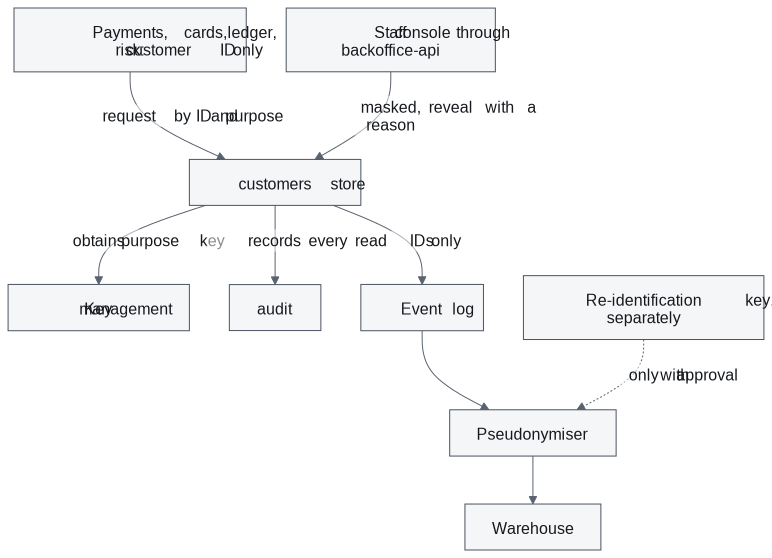
- The store in
customers, with a blind index for search and the workflow for data subject requests. - One key per purpose in the key service described in Security, backed by a hardware security module (HSM), a tamper-resistant device that holds keys.
- Retention jobs, one in each service that holds personal data, run against the
retention_policiestable thatcomplianceowns. - The register of processing activities, and the pseudonymiser in front of the warehouse, which replaces customer IDs with codes.
Personal data outside the vault, by design
The customers store covers the bank's own customers. A small number of services must hold personal data themselves; a payee at another bank, for example, has no record in customers. Each exception is encrypted with a purpose key from the same key service and follows the same retention schedule.
| Holder | What it holds | Retention class | Erasure |
|---|---|---|---|
payments | Payee name and IBAN as entered; payer name on incoming payments | AML records | Destroy the customer's data key |
Rail gateway message store (sepa-gateway, or fps-gateway under the UK profile) | Every payment message and file, retained unaltered in write-once storage | AML records | Raw messages are stored one record per transaction under the data key of the bank's customer named in it; the key is destroyed when that customer's AML period ends |
screening name index | Encrypted name parts of every customer, for the daily rescreen | While the customer remains | Removed at exit; rebuilt from customers |
onboarding evidence store | Document images, video, vendor verdict | AML records | Destroy the key |
identity | Device IDs, IP addresses, approximate location | Device data | Delete |
comms | Phone or email while a message is pending; delivery log with masked recipient | Logs | Delete |
| Helpdesk vendor | Chats and call notes, under a processing contract | Support conversations | The bank's adapter deletes through the vendor's interface |
AML monitoring must recognise "the same sender again" (Knowing the customer), while events must not carry an IBAN. payments therefore issues a counterparty_id, a keyed hash of the normalised IBAN made with a key that only payments can use. Events and the warehouse carry this pseudonym and not the IBAN. Under the UK profile the hash is made of the normalised sort code and account number in the same way.
Some files must carry names by law: under the Lithuanian profile, account reports to the tax inspectorate and the deposit insurer's depositor file; under the UK profile, the FSCS Single Customer View file. customers assembles them from IDs and figures supplied by reporting (Treasury and reporting), and records every field it releases.
How it works
The vault
customers stores each personal field as a separate encrypted row:
customer_id   field          purpose        key_id        ciphertext   created_at
c_8f2a        full_name      identity       k_identity_3  ...          2026-12-01
c_8f2a        iban_holder    payments       k_payments_2  ...          2026-12-01
c_8f2a        selfie_ref     verification   k_biometric_1 ...          2026-12-01
payments records only that customer c_8f2a sent EUR 650.00 to an IBAN. To display the payee name on the payer's screen, it uses the payee name entered by the payer and stored with the order. The purposes are an explicit list in code, and each caller has an allow-list. For example, comms may read phone for the purpose notification but may not read selfie_ref.
Every read produces an audit record stating who read which fields of which customer, for which purpose and when, without the values. Service reads are recorded afterwards, through the outbox of the store. A staff reveal goes through backoffice-api, which writes the audit record first and refuses the reveal if the record cannot be written (Platform and data).
To find a customer by phone or email, the store maintains a blind index: a keyed hash of the normalised value, made with a dedicated search key, which supports exact matches only.
Events, logs and analytics
Events carry IDs and state changes and no personal data, for example PaymentSettled {payment_id, customer_id, counterparty_id, amount}. Log lines pass through a scrubber that drops fields tagged personal and masks any value resembling an IBAN, phone number or personal code.
The warehouse receives events through a pseudonymiser, which replaces customer IDs with a keyed hash. The key that maps them back is held outside the data platform by a delegate of the data protection officer and is used only under a logged approval.
One erasure request, end to end
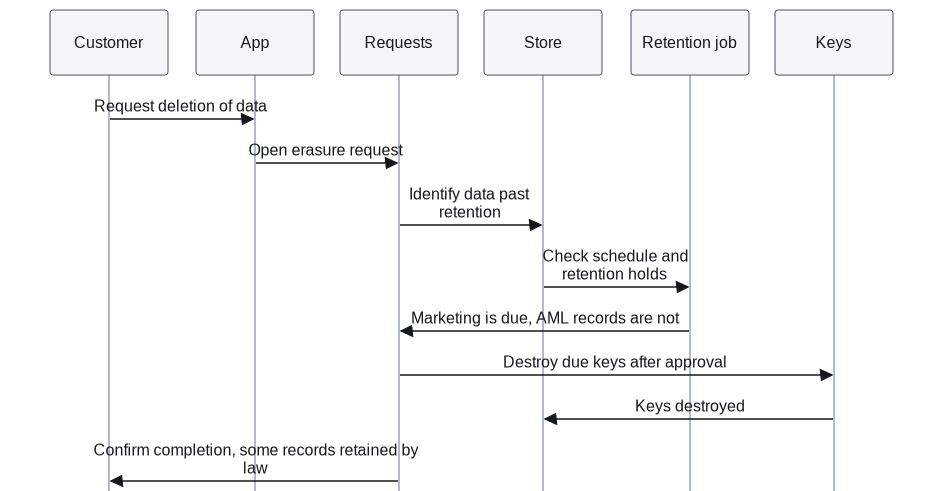
A data subject request (DSR) is a request from the person to whom the data relates. In the example, a customer closes an account on 1 March 2028 and on 10 March requests deletion of the customer's data. Marketing consents are deleted at once. Device data and support conversations are deleted when their own periods end. The passport copy, screening results and transactions are retained until the AML period ends, readable only by compliance and only for the legal purpose. The customer is informed of what is retained and until when.
The sequence shows this request. Each service in the exceptions table also receives it as an event that carries only the customer ID.
Crypto-shredding
Data is encrypted under a data key, and each data key is wrapped (encrypted) by the purpose key. A data key covers a record batch or a file, or a single customer where erasure by key destruction is required, as for raw messages and evidence bundles. A service may cache a data key for at most 5 minutes.
When retention ends, or an erasure request applies, the data key is destroyed. A face template is retained for 30 days (target); on day 31 its key is destroyed, and any copy in a backup becomes unreadable. This holds only if no readable copy exists elsewhere.
Key-encryption keys are multi-region keys, or every data key is wrapped twice (Frankfurt or London, and Ireland), so that the Ireland standby can read the data after a region loss (Security). Destroying a data key destroys every wrapping of it.
Lawful bases
The GDPR requires every use of personal data to rest on a legal reason, termed a lawful basis. The following table is the position on which the design is built under the Lithuanian profile; its confirmation by counsel is listed under Assumptions and dependencies:
| Purpose | Lawful basis | Description |
|---|---|---|
| Operate the account, execute payments, issue cards | Contract | The service cannot be provided without the processing |
| Identity checks, sanctions screening, AML monitoring and reports | Legal obligation | Required by law; the customer cannot opt out |
| Fraud prevention, network security | Legitimate interest | The customer may object, and the bank must weigh the objection |
| Product emails, offers | Consent | Disabled until the customer enables it; withdrawable |
| Face template | Explicit consent or another Art 9 condition | A route without biometrics is also offered |
The face template is processed on the customer's explicit consent (GDPR Art 9(2)(a)). Because consent is valid only where it can be refused without detriment, an applicant who declines is identified by a route that creates no face template, at the cost of a slower and more expensive identification for those applicants (Knowing the customer). Marketing does not reuse AML or fraud data. Each consent record stores the wording shown, the time, the channel and the version. Personal data is not sold.
Automated decisions
Where software alone makes a decision that significantly affects a customer, the customer may request human review, state the customer's position and contest the decision (GDPR Art 22; under the UK profile, UK GDPR Arts 22A to 22D). Three decisions of the bank are of this kind: an onboarding refusal, a fraud block that freezes an account and, in Phase 2, a credit decision. For credit under the Lithuanian profile, the Consumer Credit Directive 2023/2225 applies from 20 November 2026 (UK credit rules are in Fraud, limits and credit risk); it also requires an explanation and a human review (Art 18) and the name of any database used (Art 19).
The customer is informed that the decision was automated and may request human review and state a view. The review is a case in the single case tool in compliance, worked in the staff console. Time limits are set out in Fraud, limits and credit risk and Knowing the customer.
The hard conflict: erasure versus record keeping
GDPR erasure yields where a legal obligation requires the data to be retained, and AML law is such an obligation. Lithuanian law requires 8 years of retention after the relationship ends or the transaction is executed (as reported by Sumsub[4]). From 10 July 2027 the EU AML Regulation (AMLR, 2024/1624) applies directly; it sets 5 years, extendable case by case by up to 5 more (Art 77). The period applied to each record class on each date is therefore a configuration setting and not a constant in code; the national period and its handover to the AMLR are confirmed against the legal text in Knowing the customer, which owns the AML obligations.
The schedule is the retention_policies table owned by compliance (Knowing the customer). Compliance approves and publishes each change, which is logged. Every service that holds personal data runs a retention job against the table, customers first.
| Data class | Retention | At the end |
|---|---|---|
| AML records: identity, documents, selfie and liveness video, screening results | After the relationship ends: 8 years today as reported; 5 plus up to 5 under the AMLR from 10 July 2027 | Destroy the keys |
| Transactions, counterparty details, payment messages | Same legal period (AML and accounting) | Destroy keys; the ledger keeps amounts and IDs only |
| Face template | Target 30 days after the decision | Destroy the key |
| Support conversations | Target 3 years, for complaints | Delete |
Device data and logs, including comms delivery logs | Target 13 months, the window for reporting an unauthorised payment (PSD2 Art 71) | Delete |
| Consent records | While the consent is in force and 3 years after its withdrawal or the end of the relationship (target) | Delete |
| Data under a retention hold | Until the hold lifts | Return to the normal schedule |
The periods marked as targets are the bank's own settings (planning assumption). Each is the shortest period that covers the purpose stated in the table, and consent records follow the support-conversation period so that a consent can be evidenced in a complaint; the residual risk is that a dispute raised after the period cannot be evidenced from these records.
The ledger holds no personal data, so an erasure leaves it unchanged. AML data retained after an erasure request is marked restricted and may be read only by compliance and only for the legal purpose.
A retention hold (the flag retention_hold) is set by compliance on a customer or a data class, for example during an investigation, and retention jobs skip that data while the flag is set. A seizure of money is a distinct measure: it is a legal hold on money in ledger (Ledger and accounts), and it also sets a retention hold on the related records.
Data subject requests
Each right is implemented as a workflow with a state, an owner and a deadline.
| Right | Action |
|---|---|
| Access | Export all data the bank may disclose, with purposes and recipients, in JSON and CSV |
| Rectification | Correct once in the central store; identity changes require fresh evidence |
| Portability | The same export, limited to data provided by the customer and the customer's transactions |
| Erasure | Run the retention check, shred the data that may be shredded, inform the customer of what is retained and until when |
| Objection | Stop marketing at once (absolute right); weigh the objection against fraud processing |
The deadline is a profile setting. Under the Lithuanian profile it is one month from receipt. Where a request is complex or numerous, the bank may extend it by two further months and must inform the customer of the extension within the first month (GDPR Art 12(3)). Identity is verified with strong customer authentication before any export.
Information withheld. A customer must not be told that an alert, an investigation or a report concerning the customer exists (tipping-off, Knowing the customer). An access request returns the customer's data without the compliance case file and does not state that anything was omitted. Every access reply uses the same wording, approved by counsel before launch, whether or not a compliance case exists, so that the existence of a case cannot be inferred from the reply. The legal provision that prohibits tipping-off is cited in Knowing the customer. The reasoning is recorded in compliance with restricted access.
Impact assessments
A data protection impact assessment (DPIA) is a written risk review that the GDPR requires before high-risk uses of personal data, such as profiling people for decisions that affect them (Art 35). A DPIA is written before launch for onboarding biometrics and for transaction monitoring. In Phase 2 a third is written for credit scoring, which under the Lithuanian profile is also high-risk under the EU AI Act, with obligations from 2 December 2027. Each is reviewed when the processing changes.
Processors and transfers
A processor handles personal data on behalf of the bank: the identity vendor, the card processor, the SMS provider and the helpdesk. Each has a processing contract, hosts data in the European Economic Area (EEA), or under the UK profile in the UK or the EEA, and is accessed through an adapter owned by the bank. A transfer outside the EEA, or under the UK profile outside the UK and the EEA, requires a recorded legal safeguard, and by default there are none.
The register of processing activities is a table with the columns activity, purpose, lawful_basis, data_classes, vendor_id, location, transfer_safeguard, retention_class and dpia_ref. vendor_id refers to the register of technology providers required by the Digital Operational Resilience Act (DORA), which under the UK profile is kept as the supplier register. Platform and data owns that register, so that a single list of vendors exists.
Breaches
A personal data breach is the loss or alteration of personal data, or its disclosure to an unauthorised person. The bank notifies the supervisory authority, in Lithuania the State Data Protection Inspectorate (VDAI) and under the UK profile the Information Commission (ICO), without undue delay and where feasible within 72 hours of becoming aware (GDPR Art 33(1); UK GDPR Art 33(1)). It also informs the persons affected where they face a high risk (Art 34(1)). The incident tool starts the 72-hour clock when an incident is tagged personal data, and the read records of the central store show whose fields were read. Operational incident clocks are described in Platform and data.
Privacy in the product and for staff
- Marketing switches (product news, offers, partner offers) are separate and disabled by default.
- Open banking shares data only on the customer's instruction, per consent, with scope and expiry (Apps, web, back office and open banking).
- Staff see masked values such as
+370 6** ** 421. Revealing a value requires a reason code. Only compliance can open identity documents. - The public website sets strictly necessary cookies only.
- A reason-coded
careflag marks a customer who needs extra care. A reason that reveals health is special category data, held under its own key and shown to agents only. Running the bank describes its use. - The product serves adults only in Phase 1. Accounts for minors are deferred to Phase 2 together with guardians (Knowing the customer), and they are released only after the impact assessments have been extended to cover children's data and the consent of the holder of parental responsibility; the cost is that this customer group is not served at launch.
United Kingdom profile
| Aspect | Lithuanian profile | UK profile |
|---|---|---|
| Law | GDPR | UK GDPR and Data Protection Act 2018, as amended by the Data (Use and Access) Act 2025 |
| Supervisor | State Data Protection Inspectorate (VDAI) | Information Commission (ICO) |
| Automated decisions | GDPR Art 22 | UK GDPR Arts 22A to 22D |
| AML retention | 8 years as reported; AMLR from 10 July 2027 | Five years after the relationship ends, Money Laundering Regulations 2017, regulation 40 |
| Data subject request deadline | One month, extendable by two months | One month, extendable by two months; the clock pauses while clarification is awaited |
| Data protection complaints | Request workflow | Complaints process with acknowledgement within 30 days |
| Transfers | Hosting in the EEA | Hosting in the UK and Ireland; transfers out of the UK under UK adequacy regulations, the International Data Transfer Agreement, the UK Addendum or UK binding corporate rules |
| Credit scoring | EU AI Act high-risk obligations | No UK AI statute in force (as reported) |
The central store, per-purpose keys, crypto-shredding, the retention schedule, pseudonymised analytics and the pipeline checks are identical in both profiles; the UK profile changes settings and legal references only.
The Data (Use and Access) Act 2025 amends the UK GDPR and the Data Protection Act 2018, and all its data protection provisions are in force, the main tranche from 5 February 2026 and the complaints duty from 19 June 2026, for complaints received on or after that date (SI 2026/82[18]). The Information Commission replaced the Information Commissioner on 30 September 2026 and continues to use the name ICO (SI 2026/1015[19]). Four changes affect the design. Solely automated significant decisions are permitted on any lawful basis with safeguards, except where special category data is used; the safeguards are information, the ability to make representations, human intervention and the right to contest, which the existing review path in the case tool provides. Crime prevention and safeguarding are recognised legitimate interests that need no balancing test, which simplifies the record for fraud processing. Subject access requires only reasonable and proportionate searches. The bank must run a complaints process for data protection complaints, acknowledge each within 30 days and respond without undue delay; the request workflow carries this as a request type with its own clock. The request clock for data subject requests is one month, extendable by two months for complex requests, and pauses while the bank awaits clarification that it reasonably requires (ICO[16]). ICO guidance on automated decision-making was still in draft after its consultation closed on 29 May 2026; the design assumes that the final guidance adds no safeguard beyond the four listed above.
The UK GDPR requires an impact assessment where processing is likely to result in a high risk to individuals (Art 35(1)), and in every case of systematic and extensive profiling with significant effects (Art 35(3)). The ICO's list of operations that require one includes decisions on access to a product or service that are based to any extent on automated decision-making or that involve special category data, profiling on a large scale, and the processing of biometric data where a further risk criterion is present (ICO[15]). The three assessments described under Impact assessments, for onboarding biometrics, transaction monitoring and, in Phase 2, credit scoring, are therefore also written under the UK profile. The ICO states that this guidance is under review following the Data (Use and Access) Act.
Erasure yields where data is kept under a legal obligation (UK GDPR Art 17(3)(b)), such as the record-keeping period of regulation 40[20] of the Money Laundering Regulations 2017, which is five years from the end of the business relationship or the completion of an occasional transaction; the period is a row in retention_policies. Regulation 40(5) requires deletion of the personal data at the end of the period, which the key destruction implements; transaction records need not be kept beyond 10 years (regulation 40(4)). Breaches are notified to the Information Commission without undue delay and, where feasible, within 72 hours (UK GDPR Art 33(1)[17]). Under the UK profile the 13-month device-data target also covers the window for authorised push payment (APP) fraud reimbursement claims, which may be made within 13 months of the last payment made as part of the fraud (Fraud, limits and credit risk).
As a responder to Confirmation of Payee requests the bank discloses to other providers whether a name matches one of its accounts and, on a close match, the account name (Payments). The disclosure is an entry in the register of processing. The bank joins the service through an aggregator and hosts the responder itself, so that the aggregator relays requests and receives no bulk account-name data (Payments); the aggregator is recorded in the register as a processor. If the aggregator's terms require account-name data, the fallback listed in Payments applies and the aggregator is recorded as a processor or as a recipient according to those terms.
The recovery region in Ireland lies outside the UK, so replication of personal data relies on the UK's adequacy regulations, which cover every EEA country and require no further safeguard or transfer risk assessment (ICO[14]). Hosting and data location are covered in Platform and data.
Key design decisions
D12.1 One vault, IDs everywhere else
Decision: All personal data of the bank's customers is held in customers. Every other service, event and log holds a customer ID. The exceptions listed above are encrypted under keys from the same key service and follow the same retention schedule.
Rationale: Encryption, audit, erasure and access requests are handled in one place.
Alternative considered: Each service keeps the data it needs. Reads would be faster, but many deletion jobs would be required and many more places would be exposed to a breach.
Cost: Additional calls to customers, and the exceptions table must be kept accurate.
D12.2 Field-level encryption with per-purpose keys
Decision: Each personal field is encrypted with a key for its purpose (identity, payments, verification, marketing, support) in the HSM-backed key service.
Rationale: A leaked key exposes one purpose only, and a purpose can be erased by destroying its key.
Alternative considered: Database-wide encryption at rest only. It protects against stolen disks but not against stolen queries or misuse by an authorised insider.
Cost: Slower searches (hence the blind index) and key-lifecycle work.
D12.3 Retention as data, erasure by crypto-shredding
Decision: Retention periods are rows in retention_policies, owned by compliance and read by a retention job in every service that holds personal data. Erasure destroys keys instead of locating copies.
Rationale: AML periods change in July 2027, and a setting can be changed without a release. Key destruction also reaches backups and write-once storage.
UK profile: The table holds the UK periods, starting with five years after the relationship ends for AML records under regulation 40 of the Money Laundering Regulations 2017, with deletion required at the end of the period; the July 2027 change does not apply.
Alternative considered: Hard-coded periods and row deletion. This is straightforward but becomes incorrect on the date the law changes.
Cost: Destroyed keys cannot be recovered, so destruction requires approval by two people and a delay of several days.
D12.4 Pseudonymised analytics by default
Decision: The warehouse and feature store see keyed pseudonyms. The re-identification key is held outside the data platform.
Rationale: Analysts and models rarely need to know the identity of a person, so a warehouse leak reveals little.
Alternative considered: Raw data with access control. Joins would be easier, but a single incorrect permission would expose every customer.
Cost: Investigations and DSR answers wait for approved re-identification.
D12.5 Automated decisions always have a human review path
Decision: Onboarding refusals, fraud blocks and credit decisions carry a stored explanation and a route to a person.
Rationale: GDPR Art 22 and the Consumer Credit Directive require safeguards, and a customer who is wrongly blocked requires a means of recourse.
UK profile: The same review path meets the safeguards of UK GDPR Arts 22A to 22D: information, the ability to make representations, human intervention and the right to contest. A decision that uses special category data, such as one relying on the face template, is not made solely by automated means.
Alternative considered: A person reviews every refusal before the customer is informed. This is the strongest safeguard, but it slows onboarding and requires more staff.
Cost: Review staff, time limits, and explanations that can be produced from rules and model outputs.
D12.6 Privacy checks are part of the delivery pipeline
Decision: Every new field carries a data classification (public, internal, personal or special) in its schema. The build fails if a field has no classification, if a personal field appears in an event or log schema, or if the scrubber test fails.
Rationale: A control that depends on individual diligence fails within a year.
Alternative considered: Periodic manual review, which finds problems only after release.
Cost: Developer friction and a tool to maintain.
D12.7 The remote-identification recording is retained for the AML period
Decision: The selfie and liveness video is retained in the onboarding evidence store for the same period as the other AML identification records, under the customer's own data key, and is readable only by compliance.
Rationale: The recording is the primary evidence that a live person was identified remotely, and a record that has been destroyed cannot be produced to a supervisor. Retention is therefore the option that remains compliant if the law requires the recording, and it can be shortened by changing a row in retention_policies if the law is confirmed not to require it (Knowing the customer).
Alternative considered: Retain the vendor's verdict and the liveness result only, and delete the video with the face template after 30 days. Less sensitive data would be held, but the bank could not evidence an identification that is later challenged.
Cost: Images of customers' faces are held for years, which raises the impact of a breach of the evidence store; the per-customer key, the restricted access and the impact assessment for onboarding biometrics address that risk.
Failure modes and mitigations
| Failure | Effect | Response |
|---|---|---|
| A developer logs a name or IBAN | Personal data outside the central store | Scrubber and build test; short log retention; incident if found in production |
| A service begins storing personal data without authorisation | A copy that is never erased | Classification check in the build; the exceptions table changes only with privacy review |
| Key destroyed too early | Records that must be retained become unreadable | Four-eyes approval, a delay, retention-hold check by the job |
| A retention job stops running | Data retained past its period | Each job reports its last run to compliance; alert after one missed day |
| Access request leaks case information | Tipping-off offence | Export excludes compliance data by rule; reply wording approved by counsel |
| Data protection complaint not acknowledged in time (UK profile) | Breach of the 30-day acknowledgement duty | Complaint is a request type with its own clock; alert before the deadline |
| Transfer basis for replication to Ireland lapses (UK profile) | Replication of personal data to the recovery region lacks a legal basis | Transfer basis recorded per register row and reviewed yearly; recovery design reviewed with counsel |
Security and privacy considerations
Security covers key custody, encrypted links between services, staff sign-in and the audit trail. Card numbers and PINs do not enter the bank's services and are therefore not held in the central store.
Phasing
Phase 1: everything above except the credit components, comprising:
- the central store and its exceptions, and
counterparty_id; - scrubbing and the build check;
- retention jobs and holds;
- the request workflow with access and portability export;
- consent records, two DPIAs and the register;
- the breach clock and the masked console;
- under the UK profile, the UK retention rows, the data protection complaint request type and the transfer record for the Ireland recovery region.
Phase 2: credit-scoring DPIA and explanations, ready for the AI Act by 2 December 2027; switching the retention setting for the AMLR on 10 July 2027; business customers and their representatives in the central store.
Phase 3: per-partner data separation for banking-as-a-service customers.
Assumptions and dependencies
The design in this section rests on the following assumptions, each confirmed at the stated point. Each is a profile setting, a row in retention_policies or a configuration of the case tool, so none blocks the start of the build.
| Assumption | Confirmed by | When | If it does not hold |
|---|---|---|---|
| Lithuanian profile: the lawful bases in the table under Lawful bases are accepted, including explicit consent for the face template with a route that creates no face template for applicants who decline. | Counsel | Before the licence application | The lawful_basis column of the register of processing and the customer notices are amended. If consent is not accepted for the face template, template matching is disabled in the identity vendor adapter and every applicant is identified by the route that creates no template, within the cost envelope of section 13. |
The retention targets for support conversations (3 years), device data and logs including comms delivery logs (13 months), and consent records (3 years after withdrawal) are lawful and sufficient in the launch jurisdiction. | Counsel | Before friends and family | The corresponding rows in retention_policies are changed by compliance; no release is required. |
| Lithuanian profile: the State Data Protection Inspectorate (VDAI) applies the 72-hour breach notification and the one-month request deadline as stated in the GDPR, without an additional national procedure or form that changes the workflow, and attaches no national condition to automated fraud and credit decisions beyond GDPR Arts 22 and 35. | Counsel, from VDAI guidance | Before public launch | The request deadline and the breach clock are profile settings and are changed without a release; an additional notification form is added as a template in the incident tool, and a further safeguard for automated decisions is added to the review case template. |
| UK profile: the final ICO guidance on automated decision-making adds no safeguard beyond information, representations, human intervention and the right to contest. | The Information Commission (ICO) | Before public launch | The customer notice and the review case template in the case tool are amended; a further safeguard that requires review before the decision takes effect moves onboarding refusals to the alternative recorded in D12.5, with the additional review staff costed in section 13. |
Sources
- GDPR, Regulation (EU) 2016/679, Arts 9, 12, 22, 33, 34 and 35
- AML Regulation (EU) 2024/1624, Arts 73 and 77
- AML Directive (EU) 2015/849, Art 39
- Lithuanian AML rules, as summarised by Sumsub
- Consumer Credit Directive (EU) 2023/2225, Arts 18 and 19
- DORA, Regulation (EU) 2022/2554, Art 28(3)
- AI Act timing, Regulation (EU) 2026/1744
- PSD2, Directive (EU) 2015/2366, Art 71
- State Data Protection Inspectorate (VDAI)
- ICO, the Data (Use and Access) Act 2025: what it means for organisations
- ICO, consultation on draft guidance on automated decision-making
- ICO, safeguards for automated decision-making
- ICO, UK GDPR guidance and resources
- ICO, international transfers and adequacy regulations
- ICO, when a data protection impact assessment is required
- ICO, a guide to subject access
- UK GDPR, Article 33
- SI 2026/82, Data (Use and Access) Act 2025 commencement
- SI 2026/1015, transfer of functions to the Information Commission
- Money Laundering Regulations 2017, regulation 40
- Payment Systems Regulator, APP fraud reimbursement protections
- UK financial services regulators' approach to AI in 2026, Inside Global Tech