04. Payments: SEPA, instant payments and the payments hub
Purpose and scope
This component executes credit transfers between customers of the bank and customers of other banks, for example a customer's instant payment of EUR 650.00 that must be executed once and credited within seconds. Amounts are shown in euro; under the UK profile the same example applies in sterling. The two banks keep separate books and reconcile only through messages, which may be lost, delayed or duplicated. Under the Lithuanian profile, the law also sets a time limit: the payee's bank must make the funds available within 10 seconds of the time the payer's bank received the order, and without confirmation by then the payer's bank must restore the funds to the payer's account immediately (Instant Payments Regulation (IPR), Art 5a[2]).
SEPA (Single Euro Payments Area) is the framework under which cross-border euro payments are made on domestic terms. Its rules are issued as schemes, the rulebooks of the European Payments Council (EPC):
- SCT (SEPA Credit Transfer). The standard transfer, operating on TARGET business days, when the euro-area central bank settlement system is open, and executed by the end of the following business day (PSD2 Art 83[4]).
- SCT Inst (SEPA Instant Credit Transfer). Final within seconds, on every calendar day.
- SDD Core (SEPA Direct Debit). A collection initiated by the payee under a mandate; Phase 2.
A euro-area bank must already offer instant payments wherever it offers standard transfers, at no higher price, and perform verification of payee, a check of the payee's name before the customer authorises the payment (ECB summary[3]); these functions are therefore in Phase 1. An electronic money institution (EMI) has until 9 April 2027 to send and receive instant payments (IPR Art 5a(8)).
CENTROlink connects the bank to the systems that clear euro payments between banks and settle them in central bank money: RT1 and TIPS for instant payments and STEP2 for standard transfers (CENTROlink Rules §7[1]). Instant payments settle from a prefunded account; if its balance is insufficient, CENTROlink rejects the bank's instant orders (Rules §§60 to 70). The treasury block, treasury, funds it (08). Top-ups are assumed to be possible only while TARGET is open, Monday to Friday (see Assumptions and dependencies), so the account is funded before the Friday close for the whole weekend.
Components
The diagram shows this section's two blocks and the neighbouring blocks they call.
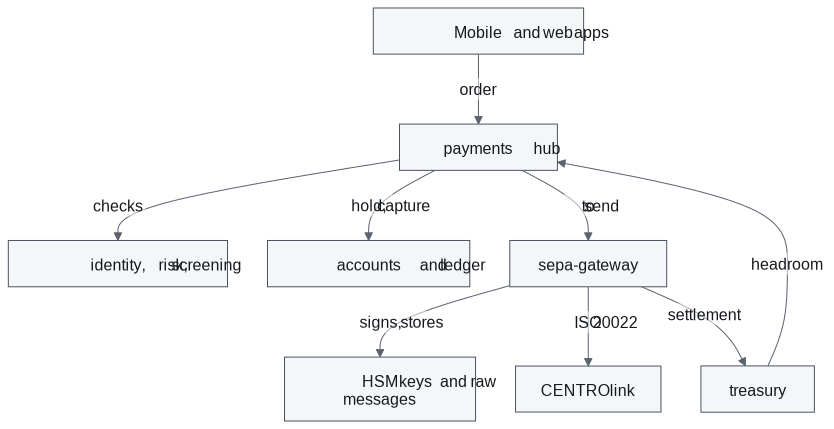
The diagram shows the Lithuanian profile; under the UK profile fps-gateway and Faster Payments take the places of sepa-gateway and CENTROlink.
payments keeps one record per transfer in payment_orders: payer, payee, amount, state and time of hand-over. The route, rail, is sct_inst (instant), sct (standard) or book (between two customers of the bank); under the UK profile the external routes are fps, bacs and chaps. Each record stores the app's idempotency key, a unique identifier by which a repeated request is recognised, and payment_transitions holds one row per state change. payments also runs standing orders, the payee check and routing, and assigns each payee a counterparty_id, a keyed hash of the normalised account identifier (the IBAN, or the sort code and account number under the UK profile), so that compliance sees patterns in payment events without names.
sepa-gateway handles external messages. Its database holds a received-message table (inbox) and a pending-message table (outbox), so that no message is lost or processed twice, together with the raw messages, the mapping between internal and network identifiers, and the settlement files. It does not decide whether a payment is permitted.
While a customer or another bank awaits a response, payments makes only the calls listed with their deadlines in 02; a missed deadline is handled per that block's row in the failure table on 02. Sanctions screening, screening, checks the payee of a standard transfer within 50 ms (deadline 300 ms); on a miss the order stays in Checking and the check is retried, and an unscreened order is never sent (06). For the prefunded account, payments reads a local copy of the headroom that treasury publishes.
ISO 20022 is the international standard for payment messages. The messages processed under the Lithuanian profile are:
| Message | Full name | Direction | Purpose |
|---|---|---|---|
pacs.008 | Interbank credit transfer | Both | The payment instruction |
pacs.002 | Payment status report | Both | Acceptance, rejection or confirmation of settlement |
pacs.004 | Payment return | Both | Return of settled funds, including a positive answer to a recall |
pacs.028 | Payment status request | Bank to CENTROlink | Enquiry about a payment whose outcome has not been reported |
camt.056 | Payment cancellation request | Both | A recall: a request to the other bank to return funds |
camt.029 | Resolution of investigation | Both | A negative answer to a recall |
camt.053 | Account statement | CENTROlink or TARGET to bank | Statement of the bank's settlement accounts |
camt.054 | Debit or credit notification | CENTROlink or TARGET to bank | Intraday notice of individual movements |
How it works
The payment order states
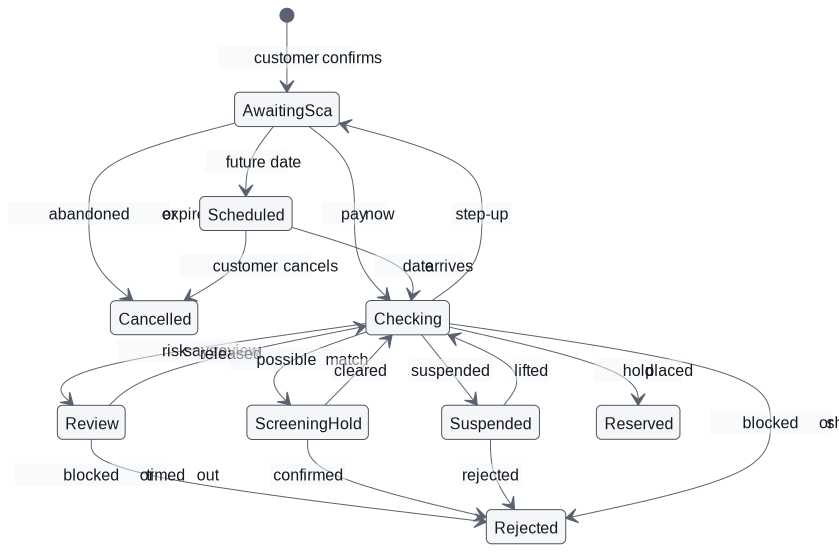
Each outgoing payment moves through fixed states; only the timestamped transitions shown below are permitted. An unsubmitted draft exists only in the app, and the order is created in AwaitingSca. The first diagram follows the order until funds are reserved.
The second diagram begins once funds are reserved and shows the transitions on each rail. Unknown is a transient state that is resolved only by a status report.
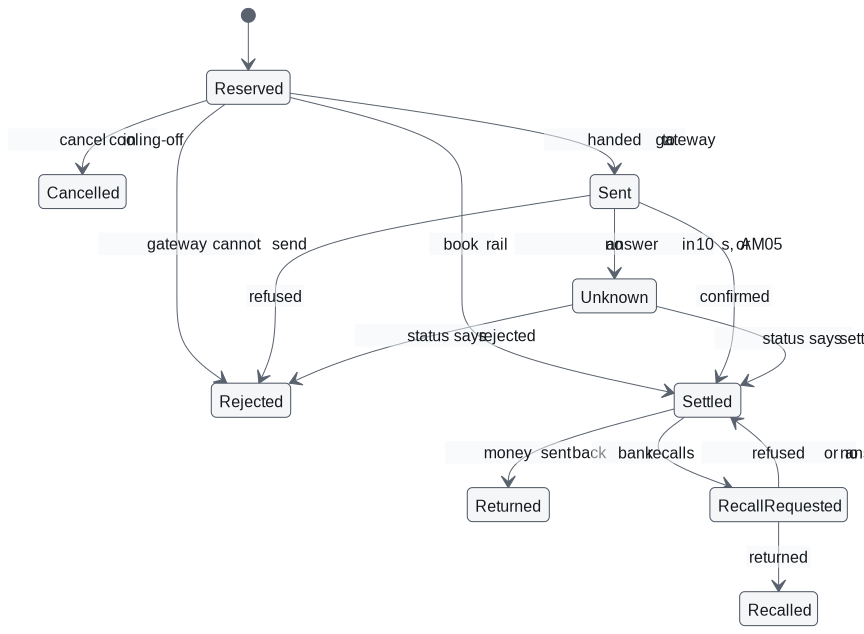
The 10-second limit and the release at Unknown apply to sct_inst only. A standard transfer settles with the file that carries it; if the file has not settled by the end of the following business day, a reconciliation break is opened and the hold retained. A book transfer settles in one ledger transaction.
| State | Description |
|---|---|
AwaitingSca | Awaiting strong customer authentication on the customer's device |
Checking | risk takes its decision, after which the ledger checks available funds and places the hold |
Review | risk has requested manual review; a fraud review case is open and the customer sees the neutral status "Processing" |
ScreeningHold | The payee's name is a possible match against a sanctions list; an analyst decides |
Suspended | compliance has suspended the payment under anti-money-laundering rules; the customer sees a neutral status |
Reserved | Funds are reserved and the message is being prepared; any cooling-off period (07) elapses in this state, during which the customer may cancel |
Unknown | The outcome has not yet been reported; this state is distinct from a failure |
Rejected | Refused with a reason code such as AC01 (incorrect account number), AC04 (closed account) or the internal code LiquidityShortage; the customer is informed unless tipping-off rules prohibit it (06) |
No funds are reserved in Review or ScreeningHold; funds are checked again on return to Checking. When an agent releases an order from Review, risk records an override and does not raise the same reasons again, but still checks funds and limits (07). Suspension applies to any outgoing order before submission (under the Lithuanian profile, to standard transfers) and to incoming credits; a payment already sent on the instant rail cannot be suspended.
The staff console's payment queue lists orders in Review, ScreeningHold, Suspended and Unknown, where manual action may be required, with age and deadline. Review and screening are case types in the single case tool in compliance (06).
Outbound instant payment, step by step
The sequence shows an instant payment of EUR 650.00 to a payee at another bank under the Lithuanian profile; the Faster Payments sequence is in the United Kingdom profile section below.
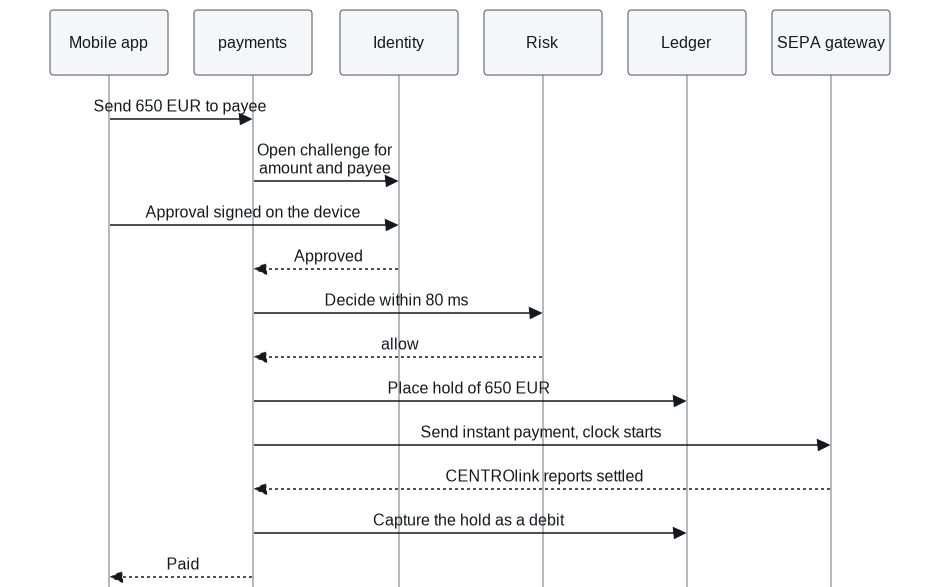
- The customer enters the payee's IBAN and name; verification of payee runs before authorisation.
paymentscreates the order inAwaitingScaunder the app's idempotency key and requests from the authentication service,identity, a challenge stating the amount and payee. The customer's device signs it andidentityconfirms (09); this is strong customer authentication (SCA).risk, which also holds all monetary limits, responds within a target of 50 ms and a deadline of 80 ms (300 ms and 1 s for a standard transfer). On a miss, the documented fallback in 07 applies.- The
ledgerplaces a hold of kindpayment, removing EUR 650.00 from the available balance without booking it. If the account is debit-blocked or has insufficient funds, the hold is refused and the order isRejected. sepa-gatewaybuilds apacs.008, signs it, stores the raw bytes and submits it;paymentsrecordssent_at.- A positive
pacs.002captures the hold as a final debit. A negative one releases the hold and displays the reason, except for a duplicate refusal (AM05, see idempotency below).
The target for internal processing up to the hand-over to sepa-gateway is 250 ms at the 99th percentile, with a limit of 1 s (02).
Reference time. The law counts the 10 seconds from the "time of receipt" of the order (IPR Art 5a(4)(c)). The time of receipt is the moment at which the payer's bank receives the order, regardless of the hour or calendar day, or the agreed time where the customer and the bank have agreed execution at a specific time on a specific day (IPR Art 5a(3)). The 2025 SCT Inst rulebook treats the time of receipt as equal, as a general rule, to the customer's authorisation of the order, marks it with the transaction timestamp (attribute AT-T056, which includes milliseconds) and divides the execution time into checkpoints at 5, 7 and 9 seconds (EPC[34]); the checkpoints are encoded per rulebook version. The Unknown timer runs from sent_at, after SCA, the risk decision and the hold, so a step-up or review cannot move a payment to Unknown before submission. sent_at follows authorisation by the internal processing time, which is limited to 1 s; the treatment of that interval, and of an order held for review after authorisation, is an assumption listed under Assumptions and dependencies.
When no answer comes
Example: the gateway submits a payment of EUR 650.00 at 14:00:00; with no response by 14:00:10, the order moves to Unknown and the following steps are taken:
- The hold is released immediately, as the law requires (IPR Art 5a(5)), and the EUR 650.00 is available again.
- The customer is informed that the payment is not yet confirmed (Art 5a(4)(e)).
- At about 14:00:12, a
pacs.028status request is sent, repeated on a backoff schedule. - The
pacs.008is not resent, the payment is not marked failed and no refund is booked; only a response from CENTROlink resolvesUnknown.
If CENTROlink reports settlement at 14:03, the funds have left the bank and payments books a forced_debit with a reason code and an alert. If the customer has meanwhile spent the released funds, the balance becomes negative and accounts runs its unarranged negative balance process (03). The account terms state that an instant payment confirmed after the funds were restored is debited when the confirmation arrives, and the bank charges no interest and no fee on a negative balance that arises in this way; cost: the bank carries the funding cost and the credit loss of such balances. If CENTROlink reports a rejection, the order closes and no funds move.
Inbound instant payment
Example: a customer receives EUR 240.00 from a payer at another bank.
- CENTROlink delivers a
pacs.008.sepa-gatewayverifies the signature, stores the raw bytes and records the message in its inbox; a repeated message identifier receives the stored response again. paymentsasks the accounts block,accounts, whether the IBAN belongs to the bank and is open or restricted, then records the payment as accepted.sepa-gatewaysends a positivepacs.002. When CENTROlink confirms settlement,paymentsposts the credit, available immediately.- Without settlement confirmation 10 seconds after the bank's response (target),
paymentssends apacs.028and keeps the credit unposted until answered. Items still open at the daily close become reconciliation breaks.
Rules for incoming payments:
- Response time. Within 2 s at the 99th percentile, hard deadline 4 s; the credit is posted on CENTROlink's settlement confirmation (target: within 1 s of it).
- Grounds for rejection. An unknown IBAN (
AC01), a closed account (AC04), or a new message repeating a transaction identifier already credited (AM05). - Accepted but blocked credits. A restricted account (frozen for sanctions, seized, deceased or debit-blocked) still receives the credit; the restriction, owned by
accounts, keeps the funds blocked andcomplianceis notified. The treatment of credits to an account frozen for sanctions is specified in 06. - Returns to closed accounts. A
pacs.004returning an earlier payment to an account closed since goes to suspense, andaccountspays it to the closing IBAN on file (03).
Sanctions screening of instant payments. screening rescreens the bank's customers at least once every calendar day and immediately after new sanctions take effect (06). During an instant payment, IPR Art 5d(2) prohibits an additional check of payer or payee against EU targeted financial sanctions beyond that rescreening; checks under other sanctions regimes or anti-money-laundering law are not affected.
Standard transfers and internal transfers
sepa-gateway submits standard pacs.008 messages in files at several windows each TARGET business day; cut-off times are held in configuration and set from the CENTROlink timetable during onboarding (see Assumptions and dependencies). Holds are captured when the file settles. Incoming standard transfers are credited on settlement and then screened, with screening fetching the payer's name from payments by API (06).
When payer and payee are both customers of the bank, payments uses the book rail: no message leaves the bank and the ledger books debit and credit in one transaction. SCA, the risk decision and verification of payee still apply.
Verification of payee
As requester, payments asks the payee's bank whether IBAN and name correspond before the customer authorises the payment (IPR Art 5c(1)). Example: for a payee entered by first name only, the payee's bank may return "close match" with the holder's full name, which the app displays with a warning. The other responses are match, no match (the funds may reach a different person) and verification not possible. The customer may still proceed (Art 5c(5)), and the bank must explain the consequences of disregarding a warning (Art 5c(7)). Because the check is performed after the customer provides the payee's details and before the customer is offered authorisation (Art 5c(1)), it is performed for a standing order when the order is created or its payee is changed, the points at which the customer authorises it, and is not repeated at each execution; residual risk: a later change of the account holder's name is not detected.
As responder, payments answers other banks about the bank's IBANs. A narrow call to the customer record, customers, returns only the holder's name. The matcher ignores differences of case, diacritics such as "ū" and word order. Target: 300 ms. Requests are exchanged over APIs under the EPC Verification Of Payee scheme, whose rulebook version 1.1 took effect on 20 September 2026 (EPC[36]). Each participant's API endpoint and supported options are published in the EPC Directory Service, which participants may download and cache locally so that no directory query is needed per request (EPC[37]), and a participant may send and receive requests directly or through a qualified routing and verification mechanism (EPC[38]). The Lithuanian adapter addresses responders from a locally cached copy of the directory and registers the bank's own responder endpoint in it; a routing and verification mechanism can be placed behind the same payee-check contract without a change to payments.
Both roles implement the internal payee-check contract, which returns one of four outcomes (match, close match, no match, unavailable) together with the adapter's reason code; payments stores both. Verification of payee is its adapter under the Lithuanian profile, and Confirmation of Payee under the UK profile.
Returns, recalls and investigations
- Reject. Refusal before settlement (negative
pacs.002); the hold is released. - Return. The payee's bank returns settled funds (
pacs.004). CENTROlink processes SCT returns within 15 service days (Rules §§84 to 111[1]). - Recall. The bank requests settled funds back (
camt.056) after a duplicate, technical error or fraud. The response ispacs.004(positive) orcamt.029(negative); without a response by the rulebook deadline, "no response" is recorded and the order remainsSettled. - Inbound recall. Another bank requests the return of funds credited to a customer of the bank. The
camt.056opens aninbound_recallcase with the rulebook deadline. If the funds are available and the customer consents in the app, they are returned (pacs.004); otherwise the bank answerscamt.029. Where the reason is fraud,compliancedecides the treatment of the funds and what the customer is told. - Investigation. A customer reports a missing payment or one sent to an incorrect IBAN. A
payment_investigationcase shows one timeline of state changes, ledger entries, raw messages (investigation role only) and status requests.
Staffing of these queues is in Running the bank.
Idempotency and ledger keys
Each step of a payment is booked under its own key, and the ledger does not book a repeated key twice. Only booked results are stored under the key, so a retry after a refusal is evaluated afresh; for example, a standing order short of funds at 06:00 has its balance checked again at the 18:00 retry.
| Step | Ledger idempotency key | Written when |
|---|---|---|
| hold | pay:<order_id>/hold | Reserved |
| capture | pay:<order_id>/capture | Settled |
| release | pay:<order_id>/release | Rejected or Cancelled after a hold, or Unknown at the timeout (instant only, at 10 seconds under the Lithuanian profile; under the UK profile the hold is kept at Unknown) |
| late settlement | pay:<order_id>/late-settlement | Unknown resolves to settled (forced debit) |
| return | pay:<order_id>/return/<return_id> | Returned or Recalled |
| inbound credit | sepa:<instructing_bic>/<tx_id>/credit | Inbound settled |
| inbound return | sepa:<instructing_bic>/<tx_id>/return-out | Funds returned by the bank after an inbound recall |
Inbound keys combine the sending bank's BIC (bank identifier code) and the transaction identifier. The bank's own transaction identifiers derive from the app's idempotency key, so a resend after a region failover is refused by CENTROlink as a duplicate (10). A negative pacs.002 with reason AM05 on an order the bank sent is never treated as a rejection: the order moves to Unknown, payments sends a pacs.028 for the original transaction identifier, and only that response resolves it.
Reconciliation
treasury performs reconciliation (08) on this component's data. The ledger mirrors each actual settlement account, prefunded and TARGET. During the day each movement CENTROlink reports is matched to a ledger posting by transaction identifier, with a target of every 15 minutes. Instant movements are matched from the settlement confirmation or the intraday notification (camt.054), both assumed to be sent on every calendar day (see Assumptions and dependencies). The daily close runs every calendar day at midnight local time of the profile. On TARGET days the camt.053 statements cover the days since the previous one and only confirm those matches. Unmatched items go to the rail's suspense account (suspense/sepa, or suspense/fps under the UK profile); target: none unexplained after 1 business day.
Future-dated and standing orders
A future-dated order is authorised with SCA at creation and waits in Scheduled. A standing order creates one order per period directly in Scheduled, using the SCA exemption for recurring payments (SCA RTS[5]); risk decides each exemption and keeps the counters, and identity enforces it. Orders activate at 06:00 Lithuanian time on the execution date (target) and continue from Checking. If funds are short, the order is retried at 18:00, then rejected, and the customer is informed through the notifications block, comms. When accounts marks a customer deceased, payments cancels that customer's scheduled and standing orders.
Design of sepa-gateway
sepa-gateway is the sole block with a network route to CENTROlink. It sends funding orders, which move the bank's funds from TARGET to the prefunded account; treasury creates and approves them (08).
Received messages land in the inbox, deduplicated by message identifier; outgoing messages pass through the outbox and are retried until acknowledged. Each outgoing message is validated against the EPC implementation guidelines and signed with a Bank of Lithuania certificate (Rules §11) whose private key stays in a hardware security module (HSM). The exact bytes go to write-once storage with a hash. Two or more gateway instances run concurrently in different data centres. Structured address fields are collected from the first day; in September 2026 the EPC deferred the end date for the unstructured address format without setting a new one (EPC[34]). Recall and response deadlines, the permitted character set and the address rules are taken from the rulebook in effect, which for instant payments is the 2025 SCT Inst rulebook version 1.2, and are held as configuration per rulebook version. Because the EPC publishes a new rulebook every two years (as reported), two mapping versions run in parallel around each switch-over date.
United Kingdom profile
| Aspect | Lithuanian profile | UK profile |
|---|---|---|
| Instant rail | SCT Inst through CENTROlink | Faster Payments, operated by Pay.UK |
| Rail gateway | sepa-gateway | fps-gateway |
| Message standard | ISO 20022 | ISO 8583 for Faster Payments; ISO 20022 for CHAPS |
| Access at launch | Direct participant in CENTROlink (D04.1) | Directly connected non-settling participant; a sponsor settles (D04.1) |
| Settlement | Prefunded account for instant payments, funded from TARGET | Deferred net settlement in the Bank of England's real-time gross settlement system (RTGS), three times on each UK business day |
| Scheme maximum per payment | None at scheme level since the 2025 SCT Inst rulebook; the bank sets its own limits and the customer may set a limit per day or per transaction (IPR Art 5a(6)) | GBP 1 million; the bank may set lower limits |
| Customer time limit | Statutory: funds available within 10 seconds of receipt (IPR Art 5a) | Scheme service level: the sender reports the fate of a Single Immediate Payment to an attended customer within 15 seconds, and the receiver answers within a few seconds set in restricted specifications; the legal execution limit is the end of the next business day |
| Account identifier | Lithuanian IBAN | Sort code and 8-digit account number, with modulus check; UK IBAN derived for cross-border use |
| Payee check | Verification of payee before each payment | Confirmation of Payee, at least when a payee is created or changed |
| Batch rail | SCT; SDD Core in Phase 2 | Inbound Bacs Direct Credits and paying-side Bacs Direct Debit through the sponsor in Phase 1 (D04.8); origination of Bacs Direct Credits in Phase 2; origination of Direct Debits and direct Bacs participation as Phase 3 options |
| Recall of a settled payment | camt.056 recall under the rulebook | No recall; Credit Payment Recovery and Bank Error Recovery on best endeavours |
| High-value rail | Not applicable | CHAPS through the sponsor; direct participation in Phase 3 |
| Delay on suspicion of fraud | Not applicable | Up to the end of the fourth business day after receipt, held in Review (D04.7) |
Faster Payments. Faster Payments, operated by Pay.UK, is available at all hours on every day of the year, and every participant must receive and respond to all payment types at all times, using stand-in processing with a Qualified Accept during an incident or maintenance. The central infrastructure rejects payments above the scheme limit of GBP 1 million, so risk applies the bank's own limit, at or below that figure, before submission. App orders are sent as Single Immediate Payments, future-dated orders as Forward-Dated Payments and standing orders as Standing Order Payments, which run on UK business days and of which sending participants must process "at least 90%" between midnight and 06:00; the activation time of standing orders is therefore a profile setting. A UK business day in this document is a weekday that is not a bank or public holiday in England and Wales, the calendar used by Faster Payments, Bacs and CHAPS. The Payment Services Regulations 2017 define a business day as any day on which the provider is open for business as required for the execution of a payment transaction (regulation 2[39]); the bank's terms fix its business days as this calendar, and statutory deadlines are computed on it.
Timing and responses. The sender must inform an attended customer of the fate of a Single Immediate Payment within 15 seconds, a limit that is unchanged where a directly connected non-settling participant is in the chain. The 15 seconds is a scheme service level; unlike the statutory 10 seconds of the Lithuanian profile it carries no duty to restore the funds, and the legal execution limit is the end of the next business day. The receiver answers with an Unqualified Accept, a Qualified Accept carrying a qualifier for later availability, whose share is restricted, or a Reject with a reason code. The per-hop response limits and the central infrastructure's behaviour on a timeout are in restricted scheme specifications (see Assumptions and dependencies), so the Unknown timer is a profile setting, payments.unknown_after, fixed below 15 seconds once they are available (D04.4). Standing Order Payments and Forward-Dated Payments are asynchronous: the hold is captured when the central infrastructure accepts the submission, no beneficiary response is awaited and payments.unknown_after does not apply. A later rejection by the receiver arrives as a Scheme Return, which moves the order to Returned and credits the customer, and an asynchronous order enters Unknown only when the central infrastructure's own acknowledgement is missing.
Access and settlement. Faster Payments settles on a deferred net basis in RTGS three times on each UK business day, at 07:00, 13:00 and 17:00 (Bank of England, RTGS daily timetable[32]); no settlement takes place at weekends (Bank of England[14]). A directly connected settling participant holds a Bank of England settlement account and cash equal to its Net Sender Cap in a separate Pre-Funded Account. A directly connected non-settling participant runs its own connection and carries the same sending and receiving obligations, while a sponsoring settling participant authorises each of its debits in near real time, is asked for authorisation before any credit to it is accepted, and settles both. The sponsor is therefore on the path of inbound as well as outbound payments, and its response falls within the 15 seconds and within the bank's inbound response budget. The bank launches in the second model and moves to the first in Phase 2 (D04.1). Pay.UK states 9 to 12 months for onboarding, and direct participation requires the bank to have, or be eligible to hold, at least one unique sort code. Funding of the settlement position is specified in 08.
fps-gateway. Under the UK profile fps-gateway is the rail gateway. It owns the Faster Payments connection, the mapping from the canonical model to Faster Payments messages, which follow ISO 8583 (D04.6), message signing and a view of the settlement position against the sponsor's limit or, from Phase 2, the Net Sender Cap. Its inbox, outbox, raw message store, HSM keys and redundant instances follow the sepa-gateway design. It maps scheme reason codes to internal codes, and inbound ledger keys use the prefix fps: in place of sepa:. Inbound payments follow the Lithuanian steps and budgets; the gateway answers with an Unqualified Accept once accounts accepts the payment and uses a Qualified Accept only in stand-in processing. A Qualified Accept commits the bank to credit the payee later or to send a Return Payment. The stand-in responder (10) therefore holds a continuously replicated list of account numbers with a status showing whether each can accept credits; it rejects payments to unknown, closed or blocked accounts, answers the others with a Qualified Accept and writes each to a durable inbox. On recovery payments applies the inbox to the ledger under the normal fps: keys, and a payment that cannot be applied leaves as a Return Payment within the scheme's period. Payments accepted in stand-in are outside the deposit-limit and screening checks until applied, which is recorded as an accepted risk, and in Phase 1 the sponsor's authorisation is still required. Because Faster Payments settles on a deferred net basis, no settlement confirmation precedes the credit; the credit is posted when the bank accepts the payment (target: within 1 s of the accept response; planning assumption). When the central infrastructure redirects a payment because the payee has switched accounts, it advises the sender; fps-gateway passes the advice to payments, which updates the saved payee and any standing order to the new sort code and account number within the scheme's timescale and records the change for the customer.
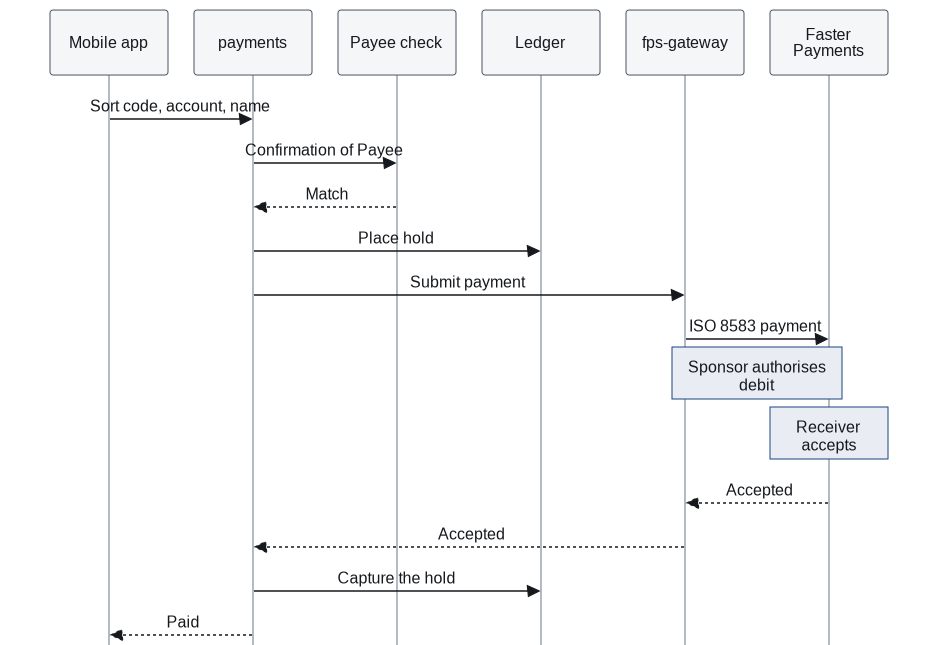
The sequence shows an outbound Single Immediate Payment; SCA and the risk decision precede the hold as on the Lithuanian profile and are omitted.
Account identifiers. An account is addressed by a 6-digit sort code and an 8-digit account number. Every sort code is registered in the Extended Industry Sort Code Directory (EISCD). accounts allocates account numbers that pass the modulus check published by Vocalink. payments loads the EISCD weekly, as the scheme requires, validates the payee's sort code against it and reads from it whether that sort code can receive Faster Payments, CHAPS or Bacs; an order to a sort code that Faster Payments cannot reach is refused, or offered on another rail, before any hold is placed. The modulus check is applied to the account number before the payee check. Because an unlisted sort code passes the modulus check by default, the check detects keying errors only and does not replace Confirmation of Payee. While the bank settles through a sponsor, the design takes the bank's sort code as allocated by the sponsor, which is part of the sponsor assumption listed below; accounts holds it as a profile setting, so allocation through Pay.UK onboarding would change no code (03). A UK IBAN is derived for cross-border use. The IBAN registry fixes its length at 22 characters and its structure as the country code GB, two check digits, a four-letter bank identifier, the 6-digit sort code and the 8-digit account number (Swift[33]). The bank identifier is the first four characters of the bank's BIC, which the bank registers with Swift and also needs for CHAPS (planning assumption).
Confirmation of Payee. Confirmation of Payee is an API overlay under Pay.UK rules, joined directly or through an accredited aggregator; the bank joins through an aggregator (13). The Payment Systems Regulator's Specific Direction 17 applies to a later entrant from the day after it becomes a Faster Payments or CHAPS participant with its own sort code in the EISCD (paragraphs 7.4 and 7.5), so Confirmation of Payee, sending and responding, must be live at launch; it must be used at least when a payee is created or its identifiers change (paragraphs 3.4 and 3.5) (Specific Direction 17[23]). Its expiry date was removed on 22 October 2026 (policy statement PS26/2[24]). The Financial Services and Markets Bill, in Commons committee in November 2026, provides for the transfer of the regulator's functions to the FCA; its directions remain in force until then (UK Parliament[25]). A close match returns the actual account name, which the app displays with a warning. Under the UK profile the adapter's reason code distinguishes a personal or business mismatch, a switched account, an account that does not exist, an opt-out and a required secondary reference; where the account does not exist, the payee cannot be saved. As responder, payments uses the existing matcher and 300 ms target; the scheme's response-time limit is in the restricted rulebook (see Assumptions and dependencies). The bank hosts the responder and the aggregator relays requests to it, so that account names are not supplied to the aggregator in bulk; cost: the bank's responder endpoint carries the scheme's availability obligation. As requester, the bank runs the check when a payee is created or its identifiers change, as the direction requires, and does not repeat it for each payment to a saved payee; residual risk: a later change of the account holder's name is not detected.
Fraud delay and reimbursement. Regulation 86 of the Payment Services Regulations 2017, as amended from 30 October 2024, permits the payer's provider, on reasonable grounds to suspect fraud or dishonesty by a third party, to delay an outbound payment until the end of the fourth business day after receipt, provided that the payer is notified by the end of the next business day. The grounds must be established by the end of the business day following receipt, the delay may be used only to make enquiries of the payer or a third party, and it must last no longer than necessary. The delay uses Review (D04.7). Reimbursement of authorised push payment fraud on Faster Payments and CHAPS is specified in 07.
Returns. A Return Payment is a new payment that references the original and is sent within 1 to 3 working days depending on the response given; a Scheme Return is generated by the central infrastructure for an asynchronous payment that the receiver rejected. A Return Payment moves the original order to Returned under the existing return key, and the gateway maps a Scheme Return to the same transition. A Faster Payment cannot be revoked or recalled once it has been sent to the central infrastructure, so RecallRequested is not used on this rail. A payment sent to the wrong account by customer or bank error is pursued through the scheme's Credit Payment Recovery process, which works on best endeavours and depends on the funds remaining and the payee's cooperation; a batch sent in error by the bank is pursued through Bank Error Recovery; funds lost to fraud are pursued through the reimbursement claim in 07. Each is a payment_investigation case type with the scheme deadlines as case clocks. Each also arrives inbound: as receiving bank, payments opens the case, accounts restricts the disputed amount where the terms allow, and any money returned leaves as a Return Payment.
Bacs and CHAPS. Bacs settles in RTGS at 09:30 on each Bacs processing day, on a three-day cycle of input, processing and entry; processing days exclude weekends and English bank holidays. A current account is usable as a main account only if it receives Bacs credits and honours Direct Debits, which pay 73% of household bills (Bacs System Principles[17]). In Phase 1 the bank is reached indirectly through the sponsor, which is a direct participant in Bacs: inbound Direct Credits are applied to customer accounts, and Direct Debits presented against customer accounts are paid or returned unpaid (D04.8). Origination of Bacs Direct Credits follows in Phase 2; origination of Direct Debits for business customers and direct participation in Bacs are Phase 3 options. CHAPS settles gross in RTGS with no minimum or maximum value, from 06:00 to 18:00 (customer payments until 17:40) on UK business days, using ISO 20022; the Bank of England plans to open at 01:30 from September 2027 (Bank of England[20]). It carries payments above the Faster Payments limit, such as house purchases, through the sponsor until Phase 3.
Paying-side Direct Debit. Under the UK profile the bank acts as paying bank from launch: a biller, called the originator, sets up a Direct Debit Instruction against a customer's account and collects under it. The bank does not originate Direct Debits for its customers before Phase 3. The route is bacs in payment_orders. The Bacs adapter is a further adapter in payments, beside fps-gateway; like the CHAPS adapter it works over the sponsor's channel, and it exchanges Bacs files with the sponsor in both directions. Its inbox, outbox and raw message store follow the sepa-gateway design, and inbound ledger keys use the prefix bacs:. The bank's sort code is marked in the EISCD as accepting Bacs credits and Direct Debits from launch. The sponsor settles the bank's Bacs position on entry day; funding is specified in 08. The functions are the following.
- Instruction register.
paymentskeeps one record per Direct Debit Instruction and account, holding the originator's identifier and name, the reference, the status and the dates of lodgement, amendment and cancellation. The register is fed by the instructions that originators lodge electronically through the Automated Direct Debit Instruction Service (AUDDIS), which arrive through the sponsor under the transaction codes 0N for a new instruction, 0C for a cancellation and 0S for the conversion of a manually lodged instruction. Changes made at the bank, such as a cancellation by the customer or the transfer of the account, are advised to originators through the Automated Direct Debit Amendment and Cancellation Service (ADDACS) (Bacs glossary[43]). - Three-day cycle. Bacs runs over three processing days: input, processing, and entry with settlement. Each Direct Debit received from the sponsor becomes a payment order with rail
bacs, and the debit is posted to the customer's account on entry day under abacs:key derived from the item, so that a file delivered twice cannot debit twice. Inbound Direct Credits are posted on entry day in the same way. - Pay or return unpaid. For each item
paymentschecks the register, obtains theriskdecision and asksaccountsfor the debit. An item is paid where an active instruction exists and the available balance covers it. It is returned unpaid through the sponsor where the instruction has been cancelled, where the funds are insufficient at the decision time or where a restriction prevents the debit. The return is made through the Automated Return of Unpaid Direct Debits service (ARUDD) with a scheme reason code (Bacs glossary[43]) and must reach the sponsor within the scheme's deadline, which is held as a profile setting (see Assumptions and dependencies). The customer is notified of an unpaid item in the app. - Customer control. The app lists the customer's instructions with the originator's name, the reference and the most recent collection, and allows the customer to cancel an instruction (09). A cancellation takes effect in the register immediately, so that later collections under it are returned unpaid, and is advised to the originator through the sponsor.
- Direct Debit Guarantee. On a valid claim the bank refunds the customer immediately and recovers the amount from the originator through the indemnity claim process; the scheme sets no time limit on claims (Bacs System Principles[17]; the mechanics as reported). A claim is a
payment_investigationcase type in the existing case tool. The refund credits the customer against a ledger account for indemnity claims due from other banks (03), which is cleared when the originator's bank settles the claim. The Guarantee entitles the customer to a full and immediate refund where an error is made in the payment of a Direct Debit by the originator or by the bank, and a customer who receives a refund without entitlement must repay it when the originator asks (Direct Debit Guarantee[45]). The bank therefore refunds on the customer's report of an error without first assessing the originator's position. The claim on the originator is a Direct Debit Indemnity Claim (DDIC), made by the paying bank in respect of an incorrect Direct Debit (Bacs glossary[43]); its settlement timetable is held as a profile setting (see Assumptions and dependencies). - Account switching. Redirection of Direct Debit Instructions through the Current Account Switch Service applies only if the bank joins that service, which is not planned before Phase 2 (planning assumption).
CHAPS through the sponsor. CHAPS is a second adapter in payments and is not part of fps-gateway. It submits ISO 20022 payments over the sponsor's channel within the sponsor's cut-off, funds each payment gross from the bank's account at the sponsor before release, and applies inbound CHAPS credits reported by the sponsor on the same day. Confirmation of Payee and the reimbursement case type apply, the latter under the CHAPS reimbursement rules. A CHAPS order without confirmation from the sponsor by the cut-off is Unknown and is resolved from the sponsor's statement.
Unchanged. The state machine, the reserve-then-send rule (D04.3), idempotency, reconciliation through suspense and the budgets of 2 s and 4 s for inbound responses, 200 requests per second, 99.95% availability and two hours' recovery are identical in both profiles. The Unknown rule (D04.4) differs between the profiles in one respect, the treatment of the hold: under the UK profile the hold is kept at Unknown and is not released at the timeout. Sanctions screening of payments under the UK regime is specified in 06; screening a new payee on each Faster Payment is the bank's policy choice, and its latency is spent inside the 15 seconds.
Key design decisions
D04.1 Direct CENTROlink participation
Decision: As a specialised bank, the bank joins CENTROlink as a direct participant with its own BIC, IBAN range and TARGET account. If the EMI route is taken first (01), it connects directly where the CENTROlink rules admit an EMI as a direct participant and otherwise through a sponsor participant (see Assumptions and dependencies), and sepa-gateway hides the difference.
Rationale: Instant payments require control of the 10-second budget, the prefunded account and incident response at night.
Alternative considered: A sponsor bank or banking-as-a-service provider would allow an earlier start, but every payment would depend on another firm's availability, cut-offs and fees.
Cost: Admission work (certificates, connectivity tests, scheme adherence, Rules §11), daily liquidity management and staff with payment rail expertise.
UK profile: The bank joins Faster Payments as a directly connected non-settling participant, with its own technical connection available at all hours and settlement through a sponsor that is a settling participant and authorises each debit and credit in near real time. In Phase 2 the bank becomes a directly connected settling participant with its own settlement account at the Bank of England, a Net Sender Cap and a Pre-Funded Account. Rationale: time to launch, because settling participation adds the settlement account and prefunding arrangements to onboarding; the connection, certification testing and assurance are the same in both models. Cost: dependence on the sponsor for settlement and for authorisation of every payment in both directions, a sponsor fee, a second real-time integration, and a second onboarding with a migration in Phase 2. Under the UK profile the launch model therefore accepts, until Phase 2, the dependency on another firm's availability and fees that this decision rejects under the Lithuanian profile; the bank retains its own connection, message handling and incident response, and does not control settlement or the authorisation of each payment. Residual risk: few banks offer this sponsorship, and the availability of Faster Payments in Phase 1 cannot exceed the sponsor's. Alternative considered: settling participation from launch in bank mode, which removes the sponsor from the payment path and the Phase 2 migration, depends on a settlement account being available during mobilisation (01) and ties up prefunding cash. It is not adopted in either mode, because the plan assumes that a bank in mobilisation holds no settlement account at launch (see Assumptions and dependencies). fps-gateway hides the difference between the two access models from payments. This access path is a planning assumption.
D04.2 One payments hub with rail adapters
Decision: A single payments service owns every payment order and its state machine. Rails are implemented as adapters behind it: sepa-gateway at present, book transfers, and SWIFT later.
Rationale: Limits, risk decisions, verification of payee and notifications are implemented once for all rails.
Alternative considered: A separate service per rail would be simpler for each individual rail, but the rules would diverge over time.
Cost: A defect in the hub affects every rail.
D04.3 Reserve first, send second, book on confirmation
Decision: A ledger hold is placed before submission, captured as a debit only on positive confirmation and released in all other cases.
Rationale: Funds in transit cannot be spent twice, and a rejection does not leave a debit and refund pair on the customer's statement.
Alternative considered: Debiting immediately and crediting back on rejection is simpler, but fills statements with offsetting entries.
Cost: The hold lies on the instant payment path and must consistently meet its latency target.
D04.4 An unknown outcome stays open until CENTROlink answers
Decision: The customer's funds are released at 10 seconds, as the law requires, but the order remains Unknown until CENTROlink reports the outcome. The bank does not infer failure, resend or book a refund on its own determination.
Rationale: An incorrect inference causes a loss or a duplicate payment, and the settlement system is the authoritative source of the outcome.
Alternative considered: Treating a timeout as failure is simpler, but a late settlement would become an undetected loss.
Cost: Late settlements require a forced debit and can make a balance negative, and customers see "not yet confirmed" for a period.
UK profile: The order moves to Unknown after payments.unknown_after, which is set below the 15-second limit for informing an attended customer, and the customer is informed that the payment is not yet confirmed. The hold is kept. A Faster Payment cannot be revoked or recalled once it has been sent to the central infrastructure, and no UK rule requires the funds to be restored at a time limit, so releasing the hold would allow the same funds to be spent twice. The hold is captured on an accept, and released only on a reject, a Scheme Return, or a reconciliation against the central infrastructure's records and the sponsor's statement that shows the payment was never accepted. The bank does not resend. Cost: the customer's funds remain unavailable until the outcome is established. The status enquiry used in place of pacs.028 is defined in the restricted scheme specifications (see Assumptions and dependencies); the reconciliation described above resolves Unknown whether or not an enquiry message is available.
D04.5 Instant by default, standard as fallback
Decision: Every eligible payment is executed as instant. Standard SCT is used only when the payee's bank cannot receive instant payments or the prefunded account is short, and only after the customer consents in the app.
Rationale: Instant payments may not cost more than standard transfers (IPR Art 5b(1)) and give a definitive outcome within seconds.
Alternative considered: Standard transfers by default would need less prefunding but give slower outcomes.
Cost: A larger prefunded account, a weekend buffer funded before the Friday close, and operations on every calendar day.
UK profile: Every payment within the bank's Faster Payments limit, which cannot exceed the scheme limit of GBP 1 million, is sent by Faster Payments. A larger payment is offered as CHAPS through the sponsor during CHAPS hours, with the customer's consent in the app. Outbound Bacs is not offered to retail customers in Phase 1. In Phase 1 the headroom that payments reads is the limit granted by the sponsor; from Phase 2 it is the Net Sender Cap less the net sending position. Direct Debits presented against the account are paid under D04.8.
D04.6 An internal canonical model, mapped to ISO 20022
Decision: Internally, payments use a compact model whose fields map one to one to the ISO 20022 elements SEPA uses. Full ISO 20022 exists only within sepa-gateway.
Rationale: The full schemas are large and change with rulebook versions, and book transfers and SWIFT should not be bound to the SEPA message structure.
Alternative considered: ISO 20022 throughout would avoid translation, but every service would need an upgrade with each rulebook.
Cost: A mapping layer to test per rulebook and a risk of omitting a field, mitigated by retaining the raw messages.
UK profile: The same canonical model maps to ISO 8583 for Faster Payments within fps-gateway, and to ISO 20022 for CHAPS. Book transfers, risk and the ledger are unaffected by the change of message standard, which is the reason the canonical model exists. A future move of Faster Payments to ISO 20022 changes only the gateway mapping. The mapping fixes UK field limits in the profile: the customer reference is limited to 18 characters at entry in the app, the payee name to the length the scheme message carries and the character set to the scheme's, so that nothing is truncated after the customer has confirmed the order. The limits are profile settings loaded from the scheme specifications (see Assumptions and dependencies).
D04.7 Delay on suspicion of fraud uses the Review state (UK profile)
Decision: Under the UK profile, an outbound payment delayed on reasonable grounds to suspect fraud or dishonesty by a third party is held in the existing Review state. A profile setting, payments.review_max_hold, fixes the maximum hold at the end of the fourth business day after receipt of the order, measured on the UK business-day calendar. The review case carries a second deadline, the end of the next business day, by which comms sends the payer the notice of delay. No funds are reserved during the delay, and on release the order returns to Checking. The power applies to a payment that the payer has authorised, that is executed wholly within the United Kingdom in sterling and that is not initiated by or through a payee (regulation 85(1A)[41]), so it covers Faster Payments and CHAPS orders and does not cover Direct Debits. An order may enter the fraud delay only until the end of the business day following receipt, and payments.review_max_hold is an outer limit: the delay ends as soon as the enquiries are complete. The review case records the grounds for suspicion at the time the delay starts; a Review entered for another reason, such as a limit or a cooling-off wait, keeps the ordinary execution time. The notice states the reason for the delay and what the customer can provide to resolve it, unless disclosure would be unlawful, and the case records any interest or charges that the customer incurs through the delay. A provider is liable for charges and interest that its customer must pay as a consequence of late execution (regulation 94[42]); the bank compensates such charges and interest for every payment delayed under this decision, whether or not the delay counts as late execution.
Rationale: The state, the review queue, the case tool and the override recorded by risk already exist, so the statutory power requires configuration and two deadlines and no change to the state machine.
Alternative considered: A separate delay state would describe the legal basis explicitly, but would duplicate Review in the state machine, the staff console and every rail.
Cost: Business-day arithmetic per profile, and an additional deadline to monitor on each review case. A case still undecided at the maximum hold follows the existing transition from Review to Rejected. The purpose of the delay is to establish whether the order should be executed (regulation 86(2B)), and a provider may not refuse an authorised order where all the conditions of the framework contract are met (regulation 82(5)[40]); the account terms therefore make the resolution of a recorded suspicion of fraud a condition of execution, and the payer is notified of the refusal and its reasons under regulation 82. Residual cost: a genuine payment that could not be verified within the period is refused and must be submitted again.
D04.8 Paying-side Bacs Direct Debit at launch under the UK profile
Decision: Under the UK profile the Phase 1 launch product honours Bacs Direct Debits as paying bank. payments holds a Direct Debit Instruction register per account, processes the three-day Bacs cycle with debits posted on entry day, decides for each item whether to pay it or return it unpaid, and handles Direct Debit Guarantee refunds and the resulting indemnity claims as a case type. Access is indirect, through the sponsor, in the same way as inbound Bacs Direct Credits and consistently with the sponsor model for Faster Payments (D04.1). Origination of Direct Debits for business customers, with the bank as sponsor of service users, and direct participation in Bacs are Phase 3 options.
Rationale: Direct Debit pays 73% of household bills, and a current account must receive Bacs credits and honour Direct Debits to be usable as a main account (Bacs System Principles[17]). An account that cannot honour Direct Debits would serve most customers as a secondary account, which limits deposits and primary-account revenue. The capability reuses the payments hub, the ledger, the case tool and the sponsor relationship that Phase 1 already requires, and the sponsor's Bacs output for the bank's sort code carries Direct Debits presented against customer accounts in any case.
Alternative considered: Introducing Direct Debit in Phase 2, with the sort code marked in the EISCD as not accepting debits and every presented item returned unpaid until then. This reduces the Phase 1 scope, but the launch product could not be used for household bills and customers would keep their main account elsewhere.
Cost: A Bacs adapter, the instruction register, a return queue with a scheme deadline, app screens, a refund case type and its ledger accounts, a Bacs file simulator and Bacs testing with the sponsor, all within the Phase 1 scope and cost envelope of 13 as a planning assumption. The bank carries the credit risk of immediate Guarantee refunds until the originator's bank settles the indemnity claim, and a further dependency on the sponsor. The scheme services used are named in the United Kingdom profile section; the return deadline, the settlement timetable of indemnity claims and the sponsor's file times are profile settings (see Assumptions and dependencies).
Failure modes and mitigations
| Failure | Effect | Response |
|---|---|---|
| CENTROlink unreachable | No SEPA payments in or out | Instant orders refused promptly with a clear message; standard transfers queued for the next cycle; see below |
No answer 10 seconds after sent_at (instant) | Outcome unknown | Release hold, inform customer, send pacs.028, never resend |
| No settlement confirmation on an inbound payment | Credit not posted | Send pacs.028; items open at the close become a reconciliation break |
| Prefunded account too low | CENTROlink rejects instant orders | Buffer funded before the Friday close; automatic top-ups only in TARGET hours; standard transfer offered, otherwise Rejected with LiquidityShortage |
risk or screening misses its deadline | No decision | Fallbacks in 07 and 02 |
| Signing key unavailable | Messages cannot be sent | Second HSM partition; instant orders refused promptly and their holds released; unsigned messages are never sent |
| Customer pays an unintended payee | Funds lost | Verification of payee warning; the bank's liability is limited where the check was performed (IPR Art 5c(8)); recall with camt.056 |
| Region failover after a send | Risk of duplicate payment | No resend while the order is unreconciled; a resend that does occur is refused as a duplicate and moves the order to Unknown (10) |
| Reconciliation break | Books disagree with settlement | Suspense account and treasury case |
| Faster Payments connection unavailable (UK profile) | No instant payments out; inbound payments still require a response | Outbound orders refused promptly and holds released; inbound payments are answered by the stand-in responder on the second connection point with a Qualified Accept (10); if no connection point is available the bank cannot respond, which is a scheme incident reported to Pay.UK and the sponsor |
No response within payments.unknown_after (UK profile) | Outcome unknown | Hold kept, customer informed within 15 seconds that the payment is unconfirmed, enquiry through fps-gateway, no resend (D04.4) |
| Sponsor authorisation refused or sponsor limit reached (UK profile, Phase 1) | Outbound Faster Payments refused | Rejected with LiquidityShortage; treasury case; the app offers a Forward-Dated Payment (08), or CHAPS where the sponsor permits |
| Sponsor authorisation service unavailable or slow (UK profile, Phase 1) | Faster Payments cannot be sent, and inbound payments cannot be authorised for credit | Outbound orders refused promptly and holds released before submission; inbound behaviour follows the scheme and the sponsor agreement (see Assumptions and dependencies); incident raised with the sponsor; the sponsor's availability and response times are contract terms and a mapped resource of both payment services in 10 |
| Amount above the Faster Payments limit (UK profile) | The central infrastructure would reject the payment | risk blocks it before submission; CHAPS offered during CHAPS hours |
| Payee check unavailable (UK profile) | Outcome unavailable | Warning displayed and recorded; the customer decides as for a no-match outcome, except that a payee whose account is reported as not existing cannot be saved |
| Customer pays an unintended payee (UK profile) | Funds lost | Confirmation of Payee warning; Credit Payment Recovery on best endeavours, with no right of recall; reimbursement claim where the cause is fraud (07) |
| Direct Debit presented without funds or against a cancelled instruction (UK profile) | Collection cannot be paid | Item returned unpaid through the sponsor within the scheme's deadline; customer notified in the app (D04.8) |
| Bacs file from the sponsor missing, late or delivered twice (UK profile) | Direct Debits and Direct Credits not posted on entry day, or presented twice | The Bacs adapter alerts payment operations when an expected file is absent; a repeated item is refused by its bacs: ledger key; incident raised with the sponsor |
| Return deadline for an unpaid Direct Debit at risk (UK profile) | The item cannot be returned once the scheme deadline has passed (planning assumption) | The return queue carries the deadline as a clock and alerts payment operations before expiry; an item that can no longer be returned is posted as a forced debit (03) |
| Indemnity claim not settled by the originator's bank (UK profile) | Guarantee refund already paid; receivable ages | Case stays open in the case tool and is escalated through the scheme (03) |
| Fraud delay reaches its maximum (UK profile) | Statutory period exhausted | Review deadline alerts the payment queue before expiry; existing transition from Review applies (D04.7) |
CENTROlink outage. Under the Lithuanian profile, CENTROlink is the sole payment rail in Phase 1, reached over two independent network paths (see Assumptions and dependencies). During an outage the app shows a banner and the status page reports it; payment operations contact the CENTROlink operator per the runbook, and incident classification under DORA, the EU Digital Operational Resilience Act, begins (10). No second rail is planned for Phase 1; this accepted dependency is in the risk register. Under the UK profile Faster Payments occupies the same position, with the additional dependency on the sponsor until Phase 2, and incidents are handled under the operational resilience rules in 10.
Security and privacy considerations
The rail gateway (sepa-gateway, or fps-gateway under the UK profile) runs in its own network segment and its signing keys never leave the HSM (11. Security). Payee names and account identifiers are personal data held outside customers by design, because external payees are not customers of the bank; in payment_orders they are encrypted under the payments purpose key. Data keys are per record batch, per file, or per customer where erasure by key destruction is required, and are cached for at most 5 minutes. Raw messages are stored one record per transaction, each under the data key of the bank's customer concerned; a multi-customer file is split into such records on arrival. Destroying a customer's key therefore erases that customer's messages even in write-once storage. Only reconciliation and investigation roles can read them. Both record types follow retention_policies (12. Privacy and data protection). Events carry identifiers and the counterparty_id, never names or account identifiers.
Phasing
- Phase 1. SCT and SCT Inst sending and receiving, verification of payee as requester and responder, book transfers, returns, outbound and inbound recalls, investigations, future-dated and standing orders, and reconciliation.
- Phase 2. SDD Core, which CENTROlink processes (Rules §§73 to 74), with the 8-week refund right (PSD2 Arts 76 and 77);
pain.001bulk files for business customers; SWIFT through a correspondent bank. - Phase 3. Payments initiated by partners through banking-as-a-service APIs.
- UK profile, Phase 1. Faster Payments sending and receiving as a directly connected non-settling participant through
fps-gateway, Confirmation of Payee as requester and responder, sort code and account number validation, weekly EISCD loading, inbound Bacs credits through the sponsor, paying-side Bacs Direct Debit through the sponsor with the Direct Debit Instruction register, the pay or return-unpaid decision and Direct Debit Guarantee refund cases (D04.8), CHAPS through the sponsor, the fraud delay inReview, book transfers, returns, Credit Payment Recovery and Bank Error Recovery cases, redirection advices, investigations, future-dated and standing orders, and reconciliation. - UK profile, Phase 2. Settling participation in Faster Payments with a Bank of England settlement account; origination of Bacs Direct Credits. Participation in the Current Account Switch Service, which is voluntary and requires Direct Debit, is not planned before Phase 2 (planning assumption).
- UK profile, Phase 3. Direct participation in CHAPS. Direct participation in Bacs and origination of Direct Debits for business customers, with the bank as sponsor of service users, are options.
- UK profile, outside every planned phase. Cheque issuing and deposit through the Image Clearing System, and cash deposit over a counter. Cash withdrawal is through the card scheme's ATM network (05). A customer who needs cheques or cash deposits is informed before the account is opened.
Assumptions and dependencies
The design in this section rests on the following assumptions, each of which is confirmed by the named party at the stated point. Each is represented by a profile setting, an adapter boundary or a simulator, so none blocks the start of the build.
| Assumption | Confirmed by | When | If it does not hold |
|---|---|---|---|
Lithuanian profile: measuring the 10 seconds from sent_at meets IPR Art 5a, because sent_at follows authorisation by at most the 1 s internal processing limit, and an order held in Review, ScreeningHold or Suspended is treated as received when it is released for execution. | Counsel | Before the licence application | The Unknown timer is referenced to the authorisation timestamp carried in AT-T056, which shortens the wait after submission by the internal processing time; an order released from review is authorised again by the customer. The change is confined to payments. |
Lithuanian profile: CENTROlink provides two independent network paths, SCT submission windows on each TARGET business day, camt.053 statements and camt.054 notifications on every calendar day, and funding of the prefunded account only while TARGET is open. | The Bank of Lithuania | Scheme onboarding | Cut-off times, statement formats and funding windows are configuration of sepa-gateway and treasury. Without weekend notifications the instant clearing account is verified as zero at each TARGET-day reconciliation. A single supported network path is recorded in the risk register as an accepted dependency. |
| Lithuanian profile: if the EMI route is taken first, the CENTROlink rules then in force admit an EMI as a direct participant. | The Bank of Lithuania | Before the licence application | sepa-gateway connects through a sponsor participant, with the sponsor's fee within the cost envelope of section 13; payments is unchanged (D04.1). |
| UK profile: a bank in mobilisation holds no Bank of England settlement account at launch, so settlement through a sponsor is the launch model in both modes. | The Bank of England and the PRA | Phase 0 exit | Settling participation is brought forward from Phase 2; the launch model, fps-gateway and the forecast are unchanged (D04.1). |
| UK profile: one sponsor bank settles and authorises Faster Payments in near real time, allocates the bank's own sort code, provides indirect Bacs access including paying-side Direct Debit under that sort code, and provides CHAPS, with fees, limit, collateral and prefunding within the cost envelope of section 13. | The sponsor bank | Sponsor contract | A second sponsor for Bacs or CHAPS adds a contract and a channel behind the existing adapter. A lower limit reduces the bank's Faster Payments limit and the headroom setting. Without paying-side Direct Debit at launch, the last item of the cut line in section 13 applies: every Direct Debit presented is returned unpaid, as in the alternative recorded in D04.8, until the function is delivered in Phase 1b. A sort code allocated through Pay.UK onboarding changes the profile setting only. |
| UK profile: the sponsor's authorisation response time and availability allow the 15-second outbound limit and the inbound budgets of 2 s and 4 s to be met, and the credit may be posted on acceptance. | The sponsor bank and Pay.UK | Sponsor contract | The inbound budgets in section 02 and the sponsor's share of them are reset; the sponsor's service levels become contract terms and impact tolerances in section 10. |
| UK profile: the restricted Faster Payments specifications set per-hop response limits, timeout behaviour, a status enquiry, a Qualified Accept quota, reject reason codes (including the one for a credit refused under the mobilisation deposit limit), field lengths and the deadlines and formats of Credit Payment Recovery and Bank Error Recovery that the design can meet through settings. | Pay.UK | Scheme onboarding | payments.unknown_after, the reason-code mapping, the field limits and the case clocks are profile settings. Without a status enquiry Unknown is resolved by reconciliation alone (D04.4). A Qualified Accept quota below the stand-in volume leads the stand-in responder to reject the excess. |
| UK profile: the Confirmation of Payee rulebook's response-time limit is met by the 300 ms responder target, and the aggregator relays requests to a responder hosted by the bank. | Pay.UK and the aggregator | Supplier contract | The responder target is tightened within payments; if the aggregator requires account-name data, it is supplied under the data-sharing terms of section 12. |
| UK profile: the Bacs scheme rules and the sponsor's service give a return deadline for unpaid Direct Debits, a settlement timetable for indemnity claims and file delivery times within the three-day cycle that leave time for the pay or return decision on entry day; files are exchanged in Standard 18, the Bacs standard file format, or in a format that the sponsor converts. | Pay.UK and the sponsor bank | Scheme onboarding | The decision time, the return deadline and the claim clocks are profile settings, and the decision is taken earlier on entry day; a different file format changes the parser of the Bacs adapter only. |
Sources
- CENTROlink Operating Rules, as amended 2023
- Instant Payments Regulation (EU) 2024/886
- ECB: Instant Payments Regulation
- PSD2, Directive (EU) 2015/2366
- SCA RTS, Delegated Regulation (EU) 2018/389
- EPC SCT Inst inter-PSP implementation guidelines 2025
- Monzo: moving the Faster Payments connection in-house
- TigerBeetle: two-phase transfers
- Stripe: idempotency
- Transactional outbox pattern
- Pay.UK: Faster Payments System Principles v11, January 2026
- Pay.UK: Faster Payment System
- Pay.UK: types of Faster Payment transactions
- Bank of England: payment settlement
- Bank of England: access to UK payment systems for non-bank payment service providers
- Bank of England: response to the RPIB consultation, 2026
- Pay.UK: Bacs System Principles v18, January 2026
- Pay.UK: Bacs payment system
- Bank of England: CHAPS
- Bank of England: extending RTGS and CHAPS settlement hours
- Pay.UK: Confirmation of Payee
- Pay.UK: Confirmation of Payee FAQs
- Payment Systems Regulator: Specific Direction 17, consolidated October 2026
- Payment Systems Regulator: policy statement PS26/2, removal of the expiry date of Specific Direction 17
- UK Parliament: Financial Services and Markets Bill
- Payment Services Regulations 2017, regulation 86
- Payment Systems Regulator: APP fraud reimbursement protections
- Pay.UK: sort code information
- Vocalink: modulus checking
- Pay.UK: how Faster Payments work
- Pay.UK: Current Account Switch Service
- Bank of England: RTGS daily timetable
- Swift: IBAN standard and registry
- EPC: SEPA Instant Credit Transfer rulebook and implementation guidelines
- EPC: SEPA Instant Credit Transfer scheme
- EPC: Verification Of Payee scheme
- EPC: EPC Directory Service
- EPC: routing and verification mechanisms for the Verification Of Payee scheme
- Payment Services Regulations 2017, regulation 2
- Payment Services Regulations 2017, regulation 82
- Payment Services Regulations 2017, regulation 85
- Payment Services Regulations 2017, regulation 94
- Bacs: glossary
- Bacs: Direct Debit services
- Direct Debit Guarantee