05. Cards: issuing, authorisation, clearing and disputes
Purpose and scope
This component issues cards, decides each authorisation request, books clearing and settlement, and handles refunds and disputes. Cards differ from transfers in three respects. The bank receives a request for a decision rather than an instruction and must answer within a fraction of a second. The final amount arrives later and may differ from the authorised one, for example because of a tip, or because a hotel reserves EUR 300 and charges EUR 280. A card scheme sits between the parties and sets its own rules and deadlines.
Example: a customer taps a phone to pay EUR 12.40 at a merchant. The terminal displays an approval within a second, but no money has moved. Funds move a day or two later, when the merchant's bank submits the final amount. Until then the bank must set aside EUR 12.40 so that the customer cannot spend it twice. Amounts are shown in euro; under the UK profile the same example applies in sterling.
Components
The parties in a card payment are:
- Cardholder: the customer who holds the card.
- Merchant: the shop or online seller.
- Acquirer: the merchant's bank, which collects card payments for the merchant. Acquiring is outside the scope of this document.
- Scheme: the card network (for example Visa or Mastercard) that carries messages between banks and sets the rules.
- Issuer: the bank that issued the card. The bank is the issuer in law and for every decision.
An issuer processor operates the issuer's side of the scheme connection. It holds the card numbers (each a PAN, primary account number) and implements the scheme's message formats. It also operates the secure components (PIN, card data, 3-D Secure, wallet tokens) and arranges card printing. It is not the issuer: the bank remains responsible to the customer and the regulator. 3-D Secure is the additional authentication step that online merchants trigger, usually a confirmation in the app.
The diagram shows one purchase and the position of the bank's blocks.
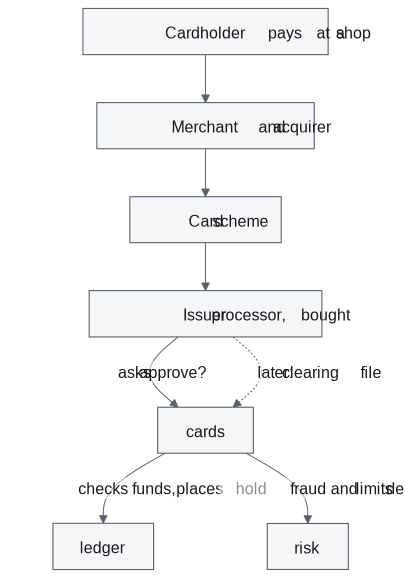
This section owns cards: the card record, authorisation, clearing, refunds, disputes, 3-D Secure and wallet tokens. A processor adapter inside cards is the only code that knows the processor's message names (Overview). cards depends on, but does not own, the book of record and the account service, ledger and accounts (Ledger and accounts); the risk check, risk (Fraud and limits); and the sign-in service, identity, which runs strong customer authentication (SCA) (Channels). It also depends on the messaging service comms and on treasury (Treasury). The hop budgets are given in the time budget table of the system map.
How it works
Authorisation: a request answered in real time
The processor receives the scheme's request and calls cards before deciding. Vendors call this relayed authorisation or just-in-time funding. It keeps the balance in the bank's ledger.
The processor supplies the card's token, the amount, the merchant's name, country and type of business, and how the card was used (chip, contactless or online). It does not send the card number; only the processor can convert the token back into one. Field names are given in the following sections. cards answers approve, decline with a stable reason code, or a partial approval. The checks run in a fixed order, cheapest first:
- Card state. Only an Active card proceeds.
- Card switches. The customer's own settings for online, contactless and cash use, kept in
cards. All money caps are held inrisk, except the fallback counter described below. - Funds. The available balance is read from
ledger: the posted balance minus open holds. - Risk.
riskdecides on fraud, money caps (per purchase, daily, monthly, cash) and account state. The account state includes a copy of any restriction owned byaccounts, such as a sanctions freeze. - Hold. The hold is placed in
ledger. Only this step changes any state.
risk answers allow, challenge, review or block. A purchase cannot wait for a person, so on a card the last three all result in a decline:
challenge: a soft decline, with a code requesting 3-D Secure or chip and PIN.review: a decline with a reason code, while a fraud review case opens in the case tool ofcompliance.block: a decline with a reason code.
Step 3 is a low-cost early decline. Step 5 is the authoritative check. The ledger refuses a hold that would reduce available funds below zero, and a hold on a debit-blocked account. It processes holds on one account sequentially, so two simultaneous purchases cannot spend the same funds.
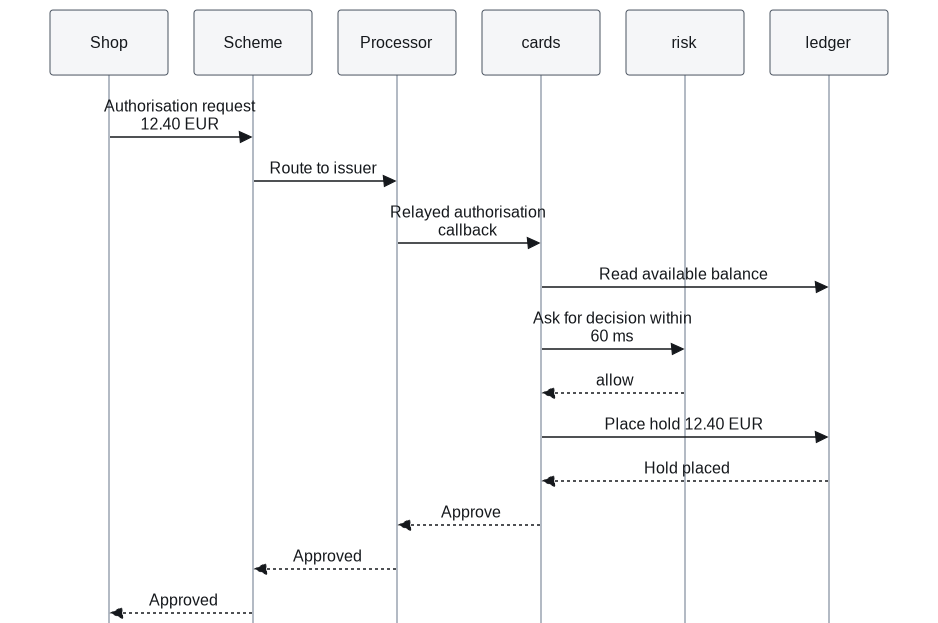
The diagram shows a purchase of EUR 12.40 in which every check passes.
The time budget
Published processor documentation allows two to three seconds for the issuer's answer: Marqeta declines the transaction if its funding request is not answered within three seconds (Marqeta[4]), and Adyen allows 2,000 ms and then applies a default approval or refusal chosen by the issuer (Adyen[5]). The limit of the selected processor is a contract term. The bank's target is well inside that period: 150 ms at the bank's edge and a hard stop at 300 ms. Both are internal engineering targets and are not prescribed by law. In the example, the request reaches the edge at 08:15:00.000:
- 08:15:00.020: network transit is complete and the callback is authenticated.
- 08:15:00.030: card state and switches are checked in the
cardsdatabase. - 08:15:00.050: the available balance is read.
- 08:15:00.090:
riskanswers, inside its 40 ms target (deadline 60 ms). - 08:15:00.120: the hold is placed and the answer is sent, leaving 30 ms of headroom before the 150 ms target.
If risk misses its deadline, a documented fallback applies. The bank approves up to the fallback amount (target EUR 30, to be tuned from data) if card state, card switches and funds passed; the ledger's debit block still applies at the hold. cards counts fallback approvals per card per day and declines beyond 3 (target).
An approval is never given without a hold. If cards or the ledger cannot place one, a technical error is returned and the processor's stand-in takes over.
An authorisation is a hold
Approval reserves money without moving it. ledger records a hold against the customer's account (a row in the hold table with kind card_authorisation, not a posting), and the available balance decreases immediately (Ledger and accounts). cards keeps one row per authorisation in card_authorisation, with columns auth_id, card_id, network_transaction_id, processor_event_id, state, amount_minor, currency, billing_amount_minor, mcc (merchant category code, four digits identifying the type of merchant), decline_reason, hold_id and expires_at. The callback also carries card_token, a wallet flag and the 3-D Secure result (illustrative names).
Hold identity. One purchase has one hold. The processor's event ID changes with every message about the same purchase (the first request, an increase, a reversal, a stand-in advice) and therefore cannot identify the hold. cards locates the authorisation by network_transaction_id, the scheme's reference for the purchase, together with the card. Two guards prevent a repeated callback from creating a second authorisation:
- A unique constraint on (
card_id,network_transaction_id) and onprocessor_event_id. The insert acts as the lock: when two copies arrive together, the second reads the row created by the first. - A message without a network transaction ID (some advices, ATM and offline transactions) is matched by the processor's own authorisation reference, which the contract must guarantee.
Ledger lines are booked under card:<auth_id>/<leg>. A step that can occur more than once carries its own message ID in the leg, so that a repeat books nothing twice:
| Ledger key | Used for |
|---|---|
card:<auth_id>/hold | First approval |
card:<auth_id>/adjust/<processor_event_id> | Increase, reversal or stand-in advice |
card:<auth_id>/capture/<clearing_line_id> | Each clearing line |
card:<auth_id>/release | Releasing the rest of the hold |
card:<refund clearing line id>/refund | Refund from the merchant |
The diagram shows the states of an authorisation. The state Declined always carries a reason code.
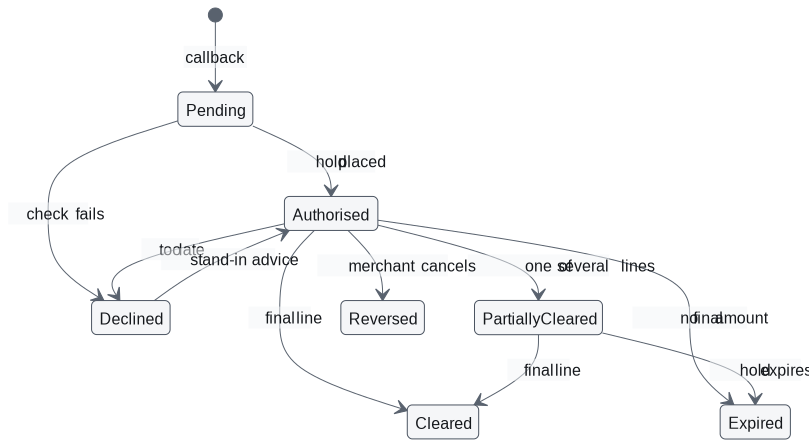
- Incremental authorisation. When a hotel adds a night, the increase passes through the same five steps and adjusts the open hold. A reversal releases or reduces the hold.
- Expiry. A hold lasts a target of 7 days, or 30 days for lodging, vehicle rental, cruises and estimated amounts. Both periods are settings of
cardsper merchant category, and they are aligned with the authorisation validity periods of the selected scheme at scheme onboarding (see Assumptions and dependencies). The expiry job releases only holds of kindcard_authorisation. - Late or declined answers. If the processor reports that the bank's answer arrived too late, or that it declined, the bank releases its hold immediately, unless a stand-in advice for that purchase has already been applied. An advice that arrives after the release places a forced hold.
Clearing and settlement
After the purchase the acquirer sends the final amount through the scheme, and the processor delivers a clearing file. Its format and frequency are set by the processor and are known only to the processor adapter; the design assumes at least one file on each scheme settlement day. For each line cards performs the following steps:
- Matching. The line is matched to an authorisation by network transaction ID and card.
- Capture. A line marked final, or without a multiple-clearing indicator, captures the cleared amount and releases the remainder. A line marked as one of several, as a hotel may send, captures only; the remainder stays held, and the authorisation remains Partially cleared, until the hold expires.
- Excess. The part of a capture above the hold, such as a tip, is booked as a
forced_debitwith reasonover_capture. A forced debit is a ledger entry that may take an ordinary account below zero, with a reason code and an alert. - Clearing without authorisation. A line with no matching or live hold is booked in full as a
forced_debit. The scheme collects from the bank regardless, so the bank records the debt and opens a review item. - Large over-capture. A cleared amount more than 20% above the authorised one goes to a review queue, where the review decides whether to dispute.
Example: a restaurant authorises EUR 40.00 and the cleared bill, including a tip, is EUR 49.00. cards captures EUR 40.00 and books the other EUR 9.00 as an over_capture forced debit. The cleared amount is 22.5% above the authorised amount, which exceeds the 20% threshold, so a review item opens. The customer sees the full EUR 49.00.
Settlement is the movement of funds between banks. treasury compares scheme settlement reports with the clearing files and raises a break, a difference requiring explanation, on any mismatch. A refund is a separate credit sent by the merchant. It books money back and does not reopen the original hold.
Purchases in another currency
The card is denominated in the base currency of the profile at launch: euro under the Lithuanian profile and sterling under the UK profile. For an online payment of USD 20.00, the bank holds an estimated euro amount plus the expected foreign-exchange (FX) fee. At clearing, the scheme's conversion yields the final euro amount. Two lines are booked: the purchase, and the bank's FX fee, which is a product setting expressed as a single percentage mark-up. The product owner sets its level before the friends and family stage, and a change of level requires no software release.
Under the Lithuanian profile, Article 4 of Regulation (EU) 2021/1230 requires the bank to express its total currency conversion charges as a percentage mark-up over the latest euro foreign exchange reference rate of the European Central Bank and to publish that mark-up. The bank must also send the cardholder an electronic message stating the mark-up without undue delay after it receives a payment order for a cash withdrawal or a point-of-sale payment in another Union currency, once in each month in which such an order is received in that currency, and must offer an opt-out (Regulation (EU) 2021/1230[6]). cards computes the mark-up when the authorisation is approved, comms sends the message as a push notification, and the fee page of the app publishes the mark-up. Under the UK profile the bank applies the same disclosure as its own standard; its sufficiency under UK law is an assumption listed below.
Stand-in: authorisation when the bank cannot answer
A declined card at the point of sale reduces customer trust. When the bank is unavailable or too slow, the processor therefore runs stand-in: it decides on the bank's behalf within limits set in advance and sends an advice for each decision (for example, an approval of EUR 12.40 for a given card on the bank's behalf). Processors document the pattern (Marqeta[4]). Monzo applies its advices afterwards without re-deciding (Monzo[9]), which is the booking rule adopted here.
- Limits.
riskholds the stand-in limits per card (a per-purchase maximum, a daily total, excluded categories such as cash), and the processor adapter incardspushes them to the processor. Initial targets are EUR 100 per purchase and EUR 200 per day, so the worst-case loss is about the number of active cards times EUR 200. - Stopped cards and accounts. The adapter pushes immediately every restriction that blocks debits, and every card state other than Active, as a card status at the processor (suspended or closed). Stand-in declines any card that is not Active there. Each push is acknowledged; an unacknowledged push sections the card desk.
- Booking advices. An advice enters Authorised directly, as a forced hold that may take the account below zero, with a reason code and an alert. If the bank already holds that purchase, the advice adjusts that hold. Funds, limits and risk are not checked again, because the merchant has already received an approval. An advice for a restricted account is booked and raises a
compliancealert. - Negative balance. If an advice overdraws the account,
accountsruns its unarranged negative balance process, with the standard customer message. Inemimode the resulting balance is recorded as a receivable of the institution and covered from its own funds on the same business day, with no interest or fee, as decided in Licence and regulation (D01.2).
Online payments, wallets and the card lifecycle
3-D Secure and strong customer authentication
For online purchases the merchant initiates 3-D Secure, the scheme's protocol for confirming that the cardholder is present. The processor runs the access control server, the component that answers on the issuer's behalf, and asks cards what to do. cards asks risk whether an exemption applies, in a separate call with a target of 100 ms.
- Frictionless: no second check. Under the Lithuanian profile the regulation permits this for small online payments (EUR 30 each, with running-total limits) and for payments assessed as low risk (Delegated Regulation 2018/389[2]).
riskdecides each case and keeps the counters;identityenforces;cardsrelays the answer. - Challenge:
cardsrequests SCA fromidentityin the app. The customer receives a push notification showing the merchant and amount and confirms with fingerprint or face, which represent possession (the bound phone) and inherence. The signed result is tied to that amount and merchant, which the regulation terms "dynamic linking".cardsreturns it to the processor.
Under the Lithuanian profile, Phase 1 uses the following exemptions and no others:
- recurring payments, for standing orders;
- online, the two above: small payments and low risk;
- at the terminal, contactless: up to EUR 50 per tap, until the running total reaches EUR 150 or five taps (Art 11[2]). The authoritative counters are kept in
risk, which counts the taps authorised since the last application of SCA and resets them on a chip and PIN purchase. The chip of the card is personalised with the same limits, so that the card requests a PIN when its own counters are reached. Cost: the two sets of counters can diverge, in which case the stricter one applies and the customer is asked for a PIN earlier than the regulation requires.
Under the UK profile the same three exemption types are used. Chapter 3 of the FCA's technical standards for strong customer authentication, which lists the exemptions in Articles 10 to 18, contains recurring transactions (Article 14), low-value remote transactions (Article 16) and transaction risk analysis (Article 18) (FCA technical standards, Chapter 3[12]; SCA itself is described in 09). Article 16 permits a remote payment of up to GBP 25 without SCA, provided that the cumulative amount since the last application of SCA does not exceed GBP 85 or that the number of such payments does not exceed five. The monetary bands of the Article 18 exemption are set in the Appendix to the standards and are held as risk parameters. From 19 March 2026 instrument FCA 2025/62 removed the regulatory contactless limits (GBP 100 per tap, GBP 300 or five taps cumulative) and added an exemption for contactless payments that the provider identifies as posing a low level of risk, subject to compliance with the transaction-monitoring requirements of Article 2 of the standards (FCA Handbook Notice 136[14], paragraphs 2.41 to 2.42 and 3.73 to 3.77). The FCA expected most providers to keep their existing limits in the short term. The bank starts at GBP 100 per tap (target), held as a risk parameter; because no regulatory cumulative limit remains, any cumulative counter is the bank's own control in risk.
The app is the only challenge method, and no SMS one-time code is offered as a fallback, consistent with D09.3 in Channels. Cost: an online purchase that requires a challenge is declined while the customer's bound device is unavailable. The time allowed for a challenge is set by the processor's access control server, and the SCA request in identity is configured to expire within it.
Wallets and network tokens
Apple Pay and Google Pay store a network token, a substitute number issued by the scheme's token service that is valid only on the customer's phone. To add the card, the app asks cards, which obtains an encrypted payload for the wallet from the processor. The customer's SCA in the bank's app serves as the wallet's step-up check. At authorisation cards maps the token to the card, so that a frozen card also blocks wallet payments. When a card is replaced, the design assumes that the scheme's token service links the existing wallet tokens to the new card number, so that the wallet continues to work without action by the customer (see Assumptions and dependencies).
The card lifecycle
The card is an explicit state machine in the cards database, advanced by the durable job runner (Platform and data). In the diagram, Live groups the three states from which a card can move to Blocked, Expired or Closed.
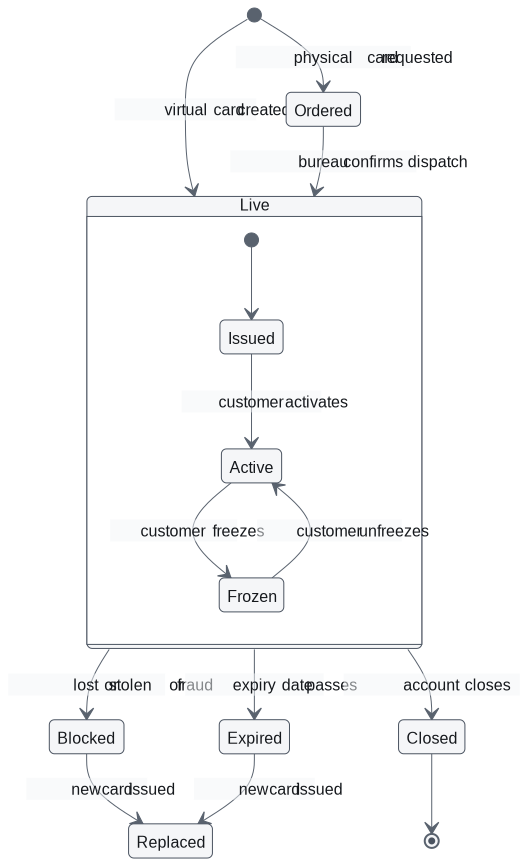
Only Active cards pass step 1. Frozen is set by the customer and is immediate and reversible. Blocked, which also covers a card lost in the post, is irreversible by design, because a compromised number must not return to use. Closed is final and keeps closed accounts out of lost-and-stolen figures.
A bank-side stop of a whole account (sanctions, seizure, death) is an account restriction owned by accounts and read in steps 3 and 4. Stand-in receives it through the push described above. A customer who has lost the phone can still block a card through the lost-or-stolen line described in Channels.
PIN, card details and PCI scope
The customer sets or views the PIN, and views the full card number and security code, only through the processor's secure component inside the bank's app. The customer completes SCA in identity, cards then requests a short-lived single-use session from the processor, and the component communicates with the processor directly. The bank's services learn only that a PIN was set or that details were shown. The bank stores a token, the last four digits and the expiry month. PIN handling is performed solely by the processor and its component, and the processor contract requires current attestations of compliance with PCI DSS and with the scheme's PIN security requirements, renewed annually.
PCI DSS, the Payment Card Industry Data Security Standard, applies to every system that stores, processes or transmits card data. Version 4.0.1[1] is the only active version. In scope are the processor's systems and, to a limited extent, the app's secure component. Out of scope by design are cards, ledger, logs, backups, the warehouse and support tools. PCI DSS requires an expiry date to be protected where it is stored, processed or transmitted with the card number or is otherwise present in the cardholder data environment (PCI SSC FAQ 1222[7]); the bank's services hold no card number. Two controls maintain this position:
- The processor contract requires callbacks and files that contain no full card numbers.
- A filter,
Pan_guard, checks every log line, event and free-text field. It blocks any value resembling a card number: 13 to 19 digits that pass the standard card-number check (the Luhn check).
The bank remains obliged to provide an attestation. A qualified security assessor confirms the applicable self-assessment questionnaire and the out-of-scope treatment of the stored token, last four digits and expiry month before the friends and family stage (see Assumptions and dependencies).
Manufacturing and delivery
For a physical card, cards sends the processor an order with the name and address from the customer records service, customers (see Privacy). The printing partner posts the card. It arrives in state Issued and cannot be used for payment. The customer activates it in the app after SCA and sets the PIN there, so no PIN letter is printed.
Disputes and chargebacks
A chargeback is the scheme procedure by which an issuer recovers a card payment from the acquirer. A customer may dispute a payment that the customer did not make or a double charge. Under the Lithuanian profile the EU payment services directive, PSD2, sets three rules (Directive 2015/2366[3]):
- The bank refunds an unauthorised payment by the end of the next business day. The exception applies where the bank has reasonable grounds to suspect fraud by the customer and reports them in writing to the authority (Art 73).
- The payer's own loss is capped at EUR 50, except in cases of fraud or gross negligence (Art 74).
- The customer has 13 months to notify the bank (Art 71).
Under the UK profile the Payment Services Regulations 2017 cap the payer's loss at GBP 35 for a lost, stolen or misappropriated instrument; the payer bears nothing where the loss could not have been detected beforehand, after notifying the bank, or where the bank did not require strong customer authentication when regulation 100 required it; and the payer bears all losses only when acting fraudulently or failing with intent or gross negligence to keep the instrument safe (regulation 77[18]). The bank must refund an unauthorised payment by the end of the business day after it becomes aware of it, unless it has reasonable grounds to suspect fraud by the customer and notifies the authority (regulation 76[18]), and the customer must notify without undue delay and within 13 months of the debit date (regulation 74[18]).
For unauthorised payments the bank therefore credits the customer first and pursues recovery afterwards. The diagram follows a dispute from the customer's report to its end.
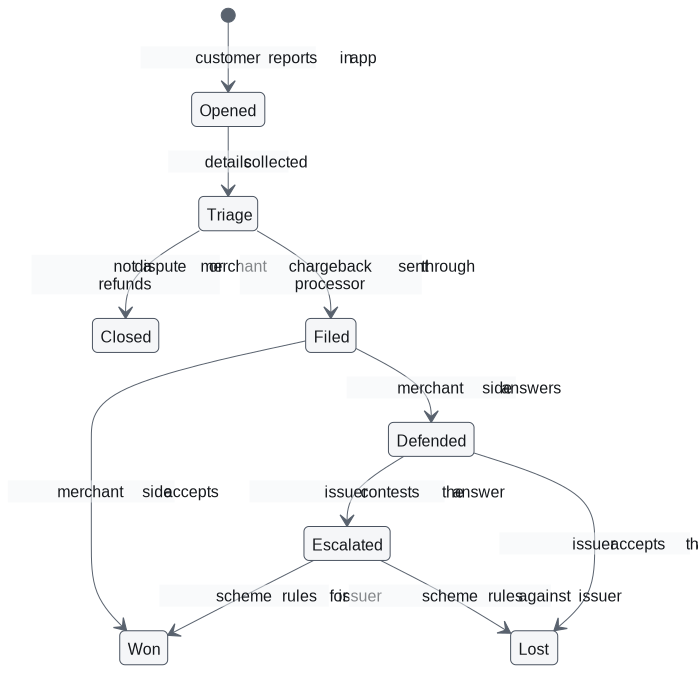
Each dispute record links the clearing line, the scheme's reason code, the state, the current deadline and the ledger entry of any provisional credit. A job-runner timer advances the case, or raises an alert, at each deadline. The deadlines are held as configuration per scheme and reason code and are loaded from the rules of the selected scheme at scheme onboarding. A support agent works disputes in the back-office console.
The effect of each end state on the customer's balance is as follows:
- Won: the acquirer's funds settle the provisional credit. The customer's balance does not change.
- Lost, payment unauthorised: the bank books the loss to an operational-loss account and the customer retains the refund.
- Lost, customer found liable (fraud or gross negligence, decided by a fraud analyst with four-eyes approval): the provisional credit is reversed with notice to the customer. The customer terms state that a provisional credit may be reversed where the investigation establishes fraud or gross negligence by the customer, and the notice gives the reasons and the complaint route (Running the bank). Residual risk: a reversal can take the account below zero, in which case the unarranged negative balance process applies.
United Kingdom profile
| Aspect | Lithuanian profile | UK profile |
|---|---|---|
| Card currency | EUR | GBP |
| Contactless exemption | EUR 50 per tap, EUR 150 or five taps cumulative | Risk-based exemption since 19 March 2026; no regulatory limit; the FCA expected most firms to keep GBP 100 |
| Payer's loss for an unauthorised payment | Capped at EUR 50 | At most GBP 35 for a lost, stolen or misappropriated instrument; nil where the bank did not require strong customer authentication |
| Refund of an unauthorised payment | End of the next business day; notification within 13 months | End of the business day after the bank becomes aware; notification within 13 months of the debit date |
| Consumer interchange caps | 0.2% debit and prepaid, 0.3% credit (Regulation (EU) 2015/751[17]) | The same caps for UK domestic transactions; no cap in force for UK to EEA card-not-present transactions |
| Scheme access | Principal membership of one scheme under the specialised bank licence (planning assumption), with a BIN sponsor as fallback and on the EMI route; settlement in euro | Principal membership of one scheme under bank (planning assumption), with a BIN sponsor as fallback; settlement in sterling through a settlement bank |
The issuer processor model, relayed authorisation, holds, clearing, stand-in, tokenisation and PCI scope are identical in both profiles. The UK interchange caps apply to domestic consumer cards (Payment Systems Regulator[10]); for card-not-present purchases between the UK and the EEA the schemes raised consumer rates from 0.2% and 0.3% to 1.15% (debit) and 1.5% (credit); the Payment Systems Regulator has decided that a price cap on these fees for EEA-issued cards at UK merchants is the remedy and is setting its level, having dropped an interim cap in October 2025, so no cap is in force at the date of this document (Payment Systems Regulator[11]). That review concerns fees paid by UK acquirers on EEA-issued cards and does not determine what a UK issuer earns.
Issuing requires principal membership of the scheme or sponsorship by a BIN sponsor, a scheme member that issues under its own bank identification number on another firm's behalf, and a non-settling member settles with the scheme indirectly (Bank of England[19]). Under bank the planning assumption is principal membership of one scheme, applied for during mobilisation, with scheme collateral to be included in the capital plan (Delivery plan); a BIN sponsor is the fallback for the friends and family stage if membership is not complete. The admission criteria and the collateral of the selected scheme are confirmed at scheme onboarding (see Assumptions and dependencies). Cost: principal membership requires the authorisation and collateral sized on forecast volume, whereas a BIN sponsor adds a further sponsor dependency and its own onboarding of the programme. Scheme settlement is in sterling through a settlement bank, which may be the Faster Payments sponsor, and follows the scheme's UK settlement calendar; cash withdrawal uses the scheme's ATM network. Regulation 100 of the Payment Services Regulations 2017 requires strong customer authentication with dynamic linking to a specific amount and payee for an electronic remote payment (regulation 100[13]); the 3-D Secure flow described above provides it. Section 75 of the Consumer Credit Act 1974 applies only to credit cards and therefore not to the Phase 1 debit card; debit disputes rely on the scheme chargeback rules.
Key design decisions
D05.1 Buy issuer processing, own the decision
Decision: Issuer processing, scheme connectivity, card-number custody, PIN and card-data security, token services and printing are procured. The authorisation decision, card state, clearing and disputes are retained in cards.
Rationale: Scheme connectivity requires certified connections, security hardware and a card-data audit. The decision requires the bank's balance and fraud signals.
Alternative considered: A processor with a pre-funded balance that decides alone. This is simpler, but the same money would be held in two books and the bank's risk decision would go unused.
Cost: Every purchase depends on a timely answer from the bank, and the processor can raise prices or withdraw. Replacing it requires re-issuing cards.
D05.2 Authorisation equals ledger hold
Decision: Every approval is a hold in ledger. No approval is given without one.
Rationale: The ledger is the single book of money. A hold corrects the available balance for every channel at once, including transfers.
Alternative considered: Reservations kept in cards and combined with ledger balances on read, which would require every service that reads a balance to know about cards.
Cost: The hold must fit within the 150 ms target. The ledger must carry the year-three peak target of 200 money-path requests per second in total (payments and card authorisations), about 1,000 posting rows per second.
D05.3 Stand-in limits and advice booking
Decision: The processor's stand-in decides within per-card limits pushed to it by the bank. Each advice is booked as Authorised without a further decision.
Rationale: Card acceptance must survive outages of the bank's systems (the availability target in the Overview). Re-deciding a case in which the merchant has already received an approval would create a debt without an explanation for the customer.
Alternative considered: Declining every request while the bank is unavailable. This is safe for the bank but strands customers at the point of sale.
Cost: Bounded but real fraud and overdraft exposure while stand-in is active. Every restriction must reach the processor immediately, otherwise stand-in could approve a frozen account.
D05.4 Card numbers and PINs are not stored in the bank's services
Decision: The bank's services hold tokens, last four digits and an expiry month. Numbers, security codes and PINs remain with the processor and its secure components.
Rationale: This keeps PCI scope small and keeps the most valuable data out of any system the bank could lose.
Alternative considered: A card-data vault operated by the bank, which would remove the dependency on the processor's display component but would bring the bank's own services into PCI scope.
Cost: Displaying a card requires that component. If it fails, card display fails but payments continue.
D05.5 One scheme at launch
Decision: The bank launches on one international card scheme, chosen together with the processor at the supplier contract. The card carries that scheme's brand alone, without co-badging. Under both profiles the planning assumption for a licensed bank is principal membership of that scheme, with a BIN sponsor as the fallback; on the EMI route the card is issued through a BIN sponsor, which holds the scheme settlement account.
Rationale: Each scheme adds certification, dispute rules and fees. A second scheme added later requires configuration and tests.
Alternative considered: Two schemes from the first day, which doubles that work before customer demand is known.
Cost: A merchant that does not accept the chosen scheme cannot be paid with the card. The design is neutral between the two international schemes, because scheme-specific message names are confined to the processor adapter.
D05.6 Virtual card first, physical on request
Decision: Every account receives a virtual card, active after the customer's first SCA in the app, with which onboarding ends. A physical card is produced only on request.
Rationale: A virtual card has negligible cost and works online and in wallets. It avoids printing cards that are never used.
Alternative considered: A physical card for every customer, which entails printing and posting cards that many customers never use.
Cost: Customers who want a plastic card or cash from an ATM wait several days for delivery.
Failure modes and mitigations
| Failure | Effect | Response |
|---|---|---|
cards or ledger unreachable | Purchases fail | Technical error; stand-in decides within the bank's limits; advices booked later |
| Answer from the bank is late | Processor ignores it | Processor configured to pass a timed-out request to stand-in (contract term); hold released unless an advice was already applied |
risk misses its deadline | Slower decision | Documented fallback, small amounts only, counted per card |
| Restriction not yet pushed to processor | Stand-in approves a frozen account | Push on restriction, acknowledged; alert |
| Clearing without hold | Unplanned debit | Forced debit with reason code, alert, review item |
| Advice overdraws account | Negative balance | Unarranged negative balance process, customer message |
| Processor outage | No card service | Scheme stand-in where it applies, status message in app |
| Card number in a log | PCI scope grows | Pan_guard, scheduled scans, incident process |
| Chargeback deadline missed | Right lost | Timers per state, alerts before deadline |
Staffing of the card desk, the rota and the daily checks are described in Running the bank.
Security and privacy considerations
- The callback is received over mutual TLS (both parties present certificates), and its signature is verified on the raw bytes before parsing (Security).
- Logs and events carry the token and never the card number.
Phasing
- Phase 1: one scheme, virtual card, physical card on request, Apple Pay and Google Pay, 3-D Secure with the app, holds, clearing, refunds, stand-in, FX with a fee, and disputes with manual steps performed by support staff. If Phase 1 slips, the wallets and then card FX move to Phase 1b, after public launch (Delivery plan).
- Phase 2: business cards for several users with per-user limits, authorisation against an overdraft, multi-currency cards, and a second scheme if required.
- Phase 3: card programmes for partners, and additional scheme functions in-house when volume justifies it (Delivery plan).
Assumptions and dependencies
The design in this section rests on the following assumptions, each confirmed at the stated point. None blocks the start of the build, because the processor adapter in cards and the settings named below isolate each of them.
| Assumption | Confirmed by | When | If it does not hold |
|---|---|---|---|
| The processor allows at least the 300 ms hard stop for the bank's answer, passes a timed-out request to stand-in, and supplies its own stable authorisation reference on every message that lacks a network transaction ID. | The processor | Supplier contract | If a timeout is declined instead, stand-in covers only outages of the bank that the processor detects, and a late answer is a decline. Without a stable reference, the adapter matches such messages on card, amount, merchant and time and sends unmatched ones to the review queue. |
The processor delivers a clearing file on each scheme settlement day, its access control server allows the SCA challenge enough time for an approval in the app, and the response time it sets for the 3-D Secure exemption call is no shorter than the 100 ms target of risk. | The processor | Supplier contract | The clearing job schedule and the expiry setting of the SCA request in identity change; where the exemption call cannot be answered in time, no exemption is requested and the purchase is challenged. No other block changes. |
| The authorisation validity periods and the dispute deadlines of the selected scheme are compatible with the configured values (holds of 7 and 30 days; one timer per dispute state). | The card scheme, through the processor | Scheme onboarding | The settings in cards change without a software release. A shorter validity period increases clearings without a live hold, which are booked as forced debits. |
| The scheme's token service links existing wallet tokens to a replacement card, and the scheme offers stand-in processing when the processor is unavailable. | The card scheme and the processor | Scheme onboarding | Customers add the replacement card to the wallet again, prompted by comms. Without scheme stand-in, a processor outage declines every purchase, and card availability depends on the service level in the processor contract. |
| The bank's own services remain outside PCI DSS scope while they hold a token, the last four digits and an expiry month without the card number, and the attestation is given on the self-assessment questionnaire that the assessor designates. | A qualified security assessor | Before friends and family | The expiry month is removed from the cards database and read from the processor on demand; any additional assessment work is completed within the cost envelope of section 13. |
| The selected scheme admits the bank as a principal member in time for public launch. | The card scheme | Scheme onboarding | A BIN sponsor issues the cards and holds the scheme settlement account; treasury reconciles against the sponsor's reports, and the sponsor's onboarding of the programme is added to the plan. |
| UK profile: the scheme collateral fits the capital plan, and a settlement bank, which may be the Faster Payments sponsor, provides sterling scheme settlement. | The card scheme and the settlement bank | Scheme onboarding | The capital plan in section 13 is revised, or the BIN sponsor fallback of the previous row applies beyond the friends and family stage. |
| UK profile: the currency conversion disclosure applied under the Lithuanian profile also satisfies the UK requirements. | Counsel | Before public launch | The message template in comms and the fee page change; cards already computes the mark-up for each purchase. |
Sources
- PCI DSS v4.0.1 announcement
- Delegated Regulation (EU) 2018/389, SCA
- Directive (EU) 2015/2366, PSD2
- Marqeta, just-in-time funding and timeouts
- Adyen issuing, relayed authorisation
- Regulation (EU) 2021/1230, cross-border payments, Article 4
- PCI SSC FAQ 1222, protection of cardholder data other than the card number
- Mastercard Gateway, 3-D Secure (search summary only)
- Monzo, processing payments in stand-in
- Payment Systems Regulator, Interchange Fee Regulation
- Payment Systems Regulator, cross-border interchange fees
- FCA technical standards on strong customer authentication, Chapter 3, exemptions
- Payment Services Regulations 2017, regulation 100
- FCA Handbook Notice 136, contactless exemption
- Instrument FCA 2025/62
- FCA, contactless limits
- Regulation (EU) 2015/751, Interchange Fee Regulation
- Payment Services Regulations 2017, regulation 74, regulation 76 and regulation 77
- Bank of England, access to UK payment systems for non-bank payment service providers
- Consumer Credit Act 1974, section 75
The hold periods, decision order, fallback amounts and the 20% review threshold are engineering choices carried over from earlier internal experiments. They are not sourced facts.