06. Knowing the customer: onboarding, screening and anti-money-laundering
Purpose and scope
An account in the wrong hands can be used to move stolen funds or to pay a person subject to financial sanctions. The law therefore imposes two obligations on every bank. The first is KYC (customer identification and due diligence): the bank verifies the identity of a customer before providing service. The second is AML (anti-money-laundering): the bank monitors the account afterwards and reports activity that appears irregular.
For each customer, the bank must:
- Verify that the person opening the account is the person named in the application.
- Screen the customer against sanctions lists and determine whether the customer is a politically exposed person (PEP), that is, a person with a prominent public function, or a family member or close associate of such a person.
- Assess the risk of the relationship and apply additional questions and closer monitoring where the risk is higher.
- Monitor the account. If, for example, an account receives funds from forty unrelated senders and transfers them abroad within an hour, an analyst must review the activity and, where it is suspicious, report it to the financial intelligence unit. Under the Lithuanian profile this is the FCIS, the Financial Crime Investigation Service; under the UK profile it is the National Crime Agency.
The bank must not inform a customer that a report has been made or is being considered. This prohibition is called tipping-off.
A bank that applies the controls too leniently risks its licence. A bank that applies them too strictly blocks legitimate customers and overloads a small compliance team with false alerts. Analyst workload is therefore a design constraint.
Components
This section covers four blocks:
| Block | Description |
|---|---|
customers | The customer record and the only store of the bank's customers' personal data (see Privacy) |
onboarding | The sign-up flow, the identity and business checks, and the customer risk rating |
screening | Matching of names against sanctions, PEP and adverse-media lists, and review of each possible match |
compliance | Transaction monitoring, alerts, the single case tool, reports to the financial intelligence unit, and the retention schedule |
The main tables in customers are:
| Table | Holds |
|---|---|
customers | customer_id, kind (person or business), status, risk_band (a copy from onboarding), next_review_due |
persons | Encrypted name, date of birth, nationalities, residence, legal_capacity (adult, minor, under_guardianship), deceased_at |
tax_status | customer_id, country, tin (tax number), self_certified_at, valid; a change of residence marks it needs_recertification |
businesses, related_parties | Phase 2: company data and the owners and directors of the company |
Phase 1 serves adult customers only. The columns for minors, guardians and deceased customers exist from the first release, so that adding these cases later does not require a schema redesign.
screening maintains an index of every customer's name to support daily rescreening. The index holds only normalised name fragments, encrypted under a vault key. It is rebuilt from customers by API and not from events.
The diagram shows these blocks and the external parties with which they interact.
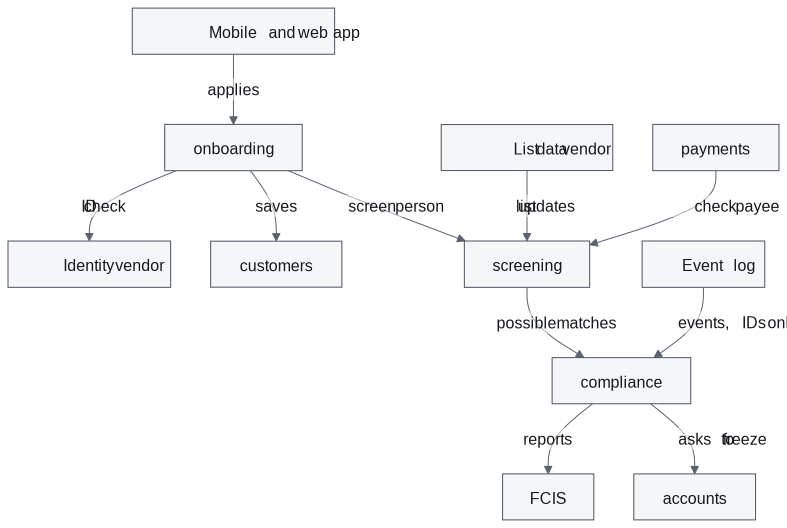
The diagram shows the Lithuanian profile; under the UK profile compliance reports to the National Crime Agency in place of the FCIS.
How it works
Onboarding sequence
Each application is stored as a record with a named step and a log of every transition, and a job runner advances it (Overview, point 8). A customer who abandons the flow during the selfie capture and returns two days later therefore resumes at the step reached.
The state diagram shows the life of one application. Identity images of abandoned applications are deleted under the retention schedule.
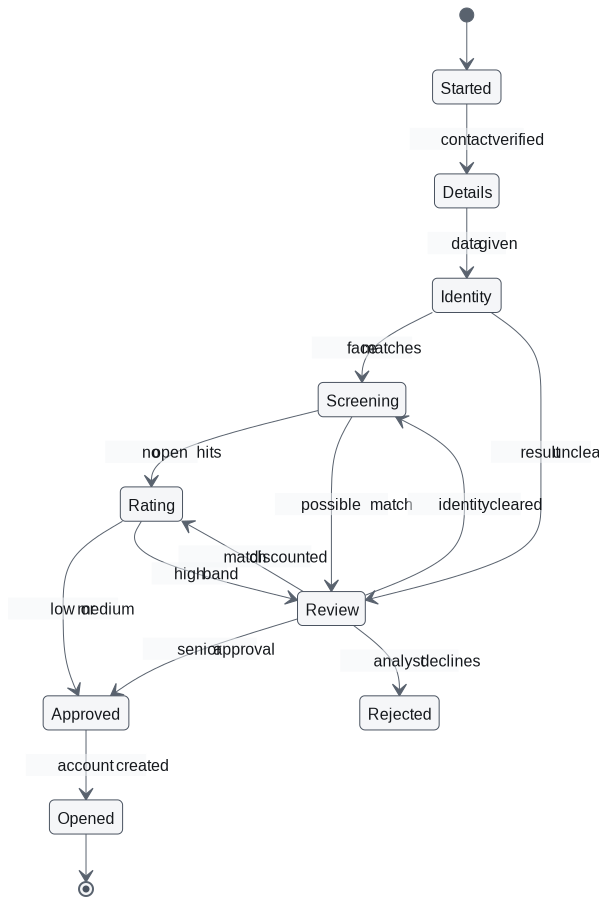
An application that is inactive for 30 days in Started, Details, Identity or Review becomes Abandoned and is closed.
In bank mode under the Lithuanian profile, an application for a payment account with basic features is decided within 10 business days and is declined only on the grounds of Directive 2014/92/EU Art 16(4) to (6); the analyst records the ground on the case, and the permitted grounds are a list held per licence mode (Licence and regulation).
In Details, the customer provides an address, tax residence, occupation, the purpose of the account and the approximate monthly volume expected to pass through it. Monitoring later compares actual activity with this expected activity.
In Identity, the vendor checks photographs of the identity card and a selfie video. Three properties are verified: that the document is genuine, that the face matches the document, and that a live person is present in front of the camera (the liveness check).
On approval, accounts opens the account and issues the account identifier, an IBAN under the Lithuanian profile and a sort code and account number under the UK profile (Ledger and accounts). customers then publishes a CustomerOnboarded event that carries only the customer's ID.
The sequence diagram shows the identity step with the vendor. A webhook is a message that the vendor sends to the bank's system when its work is complete.
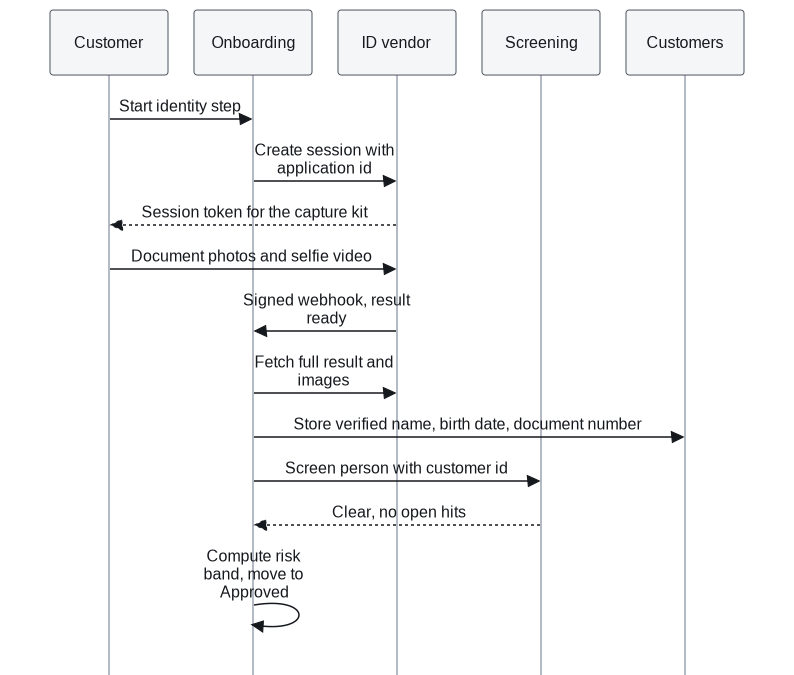
onboarding retrieves the result directly from the vendor, so that a forged webhook cannot approve an application. The vendor returns signals, and a versioned policy in onboarding converts them into the outcomes pass, refer or fail.
The evidence bundle comprises the document images, the selfie and liveness video, the vendor's verdict and the liveness result. It is stored in object storage, encrypted with a key per customer, so that destroying the key erases the bundle. Its hash is recorded in audit. The whole bundle is retained for the AML period, and the face template is deleted 30 days after the decision (Privacy, D12.7).
Established position (as reported). A 2016 law-firm note (Sorainen[5]) states that Lithuania then permitted remote identification by qualified electronic signature, by an EU electronic identification means of substantial or high assurance, or by live video. A 2020 note (Ecovis[6]) states that biometric identification requires explicit consent and a non-biometric alternative.
Assumed position (unconfirmed). The launch design assumes that identification by a document combined with a liveness check, performed through the procured identity vendor, is an accepted remote method under current Lithuanian rules. The status of Smart-ID and Mobile-ID, the national electronic identity services, as identification means for onboarding is not relied on at launch. Both points are listed under Assumptions and dependencies.
Design response. Each identification method is implemented as an adapter, so that no single method is assumed. If the document and liveness method is not accepted on its own, an adapter for a qualified electronic signature or a national electronic identity service moves from Phase 2 into Phase 1. An applicant who declines consent to the creation of a face template is identified by a route that creates none, in which an analyst compares the selfie with the document image in Review; the lawful basis and the cost of this route are stated in Privacy. Under the Lithuanian profile, banks must accept the EU digital identity wallet on request within 36 months of the implementing acts (eIDAS 2, Art 5f(2)[3]); it will be an additional adapter.
onboarding also holds a daily cap on new applications, which compliance lowers when its queue falls behind.
Onboarding of a business (Phase 2)
When a company applies in Phase 2, three steps precede Screening. The registers named below are those of the Lithuanian profile.
- Company data from the Register of Legal Entities: name, legal form, status, directors and activity code.
- Beneficial owners, the natural persons who ultimately own or control the company. Companies have filed them since 1 August 2022 in JANGIS, the beneficial-owner sub-register of the Centre of Registers, which banks consult during business due diligence (as reported). JANGIS data is compared with the applicant's declaration, and a difference becomes a review task.
- Related persons. Each owner and director is screened, and those who will use the app also pass the identity check. They are stored in
related_partieswith aroleand asource(registry,jangisorcustomer_declared).
The band of a company is never lower than the highest band among its related persons. A PEP owner therefore places the company in the High band.
Customer risk rating
The rating is a score from 0 to 100 derived from recorded factors:
- customer type, residence and nationality;
- occupation or business activity, product and expected volume;
- remote-only sign-up;
- PEP status and adverse media;
- ownership complexity.
The initial cut-offs are Low 0 to 29, Medium 30 to 59 and High 60 to 100. They are set by the compliance officer and are not prescribed by law. The cut-offs, review intervals and scenario parameters stated in this section are the launch configuration: each value is versioned, and its approval by the money laundering reporting officer is recorded before the friends and family stage and again on every later change. Under the Lithuanian profile, a PEP, residence in an EU-listed high-risk third country, or confirmed adverse media places the customer in the High band. The UK profile sets these overrides differently (see United Kingdom profile below).
The table shows the effect of each band. All values are targets and are held as configuration.
| Band | Payment limits | Periodic review | Due diligence |
|---|---|---|---|
| Low | Standard | Every 5 years or on a trigger | Standard |
| Medium | Standard | Every 3 years or on a trigger | Source of funds above a threshold |
| High | Lower until reviewed | Every year | Enhanced: source of wealth and funds, senior approval |
The limits are held in risk (Fraud, limits and credit risk), which reads the band. PEPs require enhanced due diligence with senior-management approval and evidence of the origin of their wealth (as reported by Sumsub[7]). The approval is a four-eyes step in the console, which requires the agreement of two different persons.
onboarding keeps the rating history in risk_assessments. customers holds a read-only copy of the current band, built from onboarding events.
Each rating is stored with the contributing factors and points, the version of the scoring rules, and any manual override with its reason and approver. An override is stored beside the computed band, so that the basis of any band can be reconstructed from the record.
A new scoring rule is introduced as a new version and is run over every customer before it is activated. Reviews are jobs driven by the next_review_due date, and a material increase in volume brings a review forward.
Screening
screening holds procured list data: the sanctions lists of the profile (EU and UN under the Lithuanian profile; the UK Sanctions List and UN under the UK profile), other lists adopted by policy, and PEP and adverse-media records. A single name may appear in several forms, for example without diacritics, transliterated from Cyrillic, or with the name parts reordered.
The engine normalises names (it removes accents, transliterates and sorts the parts), scores the similarity of two names and adjusts the score for date of birth and nationality. Thresholds for each list are versioned data.
Each possible match is a hit, which is in state Open, UnderReview, Escalated, Discounted or Confirmed. Discounting a hit means determining that it concerns a different person. One analyst proposes the discount and a second analyst confirms it. Onboarding cannot approve an application while a hit is open. A discount is stored against the version of the list entry, so that the same false match does not recur every night.
Daily rescreening of the bank's customers is a legal requirement. Under the Lithuanian profile, a provider offering instant transfers must check its customers against EU sanctions immediately after new measures take effect and at least once every calendar day (Instant Payments Regulation, Art 5d[1]). A list update triggers a rescreen of all customers against the changed entries, and a full nightly run provides a backstop.
Instant payments are not screened individually. Under the Lithuanian profile, the law prohibits an additional sanctions check on the payment itself beyond the rescreening described above (Payments states the rule). The prohibition applies during the execution of an instant credit transfer and covers targeted financial restrictive measures adopted under Article 215 of the Treaty on the Functioning of the European Union; it leaves unaffected the actions a provider takes to comply with other restrictive measures and with Union anti-money-laundering law (Art 5d(2)). It therefore does not restrict the screening of standard transfers described below. The bank applies no per-payment list check of any kind on the instant path under the Lithuanian profile: the other lists adopted by policy are applied through the daily rescreening of customers and through monitoring after execution. Residual risk: an instant payment to a payee designated only on a list outside the EU regime is detected after it has been executed. The control on the instant path is the account freeze described below.
A confirmed hit results in an account freeze. The steps are:
- Two persons confirm the match.
compliancerequestsaccountsto set the restrictionsanctions_freeze.ledgerrejects every debit. Incoming funds are still booked but remain blocked, and each credit raises acomplianceevent. The acceptance of credits to a frozen account under the Lithuanian profile is an assumption listed under Assumptions and dependencies; the UK rule is stated in the United Kingdom profile below.- Under the Lithuanian profile, the FCIS is notified within 2 working days (as reported); the UK profile notifies the Office of Financial Sanctions Implementation (OFSI), the part of HM Treasury that implements and enforces UK financial sanctions (see United Kingdom profile below).
- The freeze is lifted only on delisting or on written authorisation from the competent authority, and the reference is stored. An internal decision alone does not lift it.
accounts owns restrictions and risk reads a copy (Ledger and accounts).
Standard transfers: screening of the other party. A standard (non-instant) transfer, under the Lithuanian profile a SEPA Credit Transfer, allows time for a check. For example, when a customer sends a standard transfer to a payee not previously paid, payments queries screening about the payee's name before release (Payments).
If the name may match a list entry, the order is held in ScreeningHold. An analyst then either clears the order, which returns to Checking, or confirms the match, whereupon the order is Rejected. No funds are reserved while the order is held, and funds are checked again on release.
The check has a target response time of 50 ms at the 99th percentile and a deadline of 300 ms. If the response is late, the order remains in Checking and the request is retried. An order is not sent without a completed check.
Incoming standard transfers are screened after the credit is booked. screening retrieves the payer's name from payments by API. A possible match places an aml_suspension hold on the credited amount until an analyst decides the hit. Residual risk: the credited funds are available to the customer for the interval between booking and the screening result.
Monitoring after the fact
compliance reads events from payments, cards, ledger and customers. The events carry identifiers and amounts and do not carry names. To count distinct senders, each payment event carries a counterparty_id, which payments derives as a keyed hash of the other party's normalised account identifier and which serves as a pseudonym (see Privacy).
compliance runs scenarios, which are named rules with parameters. The following are initial examples, and every number is a target:
| Scenario | Fires when |
|---|---|
| Rapid in and out | More than 90% of the funds received in 48 hours leave within the same 48 hours |
| Many senders | More than 15 new senders in 7 days on a personal account, which indicates a possible money mule, that is, an account lent to move funds for others |
| Above expected activity | Monthly inflow exceeds three times the declared amount |
Example. A student's account receives 20 small transfers from 20 different senders in one week, and 95% of the funds leave within two days. The scenarios "Many senders" and "Rapid in and out" both fire and a case is opened. An analyst requests an explanation from the student, finds no plausible reason, drafts a report, and a second person approves it. The customer sees no change in the app.
Each scenario version is stored with its parameters, its approver and its test results. Before activation it is backtested: the events of the previous 12 months are replayed to count the alerts the scenario would have raised. If a change would double the number of alerts, compliance reviews that effect before approving it.
From alert to report
A scenario hit creates an alert. Alerts concerning one customer are grouped into a case.
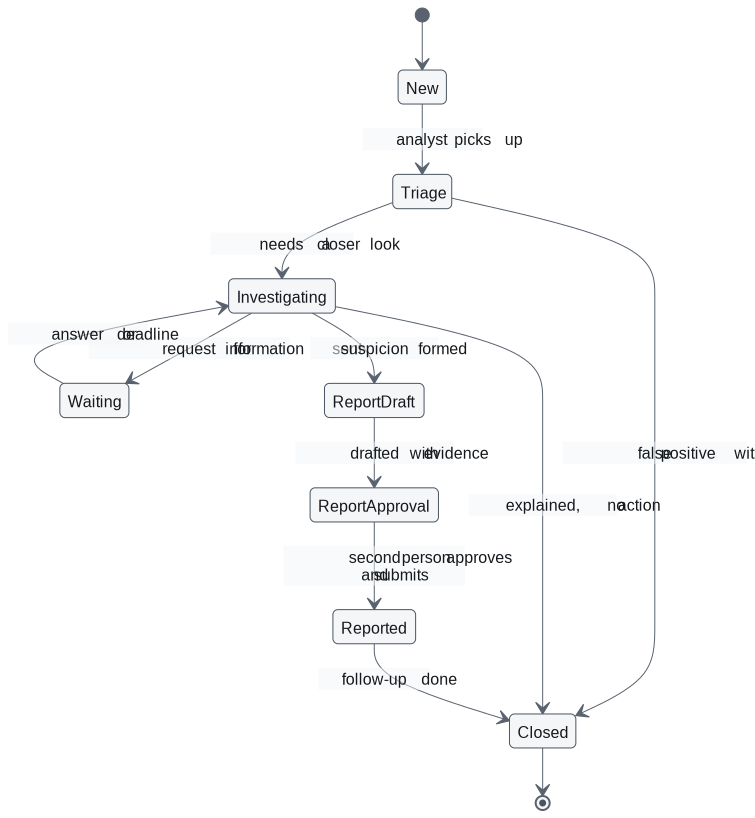
A case retains its alerts, events, documents and notes, and every change of state with the person who made it and the time. The following legal clocks of the Lithuanian profile are all held as configuration; the UK profile's clocks are listed under United Kingdom profile below:
- Suspicion is reported to the FCIS no later than one working day after it arises (as reported by Learnsignal[8] and binderr[9]).
- A suspended transaction is reported within 3 working hours (as reported by Sumsub[7]).
- From 10 July 2027, FCIS requests are answered within 5 working days (AMLR, Art 69 and Art 90[2]). They are received as a separate case type with that clock.
- The maximum length of a suspension is a configurable setting. Secondary sources state 5 or 10 working days, and the default is the shorter value, 5 working days. The clock escalates to the money laundering reporting officer and does not release the hold; release is always a recorded action of
compliance. - Until 10 July 2027, an FCIS request is answered within the period stated in the request, and within 5 working days where the request states none, so that the clock of the AMLR applies from launch.
Clocks start from the time of the event. They count the working days of the profile's jurisdiction and the bank's duty hours, and they escalate at 50% and 80% of the window.
A payment suspension is a ledger hold of kind aml_suspension. It has no expiry and can be released only by compliance. An outgoing order that compliance suspends before submission to the rail, under the Lithuanian profile a standard transfer and under the UK profile a Faster Payment that has not been sent, moves to Suspended (Payments). An incoming credit that compliance suspends is booked first, and an aml_suspension hold then covers its amount. An outgoing instant payment cannot be suspended once it has been sent. The customer and the support agent see only the neutral status of any delayed payment.
Reports are submitted through the channel that the financial intelligence unit provides. In Phase 1 compliance produces the approved report, an authorised analyst submits it through that channel, and the acknowledgement and reference number are stored on the case. An adapter for automated submission is added where the authority offers an interface to reporting entities (see Assumptions and dependencies for the Lithuanian channels).
Capacity and backlog
The compliance team at launch is the team sized in Delivery plan, which comprises a few persons. A rota covering all hours requires at least four. The system therefore measures analyst load.
compliance keeps the following figures as data:
- alerts handled per analyst per day, by case type (a target, set from measured handling time);
- analysts on shift;
- the age of every open alert and hit.
The dashboard shows alerts older than the review target, hits open for more than a day, cases within 20% of a deadline, and a weekly re-review of a sample of closed alerts.
When the oldest alert exceeds its review target, three actions follow. The head of compliance is paged. The onboarding admission cap is lowered, which reduces the number of new customers. Additional reviewers are engaged, through overtime or a contracted review team working under the money laundering reporting officer.
A scenario threshold changes only on tuning evidence (tests above and below the line), approved by the money laundering reporting officer and recorded. A backlog does not change a threshold. Out-of-hours duty, including freezing an account on a weekend sanctions hit, is described in Running the bank.
Other responsibilities
The first two items below are those of the Lithuanian profile.
- Account seizures. Bailiffs send seizure orders through PLAIS, the funds-restriction information system, and providers must execute them (as reported).
compliancematches the order to a customer and requestsaccountsto place aledgerhold of kindseizure. The customer cannot override the hold, and only the named role can release it. The hold ends in a release or in a payout approved by a second person (Ledger and accounts). The term "legal hold" in these sections refers only to this hold. - Tax inspectorate. The bank reports opened and closed accounts to the State Tax Inspectorate (VMI) within 3 business days, as an XML file (as reported).
reportingbuilds the file (Treasury and reporting). - Record keeping (both profiles). A single retention schedule,
retention_policiesincompliance, holds a row per record class (record_class,legal_basis,period,starts_at). Each service that holds personal data runs its retention job against this schedule, and a record flaggedretention_holdis not deleted. Under the Lithuanian profile, national law requires retention for 8 years after the end of the relationship (as reported by Sumsub[7]). From 10 July 2027 the AMLR sets 5 years, extendable by up to 5 more (AMLR, Art 77[2]).
United Kingdom profile
| Aspect | Lithuanian profile | UK profile |
|---|---|---|
| AML law | National law transposing the EU directives; AMLR from 10 July 2027 | Money Laundering Regulations 2017, as amended by SI 2026/621 |
| Financial intelligence unit | FCIS | National Crime Agency, through its portal for suspicious activity reports (the SAR Portal) |
| Payment held for the authority | Suspension reported within 3 working hours (as reported) | Defence request: 7 working days' notice period, 31 calendar days' moratorium on refusal |
| Sanctions lists | EU and UN | UK Sanctions List (published by the Foreign, Commonwealth and Development Office; financial sanctions enforced by OFSI), UN |
| Tipping-off | Directive (EU) 2015/849 Art 39 as transposed; AMLR Art 73 | Proceeds of Crime Act 2002 (POCA) s.333A and s.342; Terrorism Act 2000 s.21D |
| Record retention | 8 years (as reported); 5 years under the AMLR | 5 years after the relationship ends, and at most 10 years for the transaction records of a continuing relationship (Money Laundering Regulations 2017 reg. 40[14]) |
| Per-payment screening on the instant rail | Prohibited for EU targeted financial sanctions (IPR Art 5d(2)) | No prohibition found in law or FCA guidance; scheme rules assumed not to restrict it (see Assumptions and dependencies); applied to new payees as the bank's policy choice, by profile setting |
Customer due diligence. The policy in onboarding applies customer due diligence under regulations 27 and 28 of the Money Laundering Regulations 2017, enhanced due diligence under regulation 33 and the PEP rules of regulation 35[13]. Since 30 June 2026, enhanced due diligence is triggered by unusually complex or unusually large transactions, and mandatory country-based enhanced due diligence is limited to the "Call for Action" countries of the Financial Action Task Force (FATF); the country override of the rating therefore reads a list held per profile. The same instrument (SI 2026/621[15]) states the thresholds of the regulations in sterling, which the UK profile holds as configuration. Regulation 35(3A) makes lower risk the starting point for domestic PEPs and their family members and close associates (FCA guidance FG25/3), so the UK profile rates a domestic PEP by score while a foreign PEP keeps the High band. The measures of regulation 35(5), namely senior management approval, establishing the source of wealth and the source of funds, and enhanced ongoing monitoring, still apply to a domestic PEP to a reduced extent; the score therefore changes the band and leaves the PEP workflow in place. An identity service certified against the UK digital identity trust framework and listed on the register of digital verification services (DVS) can meet the identity verification of regulation 28 (HM Treasury guidance[18], which supplements the regulations and does not supersede them). It is added as one more IdvAdapter and covers identity verification only; the remaining due diligence measures stay in onboarding, and the bank remains liable for the result and for the records of regulation 40.
Industry guidance. The guidance of the Joint Money Laundering Steering Group (JMLSG) is submitted to HM Treasury for ministerial approval. Its news page records revisions published on 4 February 2026 and 3 September 2026 and, as the latest approval, one dated 27 August 2025 (JMLSG news[19]). The bank's policy follows the approved guidance and applies each published revision from its publication date, without waiting for approval. Cost: a revision that is amended before approval requires a second policy update.
Business customers (Phase 2). For a body corporate, regulation 28 requires the bank to obtain and verify the name, the registration number and the registered office, to take reasonable measures to understand the ownership and control structure, and to identify each beneficial owner and take reasonable measures to verify that identity; reliance solely on information delivered to the registrar does not meet that duty (regulation 28[11]). Before the relationship is established, regulation 30A[12] requires the bank to collect an excerpt of the register of persons with significant control, or of the corresponding register for a limited liability partnership, a registered trust or a registered overseas entity, and to report a material discrepancy to the registrar of companies or, for a trust, to HM Revenue and Customs. The UK registry adapter therefore reads the companies register, and a discrepancy becomes a review task and a report, in the same way as a JANGIS difference under the Lithuanian profile.
Reports and defence requests. compliance drafts suspicious activity reports to the National Crime Agency under POCA s.330 and s.331, which require disclosure as soon as is practicable after the suspicion arises; the statute sets no number of days, and the profile holds an internal target as the case clock. The agency states that reports should be submitted through its SAR Portal, which returns an acknowledgement and a reference number, and the agency's page describes no file or interface submission (National Crime Agency[24]). An authorised analyst therefore enters the approved report in the portal, and the reference number is stored on the case. A defence request, made before the bank moves funds that it suspects, is a case type with two clocks (POCA s.335[22]): a notice period of 7 working days from the first working day after disclosure and, on refusal, a moratorium of 31 calendar days from receipt of the refusal, which a court may extend in 31-day blocks by up to a further 186 days. Under the UK profile Phase 1 has no standard transfer, so a defence request concerns either a Faster Payment that has not yet been submitted or an inbound credit. The outbound order waits in Suspended and the inbound credit is covered by an aml_suspension hold; an analyst records the agency's response or the expiry of each period, and only then does compliance release or retain the hold. The amount below which an account may be operated without a defence request, GBP 3,000 since 31 July 2025 (POCA s.339A), is a profile setting. The 90-day notice with reasons for closing an account has exceptions for financial crime cases (Running the bank).
Sanctions. ListDataAdapter loads the UK Sanctions List, which has been the only source of UK designations since 28 January 2026, keyed by its Unique ID. A confirmed hit sets the same sanctions_freeze. compliance reports to OFSI as soon as practicable when it knows or suspects that a customer is a designated person, reports the funds it has frozen as soon as practicable, and produces the annual frozen asset review (holdings as at 30 September, due by 30 November) as a scheduled report. OFSI receives these reports through its online forms: a form for a suspected designated person, and a frozen asset report to which a completed spreadsheet template is uploaded, stating the nature and the amount of the funds held (OFSI reporting guidance[28]). compliance generates the content of each form and the completed template, and an authorised analyst submits them. The freeze is lifted on delisting or under an OFSI licence. Interest may be credited to a frozen account without notification provided that it is frozen; a payment due under a contract concluded before designation, or a transfer from a third party, may be credited and frozen, and compliance then informs OFSI without delay (OFSI general guidance[30]). No rule prescribes a screening method, whereas the FCA expects calibrated and tested screening and timely list updates.
Per-payment screening. No rule requires per-payment sanctions screening of Faster Payments, and none restricting it was found in law or in FCA guidance; the design assumes that the scheme rules, which are not public in full, do not restrict it (see Assumptions and dependencies). Under the UK profile the screening of a new payee on each first payment over the instant rail is therefore the bank's policy choice; it runs through the existing ScreeningHold, before any reservation in the ledger. Cost, which the bank accepts: the check adds its response time, 50 ms at the 99th percentile and at most the 300 ms deadline, to the bank's own steps before hand-over to fps-gateway, and a possible match holds a payment that the customer expects to arrive within seconds until an analyst clears it.
Information accompanying transfers. Where every payment service provider in the chain is established in the United Kingdom or Gibraltar, a transfer must be accompanied by at least the payment account numbers of the payer and the payee, or by a unique transaction identifier. On request from the payee's provider, the payer's provider supplies within three working days the full payer and payee information for a transfer above EUR 1,000, and at least the names and account numbers for a smaller transfer (assimilated Regulation (EU) 2015/847, Art 5[34]). A Faster Payment carries the account identifiers, and such a request is received as a case type in compliance with a clock of three working days, answered from the order record held by payments.
Unchanged. The blocks, state machines, four-eyes approval, backlog controls and aml_restricted classification are identical in both profiles; clock values, list sources, the report channel and retention periods are profile configuration.
Key design decisions
D06.1 Buy identity verification and list data, own the decision, the risk file and case management
Decision: Identity checks and list data are obtained from vendors behind the bank's adapters (IdvAdapter, ListDataAdapter). The pass, refer or fail policy, the rating, the evidence and the case tool are owned by the bank.
Rationale: Detection of forged documents and maintenance of PEP data are specialised businesses. The bank, however, is accountable for each decision and must be able to explain it years later, possibly after a change of vendor.
Alternative considered: A single vendor platform that onboards, screens, monitors and manages cases would allow a faster launch. It is rejected because the case tool and the risk file must survive a change of vendor, and the vendor's monitoring scenarios cannot be replayed for examiners.
Cost: The bank builds the policy engine, the rating and the case tool. In return, a change of vendor requires one new adapter.
D06.2 Onboarding as a resumable state machine
Decision: Each application has an explicit state and a log of transitions, advanced by the job runner. Vendor messages are idempotent, meaning that a repeated message does not change the result, and are keyed by the vendor's session ID.
Rationale: Onboarding takes from minutes to several weeks. Explicit states make drop-off measurable and allow every incomplete application to be recovered.
Alternatives considered: Holding the flow only in the app would lose the state whenever the customer's device fails. A workflow engine is deferred platform-wide (D10.4).
Cost: Every new step requires explicit states, and timeouts are jobs that the bank must write.
D06.3 Screening engine in-house, list data bought
Decision: The bank builds its own matching engine over procured list data. At launch the vendor's matching is authoritative and the in-house engine runs in shadow mode on the same customers. The switch occurs only after a recorded comparison on test name sets and live traffic, approved by the money laundering reporting officer. The comparison covers at least six months of shadow operation after public launch. The acceptance criteria are that the in-house engine raised a hit for every entry of the test name sets and for every match that the vendor's engine raised and analysts confirmed in that period, and that it raised no more false hits than the vendor's engine on the same customers.
Rationale: Counterparty screening sits on the payment path and requires a fast response inside the bank's network. Daily rescreening of up to one million customers is inexpensive on an in-house engine and costly per vendor call. Thresholds can be tuned on the bank's own history, and every score can be explained.
Alternative considered: The vendor's matching service requires less development and its tuning is tested. It is inferior on cost and speed, for the reasons given above.
Cost: The bank pays for two engines at launch and for at least six months after it. It must demonstrate to auditors, with test name sets, that the in-house engine finds true matches, and must retain that expertise in the team. The adapter allows the bank to remain on vendor matching.
D06.4 Rules first, models later, both replayable
Decision: Monitoring starts with versioned scenarios. Every evaluation records its input event IDs and the scenario version, so that any alert can be recomputed. Models are introduced later in shadow mode, where they rank the queue before they are permitted to suppress any alert.
Rationale: No history exists at launch on which to train a model. Examiners can read rules, and replay makes backtesting possible.
Alternative considered: A vendor product with models trained on other banks' data. Its decisions are difficult to explain.
Cost: Rules raise many false alerts. They are tuned with recorded testing above and below the line, and the queue is ranked and not truncated.
D06.5 Customers cannot learn of a report because the data never reaches their screens
Decision: Under the Lithuanian profile, tipping-off is prohibited under national AML law (Directive (EU) 2015/849 Art 39 as transposed; the article of Law VIII-275 is listed under Assumptions and dependencies). From 10 July 2027 it is prohibited under AMLR Art 73[2].
compliance marks reports, investigation notes and the existence of a case as aml_restricted. Only the compliance role can read them. app-api and the support views do not receive them. Restricted events are published to a topic that only compliance and audit can read, and every read is audited.
Rationale: Data that never reaches a screen cannot be disclosed through it.
UK profile: The legal basis is POCA s.333A, with s.342 on prejudicing an investigation and Terrorism Act 2000 s.21D for terrorist financing. Defence requests and OFSI reports are marked aml_restricted in the same way; the design is unchanged.
Alternative considered: Training and a warning banner in the console. This approach depends on every agent acting correctly in every case.
Cost: Agents sometimes cannot explain a delay and use a neutral script. Every new API field requires a classification test.
D06.6 One case tool for fraud, AML, sanctions and credit
Decision: Fraud reviews from risk (Fraud, limits and credit risk), AML alerts, sanctions hits, requests from the financial intelligence unit and, in Phase 2, credit reviews are all case types in one tool in compliance. Staff work them through the staff console. Each type has its own queues, permissions and clocks. A decision that releases or stops a payment is returned to payments through its API.
Rationale: A money mule is relevant to both fraud and AML. A single tool presents the complete picture and prevents three teams from contacting the same customer independently.
Alternative considered: Separate tools per team. The teams would not see each other's cases.
Cost: Permissions become more complex. A fraud analyst may see a fraud case but not the AML report on the same customer, and D06.5 enforces this per case type.
Failure modes and mitigations
| Failure | Effect | Response |
|---|---|---|
| Identity vendor down | No new customers can be verified | Applications wait and resume; a second adapter in Phase 2 |
| Forged vendor webhook | Fraudulent approval | Signature check, then retrieval of the result directly from the vendor |
| List update late or corrupt | New sanctions missed | Alarm if no update in 24 hours; previous list retained; manual check of new EU entries |
screening misses its deadline | Standard transfers wait | Order stays in Checking and is retried; never sent unchecked |
| Matching threshold too loose | Flood of false hits | Backtest changes; recorded tuning per list |
| Matching threshold too strict | Sanctioned person passes | Tests on known names before each change; vendor matcher decides at launch |
| Report deadline near | Breach of law | Clocks from event time; escalation at 50% and 80% of the window |
| Alert backlog grows past the review target | Missed reports, supervisory finding | Age indicators, paged escalation, onboarding admission cap, extra reviewers |
| Restricted field added to a customer API | Tipping-off | Classification check in the build; contract tests on app-api |
| Real hit wrongly discounted | Sanctioned customer served | Four eyes on every discount; sampled senior re-review |
| JANGIS and declared owners differ (Phase 2) | Unknown true owner | Review task; no account until resolved |
| Defence request clock missed (UK profile) | Funds moved without a defence, or held beyond the moratorium | Notice and moratorium clocks per case with escalation at 50% and 80%; release only by compliance |
| UK Sanctions List update not loaded (UK profile) | New designation missed | Same 24-hour alarm; load keyed by Unique ID; manual check of new UK designations |
Security and privacy considerations
- Identity images and raw vendor results are encrypted per customer. Staff access them only with a recorded reason (Security).
- Events carry only
customer_idandcounterparty_id. Names reachscreeningby API, and its name index is encrypted and rebuildable. - A refusal to open an account always has a human review route (GDPR Art 22[4]; under the UK profile UK GDPR Articles 22A to 22D, see Fraud, limits and credit risk and Privacy); no decision is taken on a similarity score alone.
- The relationship between AML retention and deletion requests is addressed in Privacy.
Phasing
- Phase 1: adult customers with one identity vendor; a versioned rating; screening with event-driven and nightly rescreening; the sanctions freeze through
accounts; counterparty screening for standard SEPA transfers; ten to fifteen scenarios with backtesting; the case tool with four eyes, clocks, a capacity dashboard and FCIS report drafting; PLAIS intake; VMI reporting; the retention schedule. - Phase 2: businesses with JANGIS and registry adapters; minors and guardians; a second identity vendor; national e-identity adapters; models in shadow mode; credit-review cases.
- Phase 3: due diligence for customers introduced by API partners; acceptance of the EU digital identity wallet.
- UK profile, Phase 1: UK Sanctions List loading; OFSI reporting and the annual frozen asset review; counterparty screening of new payees on Faster Payments; suspicious activity report drafting and defence request cases with their clocks; the regulation 40 retention rows; a DVS-certified identity adapter where the selected vendor is certified.
- UK profile, Phase 2: business onboarding against the companies register and the register of persons with significant control, with discrepancy reports under regulation 30A.
The in-house matching engine is on the Phase 1 cut line (Delivery plan).
Assumptions and dependencies
The design in this section rests on the following assumptions, each of which is confirmed at the stated point. Every affected value is held as profile configuration or behind an adapter, so that none of the assumptions blocks the start of the build.
| Assumption | Confirmed by | When | If it does not hold |
|---|---|---|---|
| Lithuanian profile: identification by a document combined with a liveness check, performed through the procured identity vendor, is an accepted remote identification method for a bank, and the national electronic identity services are not required at launch. | Counsel and the FCIS | Before the licence application | An adapter for a qualified electronic signature or for Smart-ID and Mobile-ID moves from Phase 2 into Phase 1, within the cost envelope of section 13. |
| Lithuanian profile: the periods taken from secondary sources match the current legal text: reporting of suspicion within one working day and of a suspended transaction within 3 working hours, a suspension of 5 or 10 working days, the freeze notice within 2 working days, retention for 8 years, the tipping-off prohibition of Law VIII-275, account reports to the VMI within 3 business days, and the duty to execute PLAIS orders. | Counsel | Before the licence application | The affected clock, retention row or report schedule is changed in profile configuration; a shorter legal period lowers the escalation points of the case clock and requires no code change. |
| Lithuanian profile: an incoming standard transfer may be screened after the credit is booked, a credit to a sanctions-frozen account may be booked and blocked, and frozen funds are released only on delisting or on written authorisation from the competent authority. | Counsel and the FCIS | Before the licence application | payments holds incoming standard credits until screening responds, and a credit to a frozen account is rejected and returned in place of being booked; both are settings of the existing ScreeningHold and sanctions_freeze. |
| Lithuanian profile: a licensed bank obtains access to the FCIS reporting channel, to JANGIS and to PLAIS during licensing, and each offers either an interface or a portal for staff. | The FCIS and the Centre of Registers | Phase 0 exit | Where only a portal exists, an authorised analyst submits or retrieves the data manually and the reference is stored on the case; where an interface exists, an adapter is added in compliance or onboarding. |
| UK profile: the Money Laundering Regulations 2017, POCA, the Terrorism Act 2000 and the sanctions regime cited in this section are the complete set of provisions that determine the design of these blocks. | Counsel | Before the licence application | A further obligation is added as profile configuration, a case type with its clock, or a scheduled report in compliance. |
| UK profile: the Faster Payments scheme rules neither require per-payment sanctions screening nor restrict the screening of new payees before submission. | Pay.UK and the sponsor bank | Scheme onboarding | Where the rules restrict it, the profile setting disables new-payee screening on the instant rail and the control becomes the daily rescreening of customers; where the rules require it for every payment, the setting extends the existing check from new payees to all payees. |
UK profile: orders and statutory notices that require the bank to restrict or pay out an account, and requests from the tax authority, arrive individually and require no automated interface at launch; they are handled as a case type in compliance, with a seizure hold placed through accounts. | Counsel | Before the licence application | An intake adapter is added in compliance, or a scheduled report in reporting, within the cost envelope of section 13. |
Sources
- Regulation (EU) 2024/886, Instant Payments Regulation (Art 5d)
- Regulation (EU) 2024/1624, AML Regulation (Art 69, 73, 77, 90)
- Regulation (EU) 2024/1183, European digital identity framework (Art 5f)
- Regulation (EU) 2016/679, GDPR (Art 22)
- Sorainen, Lithuania establishes remote client identity verification (secondary)
- Ecovis, remote customer identification and GDPR (secondary)
- Sumsub, AML regulations in Lithuania (secondary)
- Learnsignal, Lithuania AML obligations under Law VIII-275 (secondary)
- binderr, AML compliance in Lithuania (secondary)
- Money Laundering, Terrorist Financing and Transfer of Funds Regulations 2017 (UK)
- Money Laundering Regulations 2017, regulation 28 (UK)
- Money Laundering Regulations 2017, regulation 30A (UK)
- Money Laundering Regulations 2017, regulation 35 (UK)
- Money Laundering Regulations 2017, regulation 40 (UK)
- Money Laundering and Terrorist Financing (Amendment) Regulations 2026, SI 2026/621 (UK)
- Explanatory memorandum to SI 2026/621 (UK)
- FCA FG25/3, treatment of politically exposed persons
- HM Treasury, using digital identities with the Money Laundering Regulations
- JMLSG news (secondary)
- Proceeds of Crime Act 2002, Part 7 (UK)
- Proceeds of Crime Act 2002, s.333A (UK)
- Proceeds of Crime Act 2002, s.335 (UK)
- Terrorism Act 2000, Part III (UK)
- National Crime Agency, suspicious activity reports
- Circular 008/2018, extending the moratorium period
- SI 2025/877, threshold amount under POCA s.339A (UK)
- OFSI, moving to a single list for UK sanctions designations
- OFSI, suspected breach of financial sanctions
- OFSI, annual frozen asset review
- OFSI, UK financial sanctions general guidance
- FCA, sanctions systems and controls findings
- SI 2025/688, account termination notice (UK)
- Regulation (EU) 2015/847 as assimilated (UK)
- Regulation (EU) 2015/847 as assimilated, Art 5 (UK)