02. The system map: every block and how they talk
Purpose and scope
The system is divided into independently deployable blocks so that a change to one function, for example statement generation, cannot delay or interrupt a time-critical one such as card authorisation, which must be answered within a fraction of a second. This part defines the blocks, the data each owns, the permitted ways in which blocks communicate, the time budgets on the money path and the behaviour of the bank when a block fails.
Components
The bank has four layers: channels used by customers and staff, an edge that authenticates callers, the banking blocks and a shared platform. The diagram shows the dependencies between the groups.
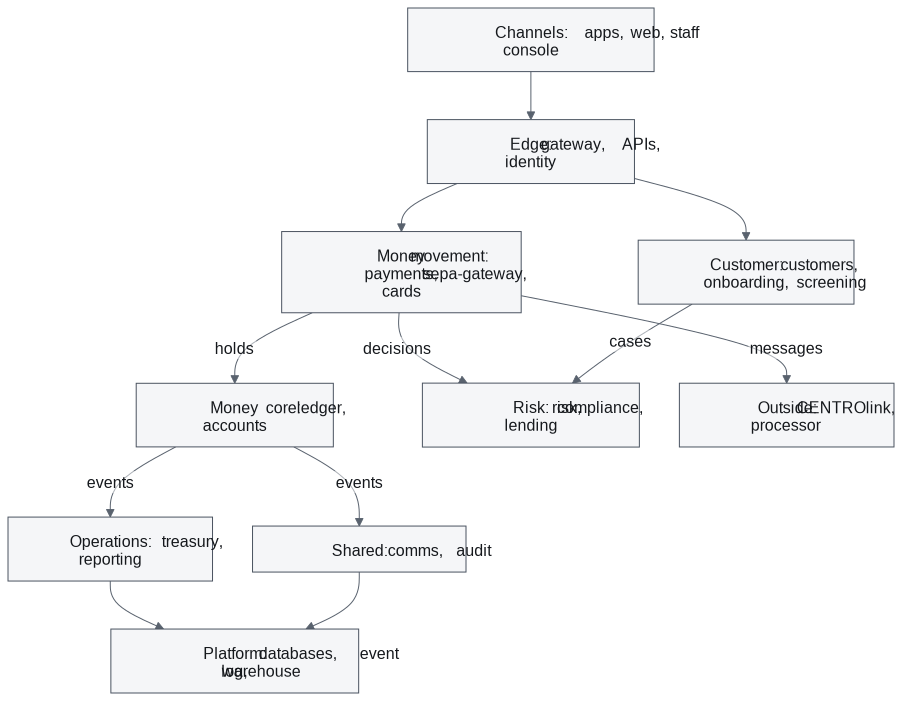
The diagram shows the Lithuanian profile; under the UK profile fps-gateway and Faster Payments take the places of sepa-gateway and CENTROlink.
In the table, "owns" means that the block holds the only copy of the data that may be changed; other blocks keep at most a read-only copy built from its events. A state machine is a record that is at exactly one named state at any time and moves only along permitted transitions.
| Block | Description | Data it owns | Detailed in |
|---|---|---|---|
| Apps, web app, website, staff console | Customer and staff interfaces. | None of record | 09 |
gateway | Entry point to the platform. Terminates TLS, filters known attack patterns and enforces request rate limits. | Rate-limit counters | 10 |
app-api | Backend of the customer apps. Relays requests and takes no decisions. | Idempotency records only | 09 |
backoffice-api | Backend of the staff console. A second person approves sensitive actions (four-eyes principle). | Pending approvals | 09 |
openbanking | Gives licensed third-party providers access to accounts with the customer's consent, under the Payment Services Directive (PSD2) in the Lithuanian profile and the Payment Services Regulations 2017 in the UK profile. | Provider registrations, access logs | 09 |
identity | Authenticates users, binds the app to one device and performs strong customer authentication (SCA), the legally required two-factor approval. | Credentials, devices, sessions, consents | 09 |
customers | Customer record and the store for personal data. | Names, addresses, documents, contacts, data subject requests | 12 |
onboarding | Processes account applications and assigns each customer a money-laundering risk rating. | Applications, vendor results, risk ratings | 06 |
screening | Checks names against sanctions lists, lists of politically exposed persons (PEPs) and adverse media. | List versions, encrypted name index, hits | 06 |
ledger | Book of record. Holds every double-entry posting, balance and hold, and enforces debit blocks. | Ledger accounts, entries, holds, closed days | 03 |
accounts | Products, the lifecycle of each account from opening to closing, account identifiers (IBANs; under the UK profile sort codes and account numbers), interest, fees and statement data. | Contracts, IBANs and other account identifiers, account restrictions, depositor view | 03 |
payments | Payments hub. Routes each order, tracks its state and verifies the payee's name. Under the UK profile it also holds the Direct Debit Instruction register. | Payment orders, state histories, payee details (encrypted); Direct Debit Instructions (UK profile) | 04 |
sepa-gateway | Lithuanian profile. Sole interface to CENTROlink, the Bank of Lithuania's payment system. Also sends the funding orders approved by treasury. | Raw messages (encrypted), settlement files | 04 |
fps-gateway | UK profile. Sole interface to Faster Payments: the connection, message mapping, signing and the view of the settlement position. | Raw messages (encrypted), settlement position records | 04 |
cards | Issues cards, decides each purchase, books clearing, handles disputes and 3-D Secure (the authentication step for online card purchases). | Card tokens, card switches, authorisations, disputes | 05 |
risk | Assesses whether a payment or card purchase is acceptable and enforces every spending limit. | Rules, decisions, limit and SCA-exemption counters, stand-in caps | 07 |
compliance | Monitors for money laundering (AML), operates the single case management tool and reports to the financial intelligence unit. | Alerts, cases, reports, compliance register, rule parameters, retention policies | 06 |
lending (Phase 2) | Takes credit decisions and services loans and overdrafts. | Credit decisions, repayment schedules | 07 |
treasury | Funds settlement, safeguards customer money on the EMI route and reconciles with external parties. Creates and approves funding orders. | Positions, instant-account headroom, reconciliation breaks | 08 |
reporting | Produces regulatory and financial reports. | Report runs, submitted files | 08 |
comms | Sends push, SMS, email and in-app messages and produces statements. | Templates, delivery records, documents | 09 |
audit | Maintains a tamper-evident record of actions and their actors. | Audit entries and their hash chain | 10, 11 |
| Data platform | The event log, a warehouse of pseudonymised data and the feature store that supplies risk models. | Topics, warehouse tables, features | 10 |
How it works
The three ways blocks talk
- Synchronous calls on the money path. Where the bank must answer the customer or the card network immediately, one block calls another with gRPC, a request-and-reply protocol between services. Each call has a deadline. When the deadline passes, the caller applies a documented fallback.
- Events for all other communication. A block saves its change and a record of it in a single atomic transaction. The record is written to an outbox table, and a relay copies it to the event log, from which other blocks read at their own pace.
- Files and messages exchanged with external parties. Each external party (CENTROlink, the card processor, regulators) is served by exactly one adapter block, so that its formats do not propagate into the rest of the bank.
The money path: an outgoing instant credit transfer
Example: a customer sends EUR 650.00 as an instant payment. Every submission carries an idempotency key, a unique identifier created once per user action, so that a retry after a lost connection cannot result in a second payment. Amounts are shown in euro; under the UK profile the same example applies in sterling.
Before this point, payments has performed the payee check, which under the Lithuanian profile is verification of payee: it asked the payee's bank whether the name entered by the customer matches the IBAN, and displayed the result to the customer, as required by Regulation (EU) 2024/886[1]. The diagram shows how the order is approved and the funds are reserved (gateway omitted; "ms" denotes milliseconds).
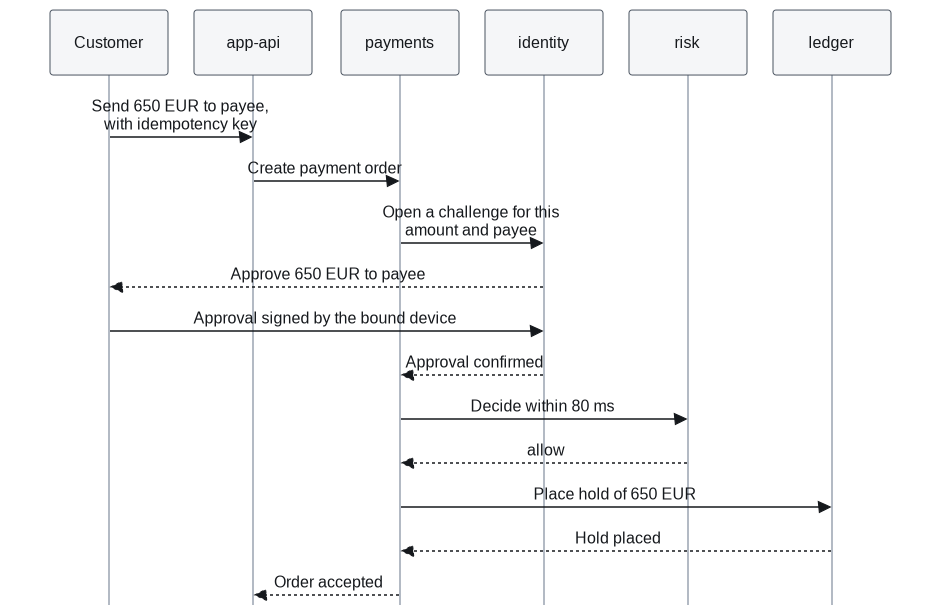
paymentscreates the order first, in stateAwaitingSca, so that the approval is bound to this order.identitysends the customer's device a request that states the amount and the payee. The customer confirms with a biometric check and the device signs the confirmation.identitythen informspaymentsthat the approval is valid. This is termed dynamic linking: the approval is valid for this payment only (Delegated Regulation 2018/389[2]).riskevaluates fraud signals and limits and returnsallow,challenge,revieworblock.- The
ledgerplaces a hold, which reduces the available balance without moving any money. If the funds are insufficient or the account has a debit block, the order ends inRejected.
payments then passes the order to sepa-gateway and records the time as sent_at. sepa-gateway sends CENTROlink a signed pacs.008, the standard (ISO 20022) bank-to-bank transfer message. The payee's bank answers with a pacs.002 status message.
If the payee's bank accepts, the hold becomes a booked debit. If it rejects, the hold is released. If no answer is received within 10 seconds of sent_at, the payment moves to Unknown and awaits a status report from CENTROlink; the handling is described in 04. The 10 seconds is the legal limit (Regulation (EU) 2024/886[1]).
Under the UK profile the steps up to the hold are identical, and the payee check is Confirmation of Payee. payments passes the order to fps-gateway, which sends it to Faster Payments in the scheme's own message format, based on ISO 8583 rather than ISO 20022, and maps the receiving bank's accept or reject response back to the same order states. The scheme requires the sending bank to inform an attended customer of the outcome of a Single Immediate Payment within 15 seconds (Faster Payments System Principles[15]); this is a scheme service level, whereas the 10 seconds of the Lithuanian profile is a statutory limit. The Unknown rule differs in one respect, the treatment of the hold: because no UK rule requires the hold to be released at the timeout and a Faster Payment cannot be recalled once sent, the hold is kept until the outcome is established, as recorded in D04.4 in 04. In Phase 1 the sponsor that settles for the bank authorises each payment in near real time, so one external party besides the scheme is on the path in both directions.
The card tap path
Example: a customer pays EUR 12.40 by contactless card at a merchant. The card processor, an external supplier, replaces the card number with a token, so that the number does not enter any block of the bank.
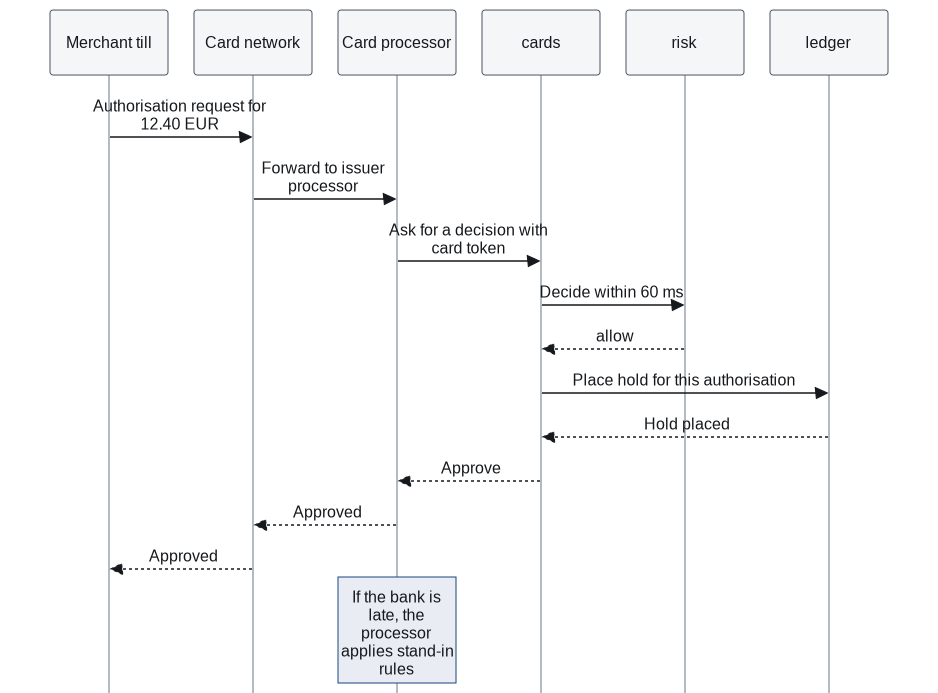
cards first checks the customer's card switches (online, contactless, cash), and risk checks every monetary cap. A card authorisation cannot wait for a person, so a review result is returned as a decline with a reason code, and a fraud review case is opened.
Funds move days later, when the clearing file arrives and cards converts each hold into a posting (05). A clearing without a hold is a forced entry, as is a stand-in approval, which is an approval granted by the processor on the bank's behalf while the bank was late. Stand-in declines any card whose account is restricted or whose card is not Active, because cards pushes those states to the processor immediately. ledger books forced entries even where the balance falls below zero, with a reason code and an alert, and accounts follows up the negative balance (03).
What happens after the fact
After the transaction, the remaining blocks learn of it from events. None of these readers can block a payment.
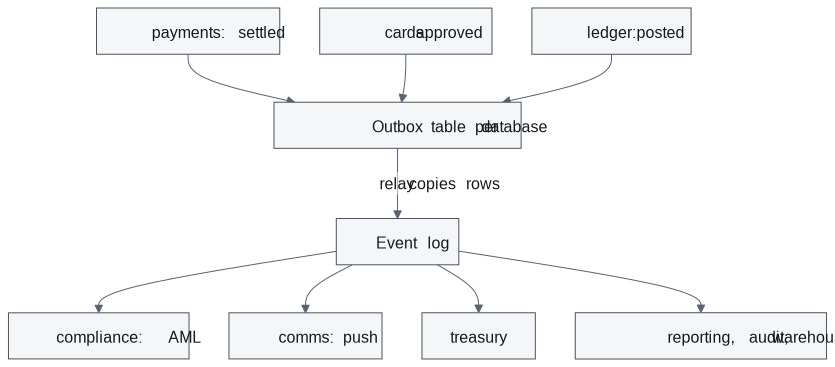
Events carry identifiers and amounts and do not carry names; comms retrieves the customer's language and device from customers itself. Payment events carry a counterparty_id for the payee: payments pseudonymises the account identifier (the IBAN, or the sort code and account number under the UK profile) with a secret key, so that compliance can count distinct senders without access to names.
Cross-cutting rules
- Data ownership. Only one block writes each fact, and no block reads another block's tables. Example:
accountssets account restrictions (sanctions freeze, seizure, deceased) at the request ofscreeningorcompliance;ledgerenforces the debit block;riskreads a copy. - Idempotency keys on every write. The same key with the same content returns the stored result, and the same key with different content is refused. Refusals are not stored under the key; only booked results are. A retry after a refusal is evaluated afresh (03).
- No transaction across two services. A process with several steps reserves first (a hold) and then commits or releases.
- State machine per long-running process. Each payment, application, dispute and loan is a row with a named state. A durable job runner advances it, so that a restart resumes from the last recorded state.
- Deadline propagation. Deadlines shrink as a request travels: each call passes on only the time it has left (gRPC deadlines[12]).
- Idempotent readers. An event may be delivered more than once, so readers skip identifiers already processed.
- Central licence settings. Licence mode and the wind-down switches are configuration settings (01), so that no block contains licence-specific code. The jurisdiction profile,
jurisdiction.profilewith valuesltanduk, is a setting of the same kind besidelicence.mode; it selects the rail gateway, the payee-check adapter and the jurisdiction's parameters, so that blocks other than the adapters contain no jurisdiction-specific code. - Audit through the outbox. Blocks write audit records as events. Only staff actions through
backoffice-apiwrite toauditdirectly, and they fail closed: ifauditis unavailable, the action is refused.
Time budgets on the money path
The figures are targets set by this document, measured at the 99th percentile. risk also has a deadline, after which the caller applies its fallback. The instant column runs from the customer's signed approval to the hand-over to the rail gateway (sepa-gateway or fps-gateway, by profile). The budgets apply to both profiles unchanged; under the UK profile fps-gateway builds and signs the Faster Payments message within the 80 ms shown for pacs.008, and the time outside the bank's control, which in Phase 1 includes the sponsor's authorisation, is governed by the Faster Payments rules described above.
| Step | Card authorisation | Outgoing instant payment |
|---|---|---|
Request arrives (processor link, or gateway and app-api) | 20 ms | 30 ms |
identity confirms the signed approval | not on this path | 20 ms |
cards or payments validate and store the request | 20 ms | 30 ms |
risk decision | target 40 ms, deadline 60 ms | target 50 ms, deadline 80 ms |
ledger places the hold | 20 ms | 20 ms |
Reply to processor, or sepa-gateway builds and signs pacs.008 | 20 ms | 80 ms |
| Total inside the bank | target 150 ms, hard stop 300 ms | target 250 ms, hard stop 1 s |
| Outside the bank's control | Processor and network, up to the processor's timeout | CENTROlink and the payee's bank, inside the legal 10 s |
Section 05 splits the card steps more finely; only the totals bind. Four further steps have their own budgets.
| Step | Target | Deadline |
|---|---|---|
risk decision on a standard (non-instant) transfer | 300 ms | 1 s |
| Incoming instant payment: the bank's answer, a positive or negative pacs.002 (under the UK profile, the Faster Payments accept or reject response) | 2 s at the 99th percentile | 4 s |
| The bank's answer to another bank's payee-name check | 300 ms | not set |
risk decision on a 3-D Secure exemption, a separate call made before the card authorisation | 100 ms | The response time set in the processor contract (05) |
For an incoming instant payment under the Lithuanian profile, the credit is posted when CENTROlink's settlement confirmation arrives (target: within 1 s of it); 04 gives the detail, including the corresponding point under the UK profile. The processor's timeout is a contract term. One issuer product, for example, documents 2,000 ms (Adyen[11]).
Calls that wait, and what may lag
The following are the only synchronous calls on the money path; each has a row in the failure table.
| Caller | Calls | Purpose |
|---|---|---|
gateway | app-api, openbanking | Route the customer's or provider's request |
app-api | payments | Create the payment order |
payments | identity | Open and confirm the SCA challenge |
payments | accounts | Find the account behind an account identifier and its status |
payments | screening | Counterparty check, standard transfers only (target 50 ms, deadline 300 ms). On a miss the order stays in Checking and is retried; it is not sent unchecked |
payments | customers | Name of the bank's own customer, to answer payee-check requests (verification of payee or Confirmation of Payee, by profile) |
payments, cards | risk | Fraud and limit decision; for cards also the 3-D Secure exemption |
payments, cards | ledger | Holds and postings |
payments | sepa-gateway | Send to CENTROlink (Lithuanian profile) |
payments | fps-gateway | Send to Faster Payments (UK profile) |
cards | identity | 3-D Secure challenge for an online card payment |
treasury is not on this list: it publishes the remaining room in the instant account (its headroom) as an event, and payments checks its local copy. Other blocks write to ledger off the money path (fees, interest, AML holds, approved adjustments); 03 lists them. All other consumers may lag: comms and treasury by seconds, compliance by minutes, reporting and the warehouse by hours.
screening rescreens every customer at least daily and immediately after new sanctions measures. Under the Lithuanian profile this is what the Instant Payments Regulation (IPR) requires, and the regulation prohibits screening each instant payment against EU sanctions lists in addition (04). The counterparty check therefore applies to standard transfers only. Under the UK profile the bank screens a new payee on each Faster Payment as a policy choice, at a latency cost inside the money path; the rule and its budget are set in 06.
United Kingdom profile
| Aspect | Lithuanian profile | UK profile |
|---|---|---|
| Profile setting | jurisdiction.profile = lt | jurisdiction.profile = uk |
| Rail gateway block | sepa-gateway, connected to CENTROlink | fps-gateway, connected to Faster Payments |
Payee-check adapter in payments | Verification of payee | Confirmation of Payee |
| Instant message format | ISO 20022 (pacs.008, pacs.002) | Faster Payments format based on ISO 8583 |
| Time outside the bank on an outgoing instant payment | Statutory limit of 10 seconds | Scheme service level: outcome reported to an attended customer within 15 seconds; the legal execution limit is the end of the next business day |
| External parties on the instant path | CENTROlink | Faster Payments and, until Phase 2, the sponsor that authorises and settles each payment |
The block list, data ownership, the three ways in which blocks communicate, the synchronous call list and the time budgets are the same in both profiles. jurisdiction.profile is read beside licence.mode and selects which rail gateway and which payee-check adapter are deployed; one deployment runs one profile. fps-gateway owns the Faster Payments connection, its message mapping, signing and the view of the settlement position. Because Faster Payments messages are not ISO 20022, the gateway maps them to the internal canonical payment model (04), and no other block sees the difference. The failure handling is unchanged apart from the rows marked UK profile in the table below.
Key design decisions
D02.1 About twenty services with hard walls
Decision: The bank consists of the roughly twenty blocks listed above. Each has its own PostgreSQL schema, its own interface and its own credentials, and no two blocks share tables.
Rationale: The parts of a bank fail and change at different rates. Card authorisation must answer at any hour while the back office deploys, and access to the personal-data store must be restricted to very few components. The Digital Operational Resilience Act (DORA) requires the bank to map and protect its critical functions (Regulation (EU) 2022/2554[3]); separate blocks make that map match the running system.
UK profile: DORA does not apply to the UK entity. The same block boundaries support the identification of important business services and the mapping of the resources behind them that the PRA and FCA operational resilience rules require (10); the decision is unchanged.
Alternative considered: A modular monolith, consisting of one program and one database. It offers one deployment, no network hops, real database transactions and boundaries that are cheap to move. Part of this approach is adopted.
A block is a logical boundary and not always a separate deployment. In Phase 1 the blocks that must fail and scale independently always run as their own programs: ledger, customers (the personal-data store), cards, sepa-gateway (fps-gateway under the UK profile), identity, risk, payments and the edge. Blocks owned by one squad with no time-critical path (compliance, treasury, reporting, comms, audit; accounts beside ledger) may ship in one deployable, keeping separate schemas and interfaces, and are split out when deployment rate, load or failure isolation requires it.
The division stops there because a single fault in one shared program would stop card authorisation and the ledger together. Hundreds of microservices, the opposite extreme, require a large platform team.
Cost:
- a wrong boundary requires moving data between databases and not only editing code;
- every money-path call incurs a network hop;
- debugging requires tracing that follows one payment through every block, from the first day;
- a small team operates many deployment pipelines.
These costs are accepted because the most important boundaries (personal data, card authorisation, the ledger, CENTROlink) are known to be required, and D02.4 reduces the cost of each block.
D02.2 Synchronous only on the money path
Decision: Synchronous gRPC calls with deadlines are used on the money path only for the calls in the table above. All other communication uses the outbox and the event log, apart from a few direct calls off the money path. Each of these is on the network allow-list, and none can block a payment.
| Caller | Calls | Purpose |
|---|---|---|
accounts, treasury, compliance, backoffice-api, lending | ledger | Fees, interest, holds and approved adjustments, listed in 03 |
backoffice-api | audit | Record staff actions |
comms, screening, reporting | customers | Read customer details |
screening | payments | Read payer names |
Rationale: Each synchronous call is a path by which an outage can spread; a failure of comms must not stop a payment. Starling Bank describes the same choice (InfoQ[5]).
Alternative considered: Events for all communication. This is rejected because a card network cannot wait on a queue, and a customer expects an immediate confirmation or refusal of a payment.
Cost: Screens built from events can lag by seconds, and tooling is required to monitor reader lag and replay events. A new synchronous call requires its own decision record and a row in the failure table.
D02.3 The ledger is the only source of truth for money
Decision: Every amount that the bank owns or owes exists as ledger entries. Balances held elsewhere are copies that can be rebuilt or reconciled against the ledger.
Rationale: Where two systems disagree about money, the authoritative one must be defined in advance. An append-only double-entry ledger gives every euro a matching counter-entry and records every correction as a new entry, as Stripe also describes (Stripe[9]). It refuses a debit beyond the available balance, except for the forced entries described above.
Alternative considered: Each money block keeps its own balance and the bank sums them. This is quicker to build and fails at the first race between a card authorisation and a transfer.
Cost: The ledger is on every money path, so it limits the availability of the bank (target 99.95% a month, see Overview) and requires the strongest protection. Reconciliation breaks require staff.
D02.4 One Rust workspace and a service template
Decision: All backend blocks reside in one Rust workspace. Shared crates (libraries) hold the money type, identifiers, ledger-entry and event types, and common components such as the outbox and job runner. The money type stores whole minor units, such as cents, bound to a currency. Each block starts from one template with health checks, metrics, tracing and mutual TLS, in which both parties to a call prove their identity with certificates.
Rationale: One build checks every caller against every interface change, and the money type cannot diverge between blocks. The template makes twenty blocks economical to operate. Monzo reports the same approach (InfoQ[6]).
Alternative considered: A repository per block with versioned libraries. Teams could proceed independently, but divergence of money and identifier types is the defect with the highest consequence.
Cost: Build times grow and require caching, and a change to a shared crate affects every block. Rule: shared crates hold types and common components and do not hold business logic.
D02.5 Identifiers, idempotency keys and correlation
Decision: Every record receives a unique identifier that does not require a central counter, so that the phone can create one before calling the bank.
- Every ID is a UUID version 7 (RFC 9562[13]), a long unique identifier that begins with its creation time, so that IDs sort in creation order. Screens display it with a short prefix such as
pay_, which is not sent in ISO 20022 messages. - An idempotency key is either generated by the app for each user action (in the
Idempotency-Keyheader) or built from an external identifier as<source>:<external id>/<leg>. Examples:pay:<order_id>/hold,card:<auth_id>/hold,sepa:<instructing_bic>/<tx_id>/credit. - A step that can occur more than once carries its own message ID in the leg, for example
card:<auth_id>/capture/<clearing_line_id>(05). - Edge blocks retain keys for at least 24 hours (target); the
ledgerretains them indefinitely. - Every request and event carries a correlation ID in the W3C Trace Context
traceparentformat (W3C[14]), so that one payment can be followed across every block.
Rationale: Retries occur at every hop, so every write must be safe to repeat; time-ordered IDs keep indexes compact. Bank-to-bank messages allow 35-character identifiers, and these IDs fit (32 characters without hyphens). End-to-end IDs supplied by customers or other banks are stored as received.
Alternative considered: Database sequence numbers. They are short, but they reveal volumes, collide across blocks and cannot be generated by the app.
Cost: IDs are long to read aloud, so the console searches by the last characters.
Failure modes and mitigations
| Failure | Behaviour of the bank |
|---|---|
ledger down | Card authorisations fall to processor stand-in and are booked later as forced entries; payments are refused or time out. Top-priority incident. |
risk misses its deadline | The fallback in 07: instant payments only to known payees up to a low amount, and not to a new payee; cards up to a small fallback amount (target 30 EUR), counted per card; every fallback flagged. |
payments or sepa-gateway down | Cards work; standard transfers queue; incoming instant payments time out. |
| CENTROlink unreachable | No SEPA payments in or out; instant orders refused promptly; standard transfers queue for the next cycle. The bank provisions two independent network paths to its connection station, and where a participant cannot work through its own station the operator provides a backup connection station located at the Bank of Lithuania (paragraph 144 of the CENTROlink Operating Rules[4]). No second rail is provided in Phase 1 (04). |
fps-gateway down (UK profile) | Cards work; outgoing Faster Payments are refused promptly. The scheme requires participants to answer incoming payments at all hours and, during incidents, to use stand-in processing with a qualified accept; the arrangement is defined in 04. |
| Faster Payments unreachable (UK profile) | No Faster Payments in or out; outgoing orders refused promptly; the handling of queued and other-rail payments is in 04. |
| Sponsor authorisation unavailable or slow (UK profile, Phase 1) | Outgoing Faster Payments are refused promptly and incoming payments cannot be authorised for credit; the sponsor's service level is a contract term (04). |
cards down | Processor stand-in decides; the bank applies its advices later, as in Monzo's design (Monzo[7]). |
identity down | Card authorisations continue; new payments and challenged online card payments wait or are declined. |
accounts down | Outgoing transfers to other banks continue; transfers to the bank's own customers and all incoming payments are refused once their deadline passes. |
customers down | Payments and cards continue; onboarding stops; the bank cannot answer other banks' payee checks, a priority incident. |
screening down | Onboardings and checked standard transfers wait; existing restrictions remain enforced. |
compliance, comms, treasury, reporting down | Events wait in the log. treasury is monitored closely, because under the Lithuanian profile top-ups of the instant account can be made only while TARGET, the central bank's settlement system, is open; settlement funding under the UK profile is in the same section (08). |
| Event log down | Outbox rows accumulate in each database; the money path is unaffected. |
| Primary region lost | Standby in Ireland within two hours, at most one minute of data lost; outgoing payments remain closed until reconciled against CENTROlink, or Faster Payments under the UK profile (10). |
| Retry storm after a slow hop | Deadlines, retry budgets and circuit breakers; rate limits at gateway. |
| A copy disagrees with the ledger | Reconciliation flags it; the ledger prevails; the copy is rebuilt. |
Running the bank describes who monitors these failures around the clock, and who acts.
Security and privacy considerations
Blocks authenticate to each other with mutual TLS and workload identity. The synchronous calls above, together with the off-path calls in D02.2, also constitute the network allow-list. Events carry IDs, amounts and pseudonyms and do not carry names or card numbers.
Personal data resides in customers. The exceptions (payee details in payments, raw messages in sepa-gateway, the name index in screening) are encrypted under vault-managed keys and listed in 12. Privacy. Only the processor holds card numbers. See also 11. Security.
Phasing
- Phase 1: Every block except
lending, including the online part of the feature store. EMI-only components, such as safeguarding reconciliation, are built only if that route is chosen (01). Instant payments, verification of payee and daily rescreening are included from the first day, because under the Lithuanian profile they are legal requirements for a euro-area bank. Customers are natural persons only. If Phase 1 slips, the cut line in 13 moves named items to after launch. Under the UK profile Phase 1 includesfps-gatewayand Confirmation of Payee in place ofsepa-gatewayand verification of payee; inbound Bacs credits, paying-side Bacs Direct Debit and CHAPS are handled through the sponsor by adapters inpaymentsbesidefps-gateway(04). - Phase 2:
lendingis added. SEPA Direct Debit and SWIFT are added as adapters besidesepa-gateway. Business accounts, including several users per business, extendidentityandcustomers. Under the UK profile, origination of Bacs Direct Credits is added to the Bacs adapter besidefps-gateway. - Phase 3:
openbankingis extended into partner APIs. Under the UK profile, direct CHAPS access is added as a further adapter; direct Bacs participation and origination of Direct Debits for business customers are options. If volume requires, customers are split into independent cells behind a router, as Nubank describes (InfoQ[8]).
Sources
- Regulation (EU) 2024/886, Instant Payments Regulation
- Delegated Regulation (EU) 2018/389, strong customer authentication
- Regulation (EU) 2022/2554, DORA
- Bank of Lithuania, CENTROlink Operating Rules 2023
- Starling Bank, resilient banking systems (InfoQ)
- Monzo, banking with thousands of microservices (InfoQ)
- Monzo, tolerating full cloud outages with Stand-in
- Nubank architecture (InfoQ)
- Stripe, Ledger
- Transactional outbox pattern
- Adyen, relayed authorisation
- gRPC, deadlines
- RFC 9562, UUID version 7
- W3C Trace Context
- Pay.UK, Faster Payments System Principles v11, January 2026
- Pay.UK, Confirmation of Payee
- FCA, operational resilience