08. Treasury, reconciliation and reporting to the regulator
Purpose and scope
Under the Lithuanian profile, the central bank's settlement system is closed from Friday evening until Monday, while customers continue to send instant payments that each require funds in the paying account, which cannot be replenished during the closure. Under the UK profile, Faster Payments operates at all hours whereas its settlement takes place on UK business days, which creates the same condition. Treasury is designed for this condition and for ordinary operating days.
A customer balance of EUR 1,200.00 displayed in the application is a liability recorded in the ledger: the bank owes the customer EUR 1,200.00. The funds themselves are held elsewhere, namely in the bank's account at the central bank, in accounts with partners and in amounts awaiting settlement with the card scheme. Amounts are shown in euro; under the UK profile the same example applies in sterling.
Example: when the customer pays EUR 650.00 to a payee, the ledger moves the liability immediately, and EUR 650.00 must also leave the bank's account and reach the payee's bank. If the account holds insufficient funds at that moment, the payment fails although the customer's displayed balance is sufficient.
The bank therefore requires a treasury function, comprising software and staff, that keeps the right amount of funds in the right account at the right time. It also requires evidence that the ledger and the external records agree, because minor errors such as a file processed twice or a payment booked but not sent would otherwise accumulate undetected. Finally, the bank must report capital and liquidity to the regulator, accounts to the tax authority and results to the auditors, and every reported figure must derive from the ledger and be explainable.
This section covers three functions: treasury (management of the funds position), reconciliation (evidence that the books and external records agree) and reporting (figures for external and internal recipients). The book of record is described in Ledger and accounts. The payment and card routes are described in Payments and Cards. The rotas that staff these duties are described in Running the bank.
Components
treasurytracks the liquidity position, funds the settlement accounts, performs the safeguarding or reserve calculations and reconciles against external records. At close it checks the depositor view produced byaccounts(Ledger and accounts).reportingmaintains a reporting data store (the "mart": tables built for reporting, separate from live databases), runs report jobs subject to sign-off and sends the daily journal to the company's general ledger.
Terms used below:
- Settlement account: the bank's account with the central bank. Under the Lithuanian profile it is held in TARGET (the euro-area system that settles payments in central bank money), reached through the Bank of Lithuania; under the UK profile it is an account at the Bank of England, held from Phase 2 as described in the United Kingdom profile section.
- Prefunded position for instant payments: under the Lithuanian profile, CENTROlink, the Bank of Lithuania's payment system, settles instant payments from an account that must already hold funds. When the balance is insufficient, instant orders are rejected (CENTROlink Operating Rules[1], sections 60 to 70). Under those rules the account is the participant's financial collateral account for instant payments: the funds on it are pledged to the Bank of Lithuania and must at all times cover the obligations arising from submitted payment orders, the participant must monitor the balance continuously and supplement it by transferring additional funds, and the balance is remunerated at the lower of zero and the deposit facility rate (paragraphs 60, 62, 66 and 69).
- Clearing account: an internal ledger account that holds funds in transit and normally has a zero balance.
- Break: a difference between two records that should agree.
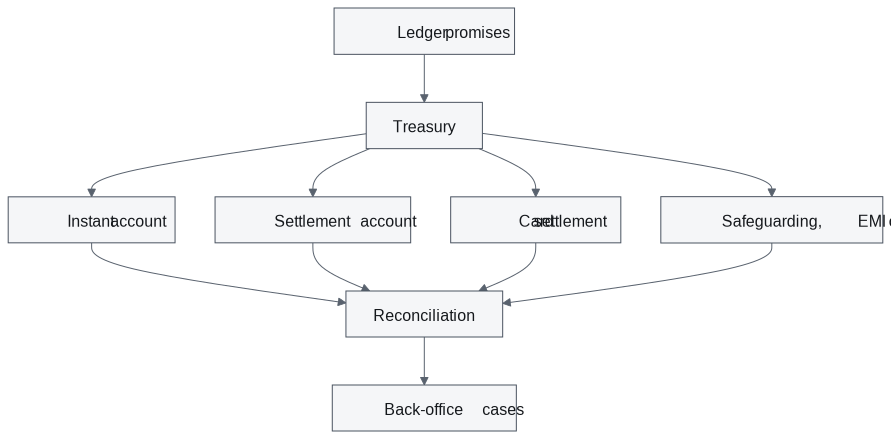
The diagram shows where funds are held and which block monitors each position. A correspondent bank account (a partner bank's account for payments outside SEPA) is introduced in Phase 2.
How it works
Intraday liquidity
Treasury maintains a position snapshot for each external account, comprising its balance, the amounts pending inbound and outbound, and a projected balance. The inputs are events already published by the money path: settlements from the rail gateway, net scheme settlement from cards and outgoing orders from payments.
Each account has a floor, the lowest acceptable balance, and a preferred balance, the balance that treasury aims to maintain. The finance lead sets both. Treasury projects the balance forward (60 minutes for the instant account, a target) and responds at three levels:
- Watch: the projected balance is below the preferred balance. A dashboard flag is raised.
- Top up: the projected balance is below the floor. Treasury creates a funding order, which moves funds from the settlement account to the instant account. Within the approved per-order and per-day caps, the order is sent automatically.
- Escalate: the order exceeds the caps, or the source account would fall below its own floor. The order remains in
AwaitingApprovaluntil two different staff members approve it (four-eyes), and the on-call treasury contact is paged.
The floors, preferred balances, caps, buffer margin and break age limits stated in this section as targets are default values held as configuration. The finance lead approves the production values in a treasury limits register before friends and family, and each later change requires four-eyes approval and is recorded in audit. Residual risk: the defaults are not calibrated against live flows until the first months of operation, and the stressed buffer figure is the control during that period.
treasury creates and approves funding orders only. Under the Lithuanian profile, sepa-gateway sends each order to the central bank as a liquidity transfer message, signed in the hardware security module. The order identifier is used as the message's end-to-end identifier, so the central bank rejects a duplicate. The diagram shows one automatic top-up.
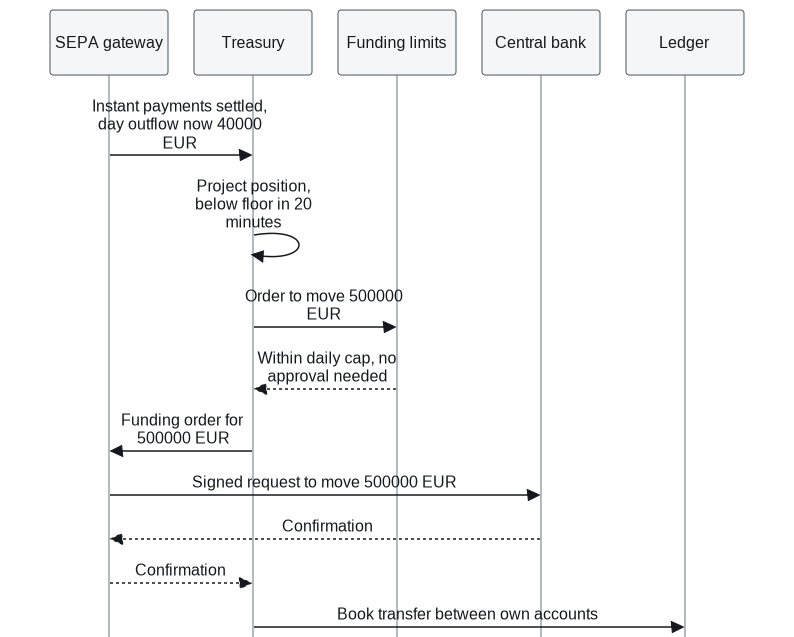
The diagram shows the Lithuanian profile; under the UK profile fps-gateway and Faster Payments take the places of sepa-gateway and CENTROlink. The channel through which a UK funding order is executed depends on the Faster Payments participation model and is described in the United Kingdom profile section.
The top-up is booked as a transfer between two of the bank's own accounts, so no customer balance changes. Each order carries a unique idempotency key, treasury:<funding order id>/transfer, so that a retry after a timeout is recognised and does not move funds a second time.
Headroom. Headroom is the amount that can still leave the instant account before the balance reaches the floor. Treasury publishes it as an event on every change and at least every 60 seconds as a heartbeat. payments checks its local copy before sending an instant order, so treasury is not on the money path and its data may lag by several seconds. After each order sent, payments deducts the amount from its local copy until the next event arrives. When headroom is insufficient, the order moves to Rejected with the reason code LiquidityShortage, and the application offers the alternative set by the profile, a standard credit transfer under the Lithuanian profile. If the local copy is older than 5 minutes (target), payments assumes no headroom for large orders and treasury sections the on-call contact.
Weekends and holidays
Settlement constraint. Under the Lithuanian profile, funds can be moved from the settlement account to the instant position only while TARGET is open, Monday to Friday. A future weekend window has been announced but not dated (ECB news[6], Bundesbank[5]). Automatic top-ups therefore operate only within those hours. Incoming instant payments add to the position.
Buffer. Before each weekend and TARGET holiday, treasury funds a buffer. Its size is the larger of two figures:
- the largest net outflow over a closed period of the same length in the last 12 months, plus a margin (target);
- a stressed outflow of 25% of instant-eligible balances over that period (planning assumption). The board sets the percentage in the risk appetite.
Until 12 months of history exist, only the second figure applies. A runbook names who may request an exceptional transfer from the Bank of Lithuania.
Throttle ladder. If headroom falls below the floor and no top-up is possible, risk applies limits in steps, each activated by the headroom event:
- Instant payments above a per-payment ceiling are refused.
- Instant payments to first-time payees are refused.
- Instant payments above a daily total per customer are refused.
The steps are limits held as data in risk. Standard transfers are processed on the next settlement day. Under the Lithuanian profile, the ladder rests on the assumption that temporary, liquidity-based limits on outbound instant payments are compatible with the duty under Regulation (EU) 2024/886[19] to offer instant payments at all times; the assumption and its fallback are listed under Assumptions and dependencies.
For cards, treasury compares the scheme's daily net settlement with the cleared card entries and plans the funding movement (Cards).
Customer money under each licence
The table shows the Lithuanian profile and uses a customer holding EUR 5,000.00 as the example. The UK counterpart is described in the United Kingdom profile section.
| EMI mode | Bank mode | |
|---|---|---|
| Legal character of the EUR 5,000.00 | E-money, not a deposit | A deposit |
| Ownership of the funds | Held apart from the institution's own funds for the benefit of the customer | The bank, which may lend them |
| Protection | Segregation in safeguarding accounts, no deposit insurance | Deposit insurance up to EUR 100,000.00 per depositor per institution |
| Daily check | Ledger liability must equal the safeguarding account balances | Depositor view, by account and currency |
| Rule source | EMD2 Art 7[2], PSD2 Art 10[3] | Deposit insurer[4] |
EMI mode. Under the Lithuanian profile, customer funds must be safeguarded within five business days of the issue of the e-money. Safeguarding means segregated accounts at a credit institution, investment in low-risk assets, or insurance or a guarantee. A Bank of Lithuania resolution (03-33) adds detail, including a recommendation to keep at least two safeguarding accounts (Ecovis[7], as reported). Treasury performs a daily safeguarding reconciliation, comparing the end-of-day ledger liability for customer e-money with the end-of-day balances of the safeguarding accounts, taken from bank statements. A shortfall is a break of type SafeguardingShortfall, of the highest severity, and requires a top-up on the same day. This module is designed in Phase 0 and built only if the EMI route is chosen.
Bank mode. Under the Lithuanian profile, deposit insurance covers a depositor's accounts and currencies together, including interest, and pays out within seven working days. E-money is excluded. Each day accounts therefore builds a depositor view, and treasury checks it against the ledger at close. The seven-day payout period requires that the bank can produce the depositor file on request. The depositor view holds, per depositor, the accounts, currencies, balances and accrued interest from which such a file is produced; the insurer's file format and delivery deadline are listed under Assumptions and dependencies.
Until the board approves an investment policy proposed by the finance lead, deposit funds are held only as central bank balances and, under the UK profile in Phase 1, as sight balances with the sponsor and with other credit institutions approved by the board. Treasury's position snapshot covers each such account. Cost: the yield forgone on assets other than central bank balances until the policy is approved.
Three further duties apply from the licence date, because Phase 1 pays interest on balances: interest rate risk on deposits, the liquidity coverage ratio and the stable-funding ratio. The mart carries maturity and repricing fields from Phase 1, and reporting produces the corresponding reports in Phase 1 if the first licence is a bank licence. reporting and treasury also supply the mart data for the bank's internal capital and liquidity adequacy assessments (ICAAP and ILAAP). The finance lead sets the ratio thresholds. This document commits only to supplying the ledger data they require.
Reconciliation: a first-class system
Reconciliation compares two records of the same facts and explains every difference. There are three kinds.
| Kind | Compares | Example | When |
|---|---|---|---|
| Internal | The ledger against its own rules | Entries sum to zero, clearing accounts at zero | Continuously, full run at close |
| External | The ledger against counterparties' records | Settlement files, processor files, bank statements | Each file on arrival, full run at close |
| Operational | Payment and card states against bookings | A Settled payment has a booked capture | Every few minutes, and at close |
Each run records its kind, the two sources, the business date and the counts of matched and unmatched items. Each unresolved difference is a break, with a type, an amount, a first-seen date, an owner, a state and a resolution note.
Matching uses identifiers already carried by the money path: the instant rail's payment identifiers (the ISO 20022 end-to-end and transaction identifiers under the Lithuanian profile, and the Faster Payments identifiers mapped by fps-gateway into the canonical model under the UK profile), the scheme transaction identifier for cards and the ledger reference. Where no identifier is available, matching falls back to amount, date and counterparty. The result remains Suggested until a person confirms it.
Example: at close, the ledger shows instant payments totalling EUR 41,250.00 sent during the day, whereas the central bank statement shows EUR 41,900.00. The difference of EUR 650.00 is a customer's rent payment. The settlement appears on the statement, but the confirmation arrived after the ledger cut-off, so the posting fell on the next business date. The difference is a break, which becomes Explained when the next day's ledger shows the matching entry.
Each break is managed as a case:
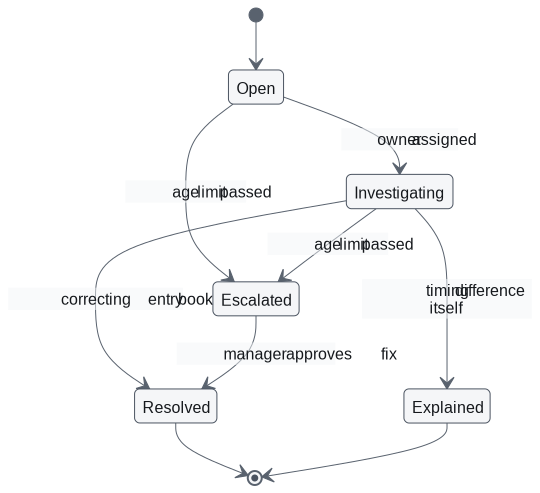
Breaks are grouped by age: same day, 1 to 2 days, 3 to 5 days and over 5 days (target). Each type has an age limit, after which the case moves to Escalated:
| Break type | Age limit (target) |
|---|---|
SafeguardingShortfall | None: escalated at once |
| Settlement or prefunded account difference | Same day |
| SEPA suspense item (funds received that no account claims) | 1 business day |
| Other external difference | 3 business days |
A correction is made by a correcting entry through the ledger with maker and checker, as described in Ledger and accounts. An incoming instant payment that the bank has accepted but whose settlement is unconfirmed at close is also a break.
End-of-day close
Close is a controlled cut in the ledger's business date and does not involve a shutdown. It runs every calendar day at the ledger cut-off, which is midnight Lithuanian time under the Lithuanian profile (Ledger and accounts). Under the Lithuanian profile, reconciliation of SCT and TARGET statements runs after the last TARGET cycle on TARGET days and covers the calendar days since the previous run. The steps are as follows:
- The business date rolls at midnight in all circumstances, and new entries are booked on the new date.
ledgerthen seals the old date. Late entries for the old date are booked on the new date with their original value date. - Internal checks run: the trial balance (a check that all debits equal all credits across the whole book), the clearing accounts and the customer balance totals.
- External reconciliations run against the statements and files received.
- In EMI mode, the safeguarding reconciliation runs. In bank mode, the depositor view is checked against the ledger.
treasurypublishes aclose_report, a one-section list of items that remain unexplained.- The general-ledger journal feed is produced.
A blocking issue does not stop payments. It suspends publication of the day's reports until a person signs off. After a region failover, sealing of the old date waits until the lost-order reconciliation described in Platform, data and operations is complete, while the date itself continues to roll.
From product ledger to company ledger
The ledger records every movement of customer funds and the bank's own operational accounts. The company also requires a conventional accounting book, the general ledger (GL), which accountants, auditors and tax authorities use. The two serve different purposes and are maintained separately.
- At close,
reportingreads the sealed day's entries and groups them by an account mapping, from product ledger account classes to GL accounts. - It writes one summarised journal per day, of a few dozen lines, each with a lineage reference.
- An adapter owned by the bank sends the journal to the procured accounting package (Overview, point 1).
- GL balances are compared with product ledger balances per class. A difference is an internal break.
Financial statements are prepared under IFRS, the international accounting standards, in both profiles: as adopted by the European Union under the Lithuanian profile and as UK-adopted under the UK profile. The account mapping and the mart are therefore built for one accounting framework. Accounting policies within the standards, including the credit-loss provisioning method described in Fraud, risk and lending, are set by the finance lead and agreed with the auditor before the first annual statements.
Reporting to the regulator
As of November 2026, the obligations depend on the licence and the profile, and some are subject to change. The table lists the Lithuanian profile; the UK obligations are listed in the United Kingdom profile section.
| Area | Description | Status |
|---|---|---|
| Prudential | Capital, liquidity and large-exposure figures for a bank. For an EMI, own funds of 2% of average outstanding e-money (EMD2 Art 5[2]) | EMI rule confirmed; bank report list as assumed below |
| Statistical and payment statistics | Data for the central bank | Report list as assumed below |
| AML and sanctions | Suspicious transaction and freeze reports to the financial intelligence unit | Owned by compliance, see Knowing the customer |
| Account closed or restricted by the bank | Report to the Bank of Lithuania within 5 calendar days | As reported |
| Deposit insurance | Depositor data for the insurer | Format and deadline as assumed below |
| Tax | Reports on accounts opened and closed, annual balances and turnover, and FATCA and CRS (rules under which banks report accounts held by foreign tax residents) | As reported; deadlines as assumed below |
An entry marked "as assumed below" corresponds to a row of Assumptions and dependencies: the requirement is set by the named authority, and the design meets it with a report definition over the existing mart. The internal thresholds for the capital and liquidity ratios are set by the finance lead above the regulatory minima and approved by the board in the risk appetite. The annual extract by account holder and controlling person and the customer's yearly interest statement are report definitions like any other, with lineage and sign-off. Withholding on deposit interest, where it applies, is a rule in accounts at interest posting and a report definition in reporting; its applicability is listed under Assumptions and dependencies.
A governed data mart with lineage
Reporting does not query live service databases. Overview point 3 prohibits it, and a heavy report must not slow the money path.
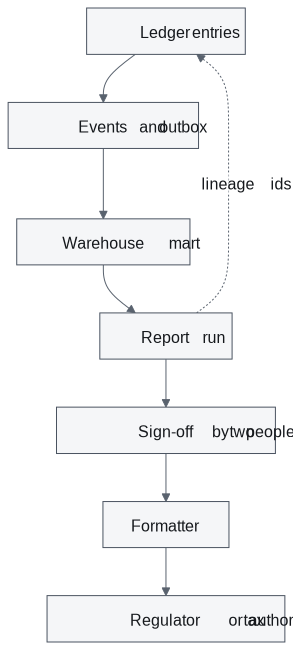
- Each service publishes events through its outbox, and the data platform lands them in the warehouse (Platform, data and operations).
reportingowns the mart, built by versioned jobs: ledger entries, accounts, counterparties and daily balances. A counterparty appears only as acounterparty_id(a keyed hash of the account identifier issued bypayments) and never by name.- A report definition is code: a query plus a mapping from columns to report cells, versioned and reviewed.
- A report run records the definition version, the data snapshot and the signatories. The same inputs produce the same output, so an auditor can repeat a run.
- Sign-off is four-eyes in the console. Only a signed run may be submitted.
- A procured formatter converts cell values into the regulator's file format behind an adapter. Prudential reports are expected to use XBRL, an XML-based reporting format.
Some files must legally carry personal data, namely the tax authority's account reports and the insurer file. customers assembles them from a list of identifiers and figures supplied by reporting, and the vault logs every field it releases (Privacy).
Lineage. Each cell has a lineage reference listing the mart rows behind it, and each mart row carries the identifiers of the ledger entries behind it. A reviewer can therefore trace a reported figure to the ledger entries and the original event. The reverse direction is also supported: for a given incorrect entry, every report run it affected can be listed.
Management information and Phase 2 risks
Management information is derived from the same mart: balances, funding use, break ageing and instant-payment shortfalls. FX risk (positions outside the base currency) is introduced with multi-currency in Phase 2, together with lending and credit-loss reporting. The mart already carries maturity and currency fields, so these reports extend the existing design.
United Kingdom profile
| Aspect | Lithuanian profile | UK profile |
|---|---|---|
| Base currency of positions and reports | EUR | GBP |
| Instant rail settlement | Prefunded CENTROlink account, funded from TARGET | Phase 1: through a sponsor settlement participant; Phase 2: own Bank of England settlement account, with a Pre-Funded Account that holds cash equal to the Net Sender Cap |
| Settlement days | TARGET days | UK business days; Faster Payments settles three times on each |
Customer money, emi | Safeguarding under Lithuanian law | Safeguarding under the FCA regime, including the supplementary regime in CASS 15 |
Customer money, bank | Lithuanian deposit insurance, EUR 100,000.00 | FSCS, GBP 120,000 per depositor per authorised firm |
| Depositor file | Format and deadline set by the insurer, as assumed below | Single Customer View and exclusions view within 24 hours |
| Prudential returns | Bank of Lithuania; bank report list as assumed below | PRA rules; FCA RegData and Bank of England BEEDS |
Settlement funding in Phase 1. Under the UK profile the bank joins Faster Payments as a directly connected non-settling participant. fps-gateway holds the bank's own connection, and a sponsor that is a directly connected settling participant authorises each debit and each credit in near real time and settles on the bank's behalf (Payments). The instant position monitored by treasury is therefore the balance held with the sponsor, against which outbound payments are authorised. Floors, headroom, the response levels and the throttle ladder apply to this position unchanged, and a funding order is a transfer into the sponsor account between the bank's own accounts. The bank keeps its operating cash for Faster Payments funding in an account at the sponsor, so that a funding order is a book transfer that can run at any hour; if the sponsor cannot offer this, funding is limited to CHAPS hours and the buffer funded before each non-settlement period is the remaining control. Because the sponsor authorises inbound credits as well as outbound debits, its availability and response time bound the service in both directions; they are contract terms and are mapped as a resource of the payment services in Platform, data and operations. Bacs is reached indirectly through the sponsor in Phase 1: the bank's inbound Direct Credits and the Direct Debits that it pays as paying bank settle in the sponsor's Bacs settlement at 09:30 on entry day, and the sponsor passes the bank's net Bacs amount to the bank's account with it (Payments, D04.8). The morning position on each Bacs processing day therefore includes the Direct Debits due for entry that day. The prefunding amount, the sponsor's limits and its fee, for Faster Payments and for Bacs, are terms of the sponsor contract and are treated in Payments; the funding arrangement on which this section relies is listed under Assumptions and dependencies.
Settlement funding from Phase 2. The bank moves to settling participation with its own settlement account at the Bank of England. Reserves accounts are sterling accounts held in the Bank of England's real-time gross settlement system (RTGS) and offered to eligible firms within the Sterling Monetary Framework (Bank of England, Market Operations Guide[17]). Banks authorised to take deposits in the UK may apply, and admission is at the Bank of England's sole discretion after its risk assessment (information for applicants[17], application form[16]). Phase 1 does not depend on such an account, because the sponsor settles on the bank's behalf. As a settling participant the bank sets a Net Sender Cap under Pay.UK's rules and holds cash equal to the cap in a separate Pre-Funded Account at the Bank of England (a Reserves Collateralisation Account for a reserves account holder). Settlement is deferred net, in central bank money, in RTGS three times on each UK business day, at 07:00, 13:00 and 17:00 (Bank of England, RTGS daily timetable[12]); no cycle runs at weekends or on bank holidays. Settlement obligations are paid in each cycle from the settlement account, and the Pre-Funded Account is drawn only if the bank fails to settle. Headroom under this model is the cap less the current net sending position, and the central infrastructure refuses a payment that would breach the cap. An increase of the cap follows the scheme's procedure and requires matching cash in the Pre-Funded Account, and both steps are possible only while RTGS is open; the cap is therefore sized in advance for the longest run of non-settlement days and cannot serve as an intraday control. Until the bank participates directly in CHAPS in Phase 3, funding and defunding the settlement account requires a CHAPS sponsor. Bacs settles once daily at 09:30 on each Bacs processing day with prefunding; the bank's Bacs items continue to settle through the sponsor, and a Bacs settlement position of the bank's own is added only if the bank joins Bacs directly, which is a Phase 3 option.
Weekends and holidays. Settlement takes place on UK business days, which are weekdays other than bank holidays in England and Wales, whereas payments continue at all hours. The net position therefore accumulates over weekends and bank holidays, and the longest run without settlement is four consecutive days, at Easter and at some year-ends. The buffer is sized for that run, against the sponsor balance in Phase 1 and against the Net Sender Cap in Phase 2. The throttle ladder applies to outbound payments only, since participants must receive and respond to all payment types at all times. An order rejected with LiquidityShortage is offered as a Forward-Dated Payment.
Customer money, bank. The FSCS protects GBP 120,000 per depositor per authorised firm for failures on or after 1 December 2025, and temporary high balances up to GBP 1.4 million for six months (Depositor Protection 10.7); the payout period is seven business days (Depositor Protection 9.3). The bank must provide all single customer views and an exclusions view to the FSCS within 24 hours of deposits becoming unavailable, and on request by the PRA or the FSCS (Depositor Protection 12.1 and 12.2). The depositor view built daily by accounts produces both files. The Single Customer View holds one record per eligible depositor: accounts aggregates all of a depositor's accounts and pots, divides a joint account between its holders, marks the eligible deposits, and moves accounts unfit for automatic payout, including accounts under a sanctions freeze, in a legal dispute or dormant, to the exclusions view. Because the 24 hours run from the failure or from a request at any time of year, the view can be rebuilt from the ledger for any past cut-off time. The PRA treats the 24 hours as starting at the end of the business day on which a request is made, and the account snapshot is taken at close of business on the relevant date. The account balance includes every payment for which value has been credited to the depositor's account and excludes every payment that has been debited from it, whether or not settlement between firms has completed; a card payment that has reduced the available balance is therefore excluded from the compensatable amount, and an outbound Faster Payment or Bacs item already debited is excluded although it has not yet settled (Depositor Protection 12.14; PRA SS18/15[24], chapter on in-flight transactions). The depositor view therefore uses the available balance, net of holds. customers assembles the personal data, as for the Lithuanian insurer file. The files are delivered by secure electronic transmission, through the Secure File Transfer Protocol or the FSCS web portal, in one of the three file layouts that the PRA treats as compatible with the FSCS's system, with one line per depositor and the character | as delimiter in text files (Depositor Protection 12.4 and SS18/15); the layout is formatter configuration, and the single-file layout is the default. The PRA or the FSCS may request the files or an effectiveness report on the system at any time, and a material change to the system is notified to both within three months with an attestation by the governing body (Depositor Protection 14.3 and 15.3, as described in SS18/15). File generation is therefore tested quarterly (target), and the board attests to the system as the depositor protection rules require.
Customer money, emi. E-money is not a deposit and is not covered by the FSCS, so safeguarding is the only protection. Relevant funds are segregated or covered by insurance or a guarantee. The supplementary regime introduced by FCA PS25/12, in force since 7 May 2026, requires internal and external safeguarding reconciliations at least once each reconciliation day, a resolution pack, a monthly safeguarding return and an annual safeguarding audit; the audit is not required where a firm has held no more than GBP 100,000 of relevant funds at any time over a period of at least 53 weeks (FCA PS25/12[25]). The daily safeguarding reconciliation and the SafeguardingShortfall break meet the reconciliation requirement; reporting adds the monthly return as a report definition, and any further FCA return required of an electronic money institution is added in the same way. Own funds are 2% of average outstanding e-money. In emi mode the balance held with the Faster Payments sponsor is funded from the firm's own money and is outside the safeguarded pool. Inbound payments received into the sponsor position are relevant funds from receipt and are transferred to the safeguarding account within the period that the FCA regime allows, and the daily reconciliation includes the sponsor position as a reconciling item (planning assumption, listed under Assumptions and dependencies). The own liquidity that this requires is part of the cost of the EMI route in Delivery plan.
Prudential regime and returns. The base capital requirement is EUR 5 million for a bank, or the higher of EUR 1 million and GBP 1 million for a small specialist bank, a PRA category with a lower floor (the PRA rule states these thresholds in euro). Required capital is driven by Pillar 1, the minimum calculated under common rules, by Pillar 2A, the firm-specific addition set by the PRA, and by buffers. A bank meeting the size and domestic-activity tests may opt into the Small Domestic Deposit Taker (SDDT) regime. Its liquidity and disclosure simplifications are in effect and its simplified capital regime applies from 1 January 2027, the date from which a bank outside the regime applies Basel 3.1 (PRA PS1/26[30]); both therefore apply before the earliest forecast authorisation. The liquidity coverage ratio and the stable-funding ratio must each be at least 100% (PRA Rulebook, Liquidity Coverage Ratio (CRR) Part[18], Article 4(2), and Liquidity (CRR) Part[18], Article 428b(2)), and liquidity is also reported in the PRA110 cash-flow mismatch return. The stable-funding provisions do not apply to an SDDT whose four-quarter moving average retail deposit ratio was at least 50% on the most recent quarterly reporting date and on each of the three preceding dates (Liquidity (CRR) Part, rules 5.4 and 5.5). The planning assumption is that the bank, which is expected to meet the size and domestic-activity tests at authorisation, opts into the SDDT regime; the firm-specific requirements that the PRA sets, namely Pillar 2A and the buffers, are an assumption listed in Licence and regulation. reporting holds each return as a report definition, so the choice selects the report set and requires no change to the mart. The mart supplies data for the required ICAAP, ILAAP, recovery plan, solvent exit analysis and resolution pack. COREP and FINREP are submitted in XBRL; most prudential returns go through FCA RegData, and Capital+ and statistical returns through the Bank of England Electronic Data Submission portal (BEEDS). Statistical obligations are notified at authorisation. Returns start at authorisation with restrictions, the start of mobilisation (Licence and regulation).
Other recipients. Amounts due to and from other firms under authorised push payment (APP) fraud reimbursement are reconciled as external items (Fraud, risk and lending). Financial statements follow UK-adopted IFRS, as stated under the general-ledger feed; the UK GAAP alternative is not used, so that one accounting framework serves both profiles at the cost of the fuller IFRS disclosures. UK tax reporting on accounts and interest is listed under Assumptions and dependencies.
What does not change. Reconciliation, break cases, the close, the general-ledger feed, the mart, lineage and sign-off are identical in both profiles; the formatter takes the submission channels as configuration, and the account mapping is maintained per profile.
Key design decisions
D08.1 Reconciliation is built in from day one, not a spreadsheet
Decision: treasury runs internal, external and operational reconciliation as software, with runs, items and breaks, ageing and owners, from the first customer.
Rationale: Payment networks, card processors and banks send files that differ from the bank's books in small ways every day. A spreadsheet is workable at a thousand payments a day but not at the peak target in year three of 200 money-path requests per second in total (payments and card authorisations), about 1,000 posting rows per second. Safeguarding also requires evidence that the checks ran daily.
Alternative considered: Spreadsheets operated by finance staff, with automation later. This is cheaper in the first week.
Cost: Additional engineering before launch, representative test files from each counterparty, and several months of tuning the matching rules.
D08.2 The instant-payment position is funded automatically within limits
Decision: Treasury projects the prefunded position and creates funding orders automatically within per-order and per-day caps while TARGET is open. Above the caps, an order requires four-eyes approval and sections the on-call contact.
Rationale: Instant payments operate 24 hours a day and fail when the account balance is insufficient, so a manual process cannot be the sole control at 3 a.m. Outside settlement days the controls are the pre-weekend buffer and the throttle ladder, as automatic top-up is unavailable.
UK profile: The same rule applies to the Faster Payments position, which is the balance held with the sponsor settlement participant in Phase 1 and the headroom under the Net Sender Cap in Phase 2. In Phase 1 automatic funding orders run at any hour where the funding account is held at the sponsor, and otherwise in CHAPS hours. In Phase 2 the cap and the cash in the Pre-Funded Account are changed through the scheme's procedure while RTGS is open, so the cap is sized in advance. Outside UK business days the buffer and the throttle ladder remain the controls.
Alternative considered: A large permanent buffer. This is simple to operate but ties up funds that could finance lending.
Cost: An automated mover is a high-trust component, and a defect could move too large an amount. The caps, the unique idempotency key and an alert on every top-up limit that risk. The weekend buffer also ties up funds.
D08.3 Buy the general ledger and the regulatory-reporting formatter, own the data and lineage
Decision: The accounting package and the XBRL formatter are procured behind adapters. The bank owns the mart, the account mapping, the report definitions and the lineage.
Rationale: Packages and taxonomies change on their vendors' schedules and provide no differentiation. The ledger is known only to the bank, so data and lineage can be built correctly only in-house.
Alternative considered: Using the product ledger as the accounting book. This removes one system but combines customer records with accounting policy.
Cost: Licence fees, adapters and maintenance of the mapping.
D08.4 Every reported number is traceable to ledger entries
Decision: Each cell in each report run carries a lineage reference that resolves to mart rows and ledger entry identifiers. A stored definition version and data snapshot make every run reproducible.
Rationale: A regulator or auditor will ask for the origin of a figure.
Alternative considered: Aggregated tables and the final files only. These are smaller and faster to build.
Cost: Additional append-only storage, and the discipline that no report uses a figure without lineage.
D08.5 Licence mode switches safeguarding or deposit-insurance modules
Decision: Licence mode is a setting. The default route is a direct bank licence, so bank mode, with its depositor view check and prudential feeds, is built for Phase 1. EMI mode adds safeguarding reconciliation, the shortfall workflow and the EMI report set; these are designed in Phase 0 and built only if the EMI route is chosen. Position, reconciliation, close, mart and lineage are shared.
Rationale: Customer funds form one ledger account class in both modes and only the surrounding checks differ, so a switch is inexpensive if the design is ready.
UK profile: The setting and the default route are the same. In bank mode the depositor view also produces the FSCS Single Customer View and exclusions view files within 24 hours. In EMI mode safeguarding follows the FCA regime, and the EMI report set adds the monthly safeguarding return and the evidence for the annual safeguarding audit.
Alternative considered: Building both modules for Phase 1, or building only bank mode and rebuilding later for an EMI. The first builds a module that may never be used. The second makes a later switch a rebuild.
Cost: The EMI modules require testing before that mode goes live, and the switch requires a rehearsal agreed with the supervisor.
Failure modes and mitigations
| Failure | Effect | Response |
|---|---|---|
| Prefunded account has insufficient funds at a weekend | Instant orders rejected, failed payments | Weekend buffer funded before Friday close, automatic top-up only while TARGET is open, throttle ladder, on-call section, manual runbook |
| Top-up sends the wrong amount | Excess funds leave the settlement account | Per-order and per-day caps, unique idempotency key per order, alert on every order, four-eyes above caps |
| Statement file late or duplicated | False breaks, or a day not reconciled | Files processed by file identifier, duplicates skipped, late files re-run the day with a note |
| Safeguarding shortfall (EMI route only) | Customer funds not fully protected | Highest-severity break, same-day top-up, report to compliance |
| Break ages without an owner | Minor error becomes a loss or audit finding | Required owner, age limits, escalation |
| Incorrect GL mapping | Income or liabilities misstated | Daily GL and ledger comparison per class, finance sign-off for mapping changes |
| Report definition changed after submission | Past report cannot be reproduced | Versioned definitions, run stores version and snapshot |
| Mart lags the ledger | Reports use stale figures | Run records the mart watermark and is refused above a lag limit |
| Sponsor settlement participant suspends or delays authorisation (UK profile, Phase 1) | Faster Payments cannot be sent, and inbound payments cannot be authorised for credit | Headroom set to zero, outbound orders rejected with LiquidityShortage before submission, inbound behaviour as set by the scheme and the sponsor agreement (Payments), sponsor incident runbook |
| Net Sender Cap reached between settlement cycles (UK profile, Phase 2) | Outbound Faster Payments refused | Headroom tracks the cap, cap sized in advance for the longest non-settlement run, cap increase with matching Pre-Funded Account cash while RTGS is open, throttle ladder |
| Single Customer View file not produced within 24 hours (UK profile, bank mode) | Breach of depositor protection rules, delayed payout | Files generated from the daily depositor view, which can be rebuilt for any cut-off time, exclusions marked daily, quarterly generation test |
| Monthly safeguarding return late or wrong (UK profile, EMI mode) | Regulatory breach | Return built from the signed daily safeguarding reconciliations, four-eyes sign-off, lineage |
Security and privacy considerations
- The mart uses customer identifiers and
counterparty_idonly (Overview, point 10).customersassembles files that require names and logs every released field. See Privacy. - Funding orders, sign-offs and break resolutions are sent to
auditwithout personal data values. - Central bank interface credentials and signing keys are held in HSM-backed key management (Security).
- Retention of reports, reconciliation records and lineage is a setting, because under the Lithuanian profile the anti-money-laundering period changes in 2027 (licence and rules). The setting covers report runs, their data snapshots and lineage references, which are retained for the longest period that applies to any record they evidence. These records hold customer identifiers and
counterparty_idonly, so the longer retention adds append-only storage and no personal data values.
Phasing
Phase 1:
- Position snapshots, limits, automatic top-up, weekend buffer, throttle ladder, four-eyes escalation and the headroom event.
- All three reconciliations, break cases and close.
- The depositor view check and the bank-mode prudential feeds, including interest rate risk and liquidity reports. Safeguarding reconciliation is built only if the EMI route is chosen.
- Daily journal to the accounting package.
- The mart with maturity and repricing fields, lineage, sign-off, launch reports (the list as assumed under Assumptions and dependencies), tax account reports and a first management pack.
- Feeds for the ICAAP and ILAAP.
- UK profile: the sterling position held with the Faster Payments sponsor settlement participant, the daily Bacs settlement through the sponsor, the FSCS Single Customer View and exclusions view files in bank mode, the monthly safeguarding return in EMI mode, and PRA and FCA returns through RegData and BEEDS, including the recovery plan, solvent exit and resolution pack data.
Phase 2: correspondent and multi-currency positions, FX risk, liquidity stress views, lending and credit-loss reporting, SDD settlement positions. UK profile: the Bank of England settlement account, the Net Sender Cap and the Pre-Funded Account.
Phase 3: partner-level settlement and reporting for banking-as-a-service clients. UK profile: direct CHAPS participation for funding and defunding the settlement account, and, if the bank joins Bacs directly, its own Bacs settlement position.
See Delivery plan and the Glossary.
Assumptions and dependencies
The design in this section rests on the following assumptions, each confirmed at the stated point. None blocks the start of the build, because each fallback is a change of configuration, an additional report definition or an adapter within the components described above.
| Assumption | Confirmed by | When | If it does not hold |
|---|---|---|---|
| Lithuanian profile: the CENTROlink rules and operating schedule in force at onboarding keep the funding mechanism of the 2023 rules, in which the instant-payment collateral account is supplemented by transfers from the bank's TARGET account on TARGET days. | The Bank of Lithuania | Scheme onboarding | The funding-order channel and the automatic top-up window in treasury are reconfigured, and the buffer is sized for the longer period without funding. |
| Lithuanian profile: temporary, liquidity-based limits on outbound instant payments (the throttle ladder) are compatible with the duty to offer instant payments at all times under Regulation (EU) 2024/886. | Counsel | Phase 0 exit | The ladder steps are disabled in risk, where they are held as data, and the stressed outflow percentage of the buffer is raised so that the buffer is the sole control; the additional idle funds fall within the cost envelope of section 13. |
| Lithuanian profile: the Bank of Lithuania's prudential and statistical report list, formats and submission channel for a specialised bank, and the deposit insurer's depositor data format and deadline, are met by report definitions over the mart and the depositor view and by configuration of the procured formatter. | The Bank of Lithuania, the deposit insurer and the finance lead | Before the licence application | The missing fields are added to the mart and the report definitions in Phase 1, and a format that the formatter does not support is produced by an additional adapter. |
| Both profiles: tax reports on accounts and interest, withholding on deposit interest and, under the Lithuanian profile, the report on accounts closed or restricted by the bank within 5 calendar days apply as stated in this section. | Counsel | Before friends and family | Each deadline is a parameter of its report definition, and a withholding rule is added to interest posting in accounts. |
| Lithuanian profile, EMI mode: the text of the Bank of Lithuania's safeguarding resolution adds no requirement beyond those stated in this section, and any external safeguarding audit is served by the daily reconciliation records. | Counsel | Before the licence application | The number of safeguarding accounts and the reconciliation frequency are settings, and the audit evidence is added as a report definition. |
| UK profile: the sponsor holds the bank's operating cash for Faster Payments funding in an account with it, so that a funding order is a book transfer at any hour, and its prefunding requirement is covered by the buffer sized for a four-day run. | The sponsor bank | Sponsor contract | Funding is limited to CHAPS hours, automatic top-up in treasury is restricted to those hours, and the buffer funded before each non-settlement period is raised accordingly. |
| UK profile: the Bank of England admits the bank to the Sterling Monetary Framework and opens its settlement account for Phase 2, and the procedure for changing the Net Sender Cap and funding the Pre-Funded Account allows the cap to be sized in advance as described. | The Bank of England and Pay.UK | Phase 2 planning | Settlement through the sponsor continues unchanged beyond Phase 1, or the cap is set higher and more cash is held in the Pre-Funded Account. |
| UK profile, EMI mode: the balance held with the Faster Payments sponsor is outside the safeguarded pool, with inbound funds transferred to the safeguarding account within the period the FCA regime allows, and the FCA return set is served by the monthly safeguarding return and further report definitions. | Counsel and the safeguarding auditor | Before the licence application | The sponsor position is brought inside the pool by a same-day sweep to the safeguarding account, the daily reconciliation treats it as a safeguarded balance, and the own liquidity required rises within the cost of the EMI route in section 13. |
Sources
- CENTROlink Operating Rules (Bank of Lithuania, 2023): the prefunded instant payment account.
- Directive 2009/110/EC (EMD2): safeguarding timing, own funds.
- Directive (EU) 2015/2366 (PSD2): safeguarding methods.
- Deposit insurance, Lithuanian insurer: cover, payout period, exclusions.
- Bundesbank, TIPS services: liquidity moves only during TARGET opening hours.
- ECB news, 28 May 2026: announced future weekend settlement window.
- Ecovis, new compliance requirements for e-money and payment institutions: secondary source on the Bank of Lithuania safeguarding resolution.
- Lithuanian Law on Tax Administration, Article 55 (as reported): account reporting to the tax authority.
- Stripe Ledger write-up: clearing accounts and reconciliation as a first-class system.
- Pay.UK, Faster Payments System Principles v11, January 2026: access models, availability, deferred net settlement, sponsor authorisation in near real time, Net Sender Cap and Pre-Funded Account (section 6).
- Pay.UK, changes to Faster Payments Net Sender Caps: how a participant sets its cap.
- Bank of England, RTGS daily timetable: times of the Faster Payments and Bacs settlements.
- Bank of England, payment settlement: settlement of Faster Payments in central bank money.
- Pay.UK, Bacs System Principles v18, January 2026: Bacs settlement time and prefunding.
- Bank of England, access to UK payment systems for non-bank PSPs: CHAPS sponsor needed to fund and defund settlement accounts.
- Sterling Monetary Framework application form: authorisation under the Financial Services and Markets Act as a condition, admission at the Bank of England's sole discretion.
- Bank of England, Market Operations Guide: our tools and information for applicants: reserves accounts within the Sterling Monetary Framework and the institutions that may apply.
- PRA Rulebook, Liquidity Coverage Ratio (CRR) Part, Article 4(2), and Liquidity (CRR) Part, Article 428b(2) and rules 5.4 and 5.5: liquidity coverage ratio and stable-funding ratio of at least 100%, retail deposit ratio condition for an SDDT.
- Regulation (EU) 2024/886: duty to offer instant credit transfers.
- PRA Rulebook, Depositor Protection: FSCS limit, payout period (rule 9.3), period for temporary high balances (rule 10.7) and delivery of the Single Customer View (rules 12.1 and 12.2).
- PRA Rulebook, Depositor Protection 12, Single Customer View: 24-hour file requirement.
- PRA news, November 2025: FSCS limit of GBP 120,000.
- PRA PS24/25: limit for temporary high balances.
- PRA SS18/15, November 2025: exclusions view, start of the 24-hour period, file layouts and delimiter, secure transmission, effectiveness report and attestation, treatment of in-flight transactions.
- FCA PS25/12 and policy statement text: safeguarding supplementary regime, commencement on 7 May 2026, reconciliation frequency and audit threshold.
- FCA Dear CEO letter to e-money firms, May 2021: e-money outside FSCS cover.
- Electronic Money Regulations 2011, Schedule 2: EMI own funds.
- PRA Rulebook, Definition of Capital: base capital requirements.
- Bank of England, Strong and Simple, PS15/23 and final policy statement, January 2026: SDDT regime.
- PRA PS1/26, implementation of Basel 3.1 final rules: Basel 3.1 from 1 January 2027.
- Deloitte, capital regime for small domestic deposit takers: ICAAP and ILAAP (as reported).
- PRA PS10/26, PRA SS2/24 and PRA SS19/13, March 2026 update: recovery plan, solvent exit and resolution pack.
- Bank of England, regulatory reporting for banks, FCA COREP and FINREP and Bank of England statistical reporting: returns, including PRA110, and channels.
- Bank of England, mobilisation: deposit limit during mobilisation.
- UK Endorsement Board, adopted standards: UK-adopted IFRS.