11. Security
Purpose and scope
Access to customer data and to money movement is restricted to authorised staff, and misuse must be prevented or, failing that, detected and attributed. For example, a support agent who opens a customer's balance in the console without a service reason, at 3 a.m. on a Sunday, constitutes an incident; the bank must block the access or detect it and prove who performed it.
The design protects four assets:
- Customers' money: balances in
ledger, and payments leaving through the rail gateway (sepa-gateway, orfps-gatewayunder the UK profile) andcards. - Customers' data: held in
customers(Privacy and data protection). - The bank's ability to operate: an outage harms customers to the same degree as theft.
- The keys that sign payment messages and decrypt data: a holder of these keys can act as the bank.
Five sources of threat are considered:
- External attackers: intrusion, stolen customer passwords and malware.
- Fraudsters using the product as designed: scams are covered in Fraud, limits and credit risk. This section covers abuse of the product's own features.
- Insiders: malicious, coerced or mistaken staff. A support agent who looks up a neighbour's balance is an incident.
- Compromised vendors and dependencies: a breached vendor, processor or library.
- The bank's own defects: a missing permission check exposes data without requiring attacker skill.
Components
Security consists of a set of rules, shared libraries and a few platform components:
- Network zones: all resources are private by default. The only public entry point is
gateway, with one connection to the instant rail through the rail gateway (sepa-gatewayto CENTROlink, orfps-gatewayto Faster Payments under the UK profile) and one to the card processor (cards). Outbound traffic is permitted only to allow-listed addresses. - Workload identity and mutual TLS: Transport Layer Security (TLS) encrypts traffic between parties. In mutual TLS both parties present a certificate, so each service proves its identity on every call.
- Key management: a cloud key service backed by hardware security modules (HSMs). An HSM is a tamper-resistant device that uses keys without releasing them.
- Staff access: the company's identity provider, with single sign-on (SSO), hardware keys and just-in-time grants.
- Approvals: one shared component behind
backoffice-apithat enforces the two-person rule. auditand detection: the tamper-evident record (its storage is described in Platform, data and operations), central logs, detection rules and an on-call rota.
The following diagram shows the trust zones and the points at which they connect to each other and to the outside world.
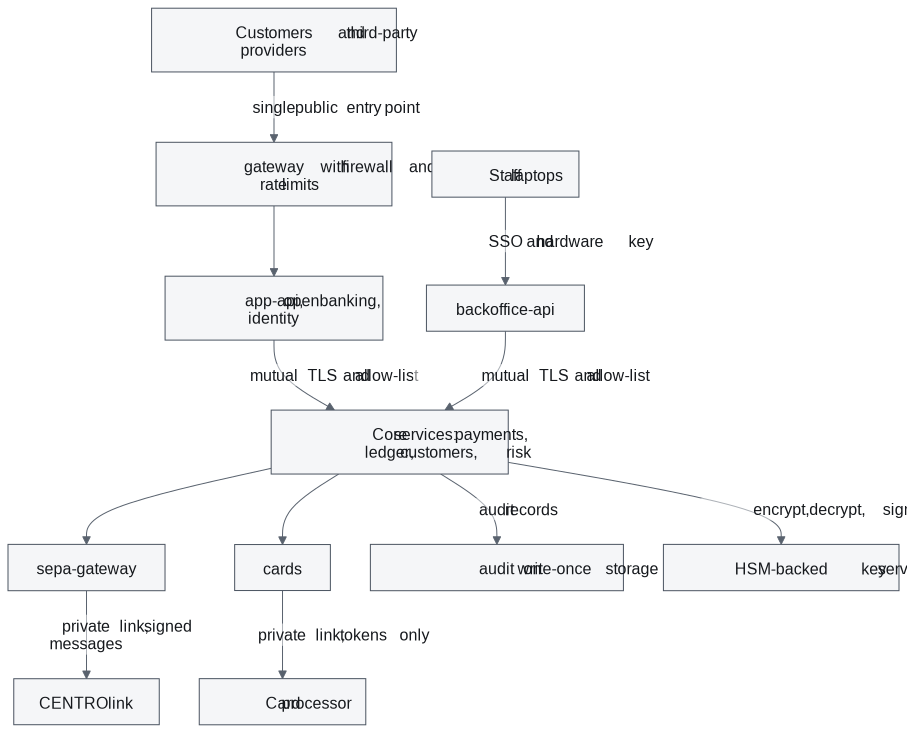
The diagram shows the Lithuanian profile; under the UK profile fps-gateway and Faster Payments take the places of sepa-gateway and CENTROlink.
How it works
Machines: identification and checking of every call
The platform issues each service a short-lived certificate (target: 24 hours or less, rotated automatically), and no service stores a password in a file. The receiving service checks the caller against a per-method allow-list kept in code. For example, payments may call ledger.PlaceHold and comms may not. The ledger's list is the table of allowed callers and entry kinds in Ledger and accounts. A call that is not on the list is refused and logged, including calls originating inside the cluster.
The following sequence shows a customer payment of 650 EUR to a payee across service boundaries. The order exists before the customer authenticates it, so the authentication is bound to that single order. The checks at each step are listed beneath the diagram. Amounts are shown in euro; under the UK profile the same example applies in sterling.
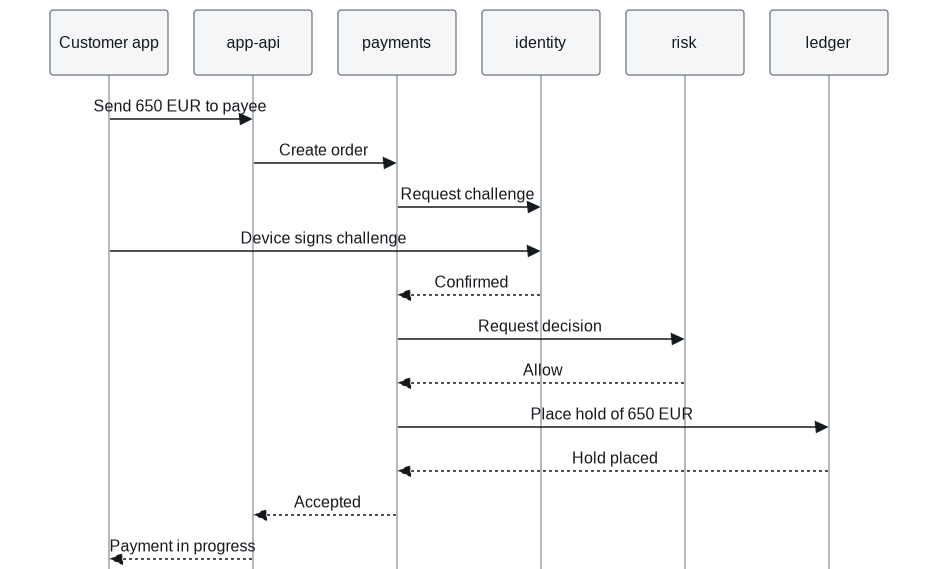
The checks applied in the sequence are as follows:
- The request reaches
app-apionly throughgateway, after the firewall and rate limits. - Every call between services runs over mutual TLS, and the receiver checks its allow-list.
- The order carries an idempotency key and remains in
AwaitingScauntilidentityconfirms.
Services write audit records through their outbox and not on the payment path (Platform, data and operations). Three checks are of particular importance:
- Object ownership. An API must not return another party's record when an attacker alters an ID in the request. The OWASP API Security Top 10 (2023) ranks this flaw, broken object level authorisation, first. Every service that receives a customer or account ID verifies, through one shared library, that the caller is entitled to access that object. A test suite submits other customers' IDs to every endpoint.
- Idempotency. Every write carries an idempotency key, a unique label that gives a request submitted twice the effect of a request submitted once. A replay returns the first result and does not move money a second time. The same key with different content is rejected (Ledger and accounts).
- Strong customer authentication (SCA).
identityissues and verifies the challenge. The proof is bound to the amount and the payee (dynamic linking), as the PSD2 rules require under the Lithuanian profile (Delegated Regulation 2018/389[3]); under the UK profile SCA is required by the Payment Services Regulations 2017 and the FCA's technical standards (Apps, web, back office and open banking).riskdecides exemptions and maintains their counters, andidentityenforces them. Sign-in is described in Apps, web, back office and open banking.
gateway applies rate limits per customer, device and IP address. Tests target business-logic abuse, including negative amounts, two payments competing for one balance, and cycling of savings pots to circumvent a limit.
People: staff identity and access
Staff do not sign in through identity. They use the company's identity provider with single sign-on, which provides one login for all internal tools, together with a phishing-resistant hardware key. The key follows the FIDO2 standard and does not respond to a counterfeit site. SMS and app codes are not available to staff, because a counterfeit login page can capture them.
- Console work: each role sees only the data it requires. A support agent sees a customer's masked contact details and recent payments but not the passport scan.
- Production systems: no human holds standing access. Just-in-time access means that an engineer requests access for one ticket, one scope and one window (target: 4 hours at most). A second engineer approves, and the grant expires automatically. Engineering access shows encrypted fields only.
- Break-glass: a sealed emergency role for use when the approval path itself has failed. Use of the role pages the security lead immediately and records the session. The security lead reviews every use within one business day (target).
Running the bank states who staffs the security on-call rota and the lost-phone line.
Data: keys, envelope encryption and secrets
Data is protected by envelope encryption. Each batch of data receives a data key, and a key-encryption key held inside the HSM wraps (encrypts) the data key. The root key never leaves the HSM, so a copy of the encrypted data is unusable without it. Every unwrap request is checked against the caller's identity and logged.
| Level | Example | Where it lives | Rotation |
|---|---|---|---|
| Root key | One per environment and region | HSM, never exported | Yearly or on suspicion (target) |
| Key-encryption key | customers/personal-fields | HSM-backed key service | Yearly, automatic (target) |
| Data key | Per record batch, per file, or per customer where erasure by key destruction is needed (raw messages, evidence bundles) | Wrapped, next to the data | New for each batch, file or customer; cached at most 5 minutes |
| Payment-message signing key | Signs ISO 20022 messages to CENTROlink; under the UK profile, secures the Faster Payments connection of fps-gateway | HSM, signing inside it | Per the procedures of the Bank of Lithuania's certification system; under the UK profile per the scheme's technical specifications (see Assumptions and dependencies) |
| Workload certificate | Identity of payments | Platform issuer | 24 hours or less (target) |
| Card and PIN keys | Card verification, PIN blocks | Processor or a cloud payment-cryptography service | Owned by that provider |
CENTROlink requires signature certificates from the Bank of Lithuania's certification system (CENTROlink Rules 2023, §11[4]). sepa-gateway has the HSM sign each message. Personal fields in customers are encrypted per field in this way (Privacy and data protection). A service caches an unwrapped data key for at most 5 minutes (target), so that most calls require no round trip to the key service.
Under the Lithuanian profile, Frankfurt is the main region and Ireland the standby. The standby must be able to sign and to read, which requires three conditions:
- Key-encryption keys are multi-region keys, or every data key is wrapped twice, in Frankfurt and in Ireland.
- A second CENTROlink signing certificate is enrolled for an HSM in Ireland and registered with the Bank of Lithuania before launch.
- A second private link to CENTROlink terminates in Ireland. The quarterly failover drill signs and sends a test message from Ireland.
The CENTROlink Rules require the system operator to make a backup connection station at the Bank of Lithuania available to a participant that cannot work through its own connection station (paragraph 144). This station is the fallback if the standby region cannot sign or connect; the acceptance of the second connection point is treated in Platform, data and operations.
Cryptographic algorithms are kept replaceable, so that a later migration to post-quantum cryptography (encryption designed to resist future quantum computers) is a key rotation and does not require a redesign.
Secrets such as vendor API keys are held in a managed secrets store, which services read at start-up through workload identity. Database credentials are short-lived per service where supported. A scanner blocks any commit that contains a secret.
Staff actions: the two-person rule
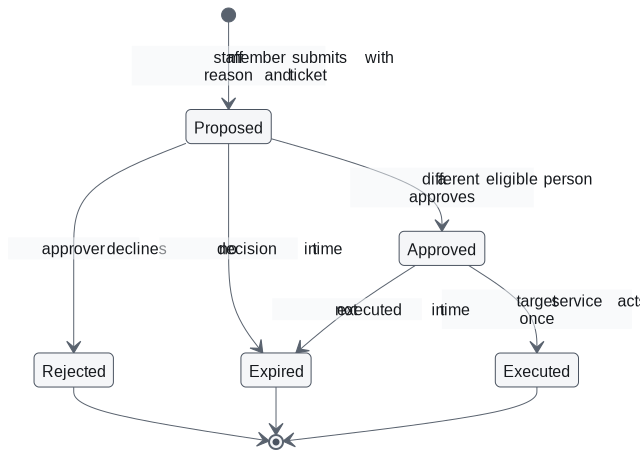
For actions outside the normal customer flow, one person proposes and a different person approves (the four-eyes principle). The approval component refuses an approval by the proposer, and the target service refuses to act without an approved request.
The following state diagram shows the life cycle of one approval request.
| Action | Proposer | Approver | Enforced by |
|---|---|---|---|
| Manual ledger adjustment | Operations | Finance | ledger |
| Lift a fraud freeze | Fraud analyst | Second fraud analyst or team lead | accounts |
| Lift a sanctions freeze judged a false positive | Compliance analyst | Senior compliance | accounts, with ledger enforcing the debit block |
| Release a seizure, estate or AML suspension hold | Named role in accounts or compliance | A second person in that role | ledger |
| Pay out a seizure or estate hold (to the bailiff or the heirs) | Named role in accounts | A second person in that role | accounts books it, ledger allows the one debit |
| Mark a customer as deceased | Support agent | Team lead | accounts |
| Discount a sanctions or PEP screening hit | Compliance analyst | Second compliance analyst | screening |
| Raise limits above the product maximum | Support agent | Risk team | risk |
| Payment on the bank's own behalf, such as an out-of-policy refund | Operations | Finance | payments |
| Reveal a full identity document | Support agent | Team lead | customers |
| Bulk export of customer data | Any role | Data protection officer | customers |
| Change a fraud rule in production | Risk team | Second risk team member | risk |
| Grant production access | Engineer | Second engineer | Access tooling |
| Disable or rotate a root or signing key | Security | Second security engineer | Key service |
A freeze for a confirmed match on a sanctions list is excluded from this table. It ends only after the person is delisted or the competent authority authorises release, and the record keeps the authority's reference. No internal approval can lift it alone. The release procedure and its evidence are set out in Knowing the customer.
Example: a customer requests an increase of the daily card limit to 5,000 EUR, above the product maximum. A support agent proposes the change and a member of the risk team approves it. The system refuses the approval if both roles are held by the same person, and it stores both names.
For actions that reduce a control (unfreeze, limit increase, rule change), the approver must also work in a different reporting line from the proposer. Segregation of duties extends further: the author of money-moving code cannot deploy it alone, and operations staff do not approve their own reconciliation breaks (Treasury).
The audit trail as evidence
Every staff action, approval, access grant and sensitive system action writes a record to audit. The record states who performed the action (a person or a workload), what was done, which object was affected, when, why (ticket or reason) and with what outcome. It holds IDs and field names and no personal values.
Services write through their outbox, which is asynchronous. Staff actions through backoffice-api are the exception: they write synchronously and fail closed, so that the action does not take place if the audit write fails.
Each record carries a hash (a fingerprint) of the previous record, so that an edit or deletion breaks the chain. Every hour (target) the chain head is copied to write-once storage that the bank's own administrators cannot alter. A daily verifier recomputes the chain. The ledger keeps its own, separate chain (Ledger and accounts).
Detection and response
All logs are sent to a store outside the production account, so that an attacker in production cannot erase them. Detection rules raise an alert on:
- calls that are not on an allow-list;
- spikes in failed logins;
- unusual rates of key unwrapping;
- use of break-glass;
- staff opening many customer records;
- changes to network or key policies.
A security engineer is on call around the clock. Each playbook is rehearsed twice a year (target):
- Account takeover wave: stronger checks are required on new devices, device enrolment is slowed, outgoing payments from accounts with takeover signals are held, and customers are warned in the app.
- Key compromise: the key is disabled, rotated, and the affected data keys are re-wrapped. For a CENTROlink signing key, the revocation process of the Bank of Lithuania's certification system applies; for the Faster Payments connection under the UK profile, the scheme's process applies (see Assumptions and dependencies).
- Vendor breach: the vendor's network path and credentials are cut at its adapter, a fallback is activated where one exists, and the data held by the vendor is assessed.
- Ransomware in corporate IT: corporate IT shares no network or administrator accounts with production, so production continues to operate.
Operational resilience law (DORA)
The Digital Operational Resilience Act (DORA, Regulation 2022/2554[1]) has applied since 17 January 2025 (Art. 64). Under the Lithuanian profile it entails four duties for this section:
- A documented ICT (information and communication technology) risk management framework.
- A register of ICT third-party contracts, reported at least yearly (Art. 28(3)). Platform, data and operations owns the register.
- Documented and tested exit plans for ICT services that support critical or important functions (Art. 28(8)).
- Threat-led penetration tests at least every three years, for banks the authority designates (Art. 26).
The major-incident reporting clocks are described in Platform, data and operations, and the on-call tool starts them. A personal-data breach also starts the 72-hour breach notification clock (Privacy and data protection).
Card data rules (PCI DSS)
PCI DSS (Payment Card Industry Data Security Standard) v4.0.1 is the only active version (PCI SSC[5]). Keeping card data out of the bank's systems (D11.4) limits the scope. The scope still covers the processor connection and the app screens that show card details through the processor's hosted component. The validation level, the applicable questionnaire and the allocation of PIN security duties between the bank and the processor are treated in Cards.
Secure development and testing
- Threat modelling in every design document, reviewed by security before build.
- Second-person review of every code and infrastructure change.
- Dependency and container scanning on every build; critical money-path findings fixed within 7 days (target).
- Software bill of materials (SBOM) per build: an inventory of every library included, which allows exposure to a disclosed vulnerability to be assessed within minutes.
- Signed builds: the cluster runs only signed images built from reviewed commits.
- Memory safety: Rust eliminates buffer overflows but not missing permission checks or leaked keys. A security reviewer must approve any
unsafeRust.
| Test or training | Frequency (target) |
|---|---|
| External penetration test (hired experts attempt to break in) | Before launch, then twice a year |
| Red-team exercise (experts use real attackers' methods, including phishing of staff) | Yearly, from Phase 2 |
| Restore and key-rotation drills | Quarterly |
| Staff security training | On joining, then yearly |
Most engineers never learn a production secret.
United Kingdom profile
| Aspect | Lithuanian profile | UK profile |
|---|---|---|
| Rail connection and signing | sepa-gateway, CENTROlink certificates from the Bank of Lithuania | fps-gateway, Faster Payments connection; key requirements per the scheme's restricted specifications (see Assumptions and dependencies) |
| Key location | HSMs in Frankfurt and Ireland | HSMs in London and Ireland |
| Threat-led testing | DORA Art. 26, if designated | CBEST for systemically important firms selected by the regulators; STAR-FS for other firms, self-initiated by the bank in Phase 3 unless the supervisor requests a test earlier |
The controls in this section apply unchanged under the UK profile. The UK entity holds its own keys, generated in HSMs in London and Ireland and never shared with a Lithuanian entity. fps-gateway has the HSM perform every signing or authentication operation on the Faster Payments connection, and the Ireland recovery region holds its own key material and connection point under the same three conditions as the Lithuanian profile. The connection runs over circuits supplied through the scheme's infrastructure provider with cryptography specified by the scheme, and a gateway hosted in a public cloud must comply with Pay.UK's Cloud Risk Policy and Cloud Code of Conduct (FPS Principles[15], sections 9 and 12; Platform, data and operations). CBEST, the threat-led penetration testing framework of the Bank of England, is for systemically important firms and market infrastructure, whereas STAR-FS (2024) extends threat-led testing to other firms. A firm may also initiate a STAR-FS test itself, and a self-initiated test can count as a supervisory assessment if the regulators are notified (STAR-FS implementation guide[11]). The bank initiates a STAR-FS test itself in Phase 3 and notifies the regulators so that the test can count as a supervisory assessment; a supervisory request for an earlier test takes precedence. Cost: one threat-led test is planned in Phase 3 whether or not the supervisor requests it. The penetration tests and red-team exercises in the table above are retained in both profiles. Cyber Essentials is described by the National Cyber Security Centre as the minimum standard of cyber security that the Government recommends for organisations of all sizes (NCSC[14]); the bank does not seek that certification in Phase 1, because its controls are already mapped to ISO/IEC 27001 under D11.7, and it obtains the certification if a partner contract requires it.
The FCA, the PRA and the Bank of England opened a joint consultation on guidance for cyber risk and resilience management on 19 November 2026 (FCA GC26/9 and PRA CP17/26). Comments close on 26 February 2027 and the final guidance is expected in the first half of 2027 (FCA[13]). The final guidance is added to the control register of D11.7 as a mapped framework when it is published.
Key design decisions
D11.1 Zero trust between services
Decision: No call is trusted on the basis of its origin. Every call carries a workload identity over mutual TLS and is checked against a per-method allow-list. This follows NIST's zero trust architecture (SP 800-207[7]).
Rationale: One compromised or defective service must not be able to reach the ledger.
Alternative considered: A trusted internal network with subnet firewalls. It is simpler, but it is rejected because any resource inside the network can call any other.
Cost: Certificate rotation and allow-lists must be maintained, debugging becomes harder, and each call takes a few milliseconds longer.
D11.2 No standing human access to production data
Decision: Production access is just in time, approved by a second person, scoped and time-limited. Customer data is reached only through the console.
Rationale: Stolen laptops, phished passwords and curious insiders all exploit standing access.
Alternative considered: A small group with permanent administrator rights. It is faster in incidents, but it is rejected because standing administrator access is a frequent root cause of breaches.
Cost: Incident response loses some minutes. Pre-approved emergency scopes and break-glass reduce the loss.
D11.3 All keys in HSM-backed services, none in code or config
Decision: Keys are generated and used inside HSM-backed services or at the payment-cryptography provider. Data uses envelope encryption, and services fetch secrets at run time. Root keys are never exported. A move to another HSM service requires creating new keys there, re-encrypting the data under them, and exchanging card and payment keys with the processor and CENTROlink in a key ceremony.
Rationale: A key stored in a file spreads to backups, logs and laptops. A key in an HSM can be used but not copied, and every use is logged.
UK profile: The keys of the UK entity reside in HSMs in London and Ireland, and the key ceremony on a move to another HSM service covers the Faster Payments connection of fps-gateway in place of CENTROlink.
Alternative considered: Keys loaded into service memory from a secrets store. It is cheaper, but it is rejected because a memory dump exposes the keys.
Cost: Each call adds latency and a fee. Unwrapped data keys require careful caching, and the bank depends on the cloud provider, which the exit plan covers (Platform, data and operations).
D11.4 Card data stays out of the bank's systems
Decision: Full card numbers, security codes and PINs never enter the bank's services. The bank holds tokens and the last four digits. Card and PIN cryptography remains at the processor or a payment-cryptography service.
Rationale: It reduces the PCI DSS scope and removes the most valuable data from what a breach could expose.
Alternative considered: Holding card data to bring processing in-house sooner. It is rejected because it brings duties that cannot be staffed in Phase 1.
Cost: The bank depends on the processor, and a later move in-house becomes harder (Cards).
D11.5 Two-person rule enforced by the system
Decision: The actions in the table above require a different approver, enforced by the approval component and the target service and recorded in audit.
Rationale: It protects against a single malicious, coerced or mistaken person, and it evidences that the control operated.
Alternative considered: A written procedure with later sampling. It is rejected because it detects problems after the money has left.
Cost: Operations become slower, and every shift requires approvers.
D11.6 Tamper-evident audit as a product feature
Decision: audit is a service with an owner, a hash chain, write-once copies and a daily verifier. Every block writes to it.
Rationale: Supervisors and courts require evidence, and attackers delete logs first.
Alternative considered: Ordinary application logs. They are cheap, but they are rejected because administrators can change them.
Cost: Storage fees, a hard dependency for staff actions, and the discipline required to keep personal values out.
D11.7 Security work is planned against a named framework
Decision: Controls are mapped to ISO/IEC 27001 (an international standard for information security management) and to DORA's ICT risk requirements. Gaps are recorded in one register, and other sections link to it by control_id. No certification is claimed until an accredited body grants one. Certification is not sought in Phase 1. The Phase 2 gap assessment is conducted to certification scope, so that a certification audit can be commissioned in Phase 3 if a partner contract or the supervisor requires one. Residual risk: a partner that requires a certificate before Phase 3 has to accept the control mapping in the interim.
Rationale: The supervisor, auditors and partners share one vocabulary, and gaps between teams become visible.
UK profile: Controls are mapped to ISO/IEC 27001 and to the PRA and FCA operational resilience and outsourcing rules described in Platform, data and operations, in place of DORA.
Alternative considered: A proprietary control list. It is faster to start, but it is rejected because it is harder to present to third parties and is easily left incomplete.
Cost: Documentation effort, and possibly a certification audit later.
Failure modes and mitigations
The threat model, block by block:
| Block | Top threat | Main control |
|---|---|---|
gateway | Credential stuffing, denial of service | Rate limits, bot detection, firewall, provider denial-of-service protection |
identity | Account takeover by phishing or SIM swap | Device binding, SCA with dynamic linking, no SMS-only recovery |
app-api, openbanking | Reading another customer's data by changing an ID | Object checks in every service, cross-customer tests |
customers | Bulk theft of personal data | Field encryption, no bulk read API, two-person export |
payments, ledger | Double spend by replay or race | Idempotency keys, holds |
sepa-gateway | Forged or altered payment messages | HSM signing, one private link, reconciliation |
fps-gateway (UK profile) | Forged or altered payment messages | HSM-held keys, scheme-supplied private circuits, reconciliation |
cards | Card data leak | Tokens only, processor-side cryptography |
risk | Insider weakens a fraud rule | Two-person rule changes, versions in audit |
backoffice-api | Phished staff account or browsing insider | Hardware keys, role scopes, browsing detection |
| Build pipeline and vendors | Malicious dependency, tampered image, vendor breach | Scanning, SBOM, signed images, minimal data per adapter, supplier register |
Failure of the controls themselves is addressed as follows:
| Failure | Effect | Response |
|---|---|---|
| Key service unavailable | No decryption or message signing | Multi-zone service and a 5-minute cache of unwrapped data keys (target). Instant orders are refused promptly with a try-again code and are never sent unsigned. Standard SCT files wait for signing |
| Certificate rotation fails | Services refuse each other | Alert 6 hours before expiry (target), staged rotation, tested manual reissue |
| Approver unavailable | Sensitive action waits | Approver pools per shift, escalation after 30 minutes for urgent freezes (target) |
| Audit write fails | Staff action without evidence | Staff actions fail closed. System records wait in the outbox and alert |
Security and privacy considerations
Keys and audit are owned by this section. audit and logs hold IDs and field names and never personal values. Privacy and data protection covers field-level keys, retention and erasure.
Phasing
- Phase 1, between services: mutual TLS and allow-lists everywhere.
- Phase 1, keys and secrets: the key service, envelope encryption, the secrets store, and HSM signing for CENTROlink, or for the Faster Payments connection under the UK profile.
- Phase 1, staff access: SSO with hardware keys, just-in-time access and break-glass.
- Phase 1, approvals and audit: the approval component, and
auditwith write-once copies. - Phase 1, detection: central logs, detection rules, the on-call rota, four playbooks and the incident reporting clocks of the profile.
- Phase 1, build: signed builds and SBOMs.
- Phase 1, testing: a penetration test before launch.
- Phase 2: approvals for business accounts with several users (a business account owner approving an employee's payment uses the same component), lending and FX changes added to the two-person table, SWIFT keys, the first red-team exercise and an ISO 27001 gap assessment.
- Phase 3: partner APIs with per-partner credentials, scopes and rate limits, and threat-led penetration testing if designated, or under the UK profile a STAR-FS test, requested by the supervisor or initiated by the bank.
Assumptions and dependencies
The design in this section rests on the following assumptions, each confirmed at the stated point. None blocks the start of the build, because each fallback changes a key location, a schedule or a mapped framework and leaves the service design unchanged.
| Assumption | Confirmed by | When | If it does not hold |
|---|---|---|---|
| Lithuanian profile: the rotation and revocation procedures of the Bank of Lithuania's certification system can be operated with signing keys held in an HSM, and a second signing certificate can be enrolled for an HSM in Ireland. | The Bank of Lithuania | Scheme onboarding | The rotation interval in the key table and the key-compromise playbook follow the issued procedures. If a second certificate is refused, the signing key is held as a multi-region key available to the Ireland HSM, and the backup connection station at the Bank of Lithuania is the interim fallback. |
| Lithuanian profile: the Bank of Lithuania accepts custody of the bank's keys in a cloud provider's HSM-backed key service with non-exportable root keys (D11.3). | The Bank of Lithuania | Before the licence application | Root and signing keys move to dedicated single-tenant HSMs through the key ceremony of D11.3; envelope encryption and the service interfaces are unchanged, and the cost falls within the cost envelope of section 13. |
| Lithuanian profile: the bank is not designated for threat-led penetration testing under DORA Art. 26 before Phase 3. | The Bank of Lithuania | Phase 2 planning | The threat-led test is brought forward to the date set by the authority and takes the place of the red-team exercise of that year. |
| UK profile: the key, certificate, rotation and revocation requirements in the restricted Faster Payments specifications, and Pay.UK's Cloud Risk Policy and Cloud Code of Conduct, can be met with keys held in a cloud HSM-backed key service in London and Ireland. | Pay.UK | Scheme onboarding | The connection keys of fps-gateway move to dedicated HSMs of the type the scheme specifies, with recovery key material held at a second UK location if Ireland is not accepted; only the signing adapter of fps-gateway and the key table change. |
| UK profile: the final guidance on cyber risk and resilience management (FCA GC26/9 and PRA CP17/26) requires no control beyond those mapped under D11.7. | The PRA and FCA | Before public launch | The final guidance is mapped in the control register of D11.7, and each gap is recorded there with an owner and closed before public launch. |
Sources
- DORA, Regulation (EU) 2022/2554
- DORA incident reporting, Delegated Regulation (EU) 2025/301
- PSD2 SCA rules, Delegated Regulation (EU) 2018/389
- CENTROlink Operating Rules 2023, Bank of Lithuania
- PCI DSS v4.0.1 announcement, PCI Security Standards Council
- PCI DSS scoping and segmentation guidance
- NIST SP 800-207, Zero Trust Architecture
- OWASP API Security Top 10, 2023 edition
- Monzo: moving the Faster Payments connection in-house, including HSM use
- Bank of England, 2025 CBEST thematic, including STAR-FS
- Bank of England, STAR-FS implementation guide, March 2024
- FCA GC26/9, cyber risk and resilience management
- FCA, GC26/9 consultation page: dates and status
- NCSC, Cyber Essentials overview
- Pay.UK, Faster Payments System Principles v11, January 2026
- FCA Handbook Notice 136, SCA standards amended by instrument FCA 2025/62