14. Running the bank: operations and governance
Purpose and scope
The licence depends on people and routines as well as on software. A supervisor asks who performs the work, who checks it, what the board receives and how the bank would be stopped in an orderly way. This part assigns each of these duties to a component of the system, so that no duty depends on an individual's memory or on an unmanaged spreadsheet.
Two examples illustrate the scope. A report of a lost or stolen device must be answered at any hour by a person who blocks the card and the device and takes no other action. Each Monday morning, a person must confirm that the weekend's instant payments agree with the money that moved and that the Friday funding was sufficient. Neither duty is software, and both require software support.
Components
This section owns no service. It defines the operating model, which is supported by existing blocks:
- the staff console, built by
backoffice-api(section 09), in which every desk works; - the single case tool in
compliance, in which fraud, anti-money-laundering (AML), sanctions, complaints, investigations and customer life events are all case types; - the job runner (section 10), which turns recurring duties into scheduled tasks with timers;
audit, which keeps the evidence;- the reporting data store of section 08, which feeds management information;
- the approval component of section 11, which enforces the two-person rule.
How it works
The operating day and week
Under the Lithuanian profile, two operating calendars apply. Instant euro transfers (SEPA instant credit transfers, SCT Inst) run on every calendar day. Standard SEPA transfers and direct debits run only on TARGET days, when the Eurosystem's settlement system is open (CENTROlink Rules §§73 to 74[1]).
Instant payments are paid from an account that must already hold funds, the instant position. The position can be replenished from the bank's TARGET settlement account only while TARGET is open. T2, the settlement service of TARGET, is open from Monday to Friday and is closed for euro settlement on 1 January, Good Friday, Easter Monday, 1 May, 25 December and 26 December (ECB, T2[8]). The weekend is therefore the period of greatest liquidity exposure.
Under the UK profile the instant rail, Faster Payments, runs on every calendar day and settles three times on each UK business day (section 04). A UK business day is a weekday that is not a bank holiday in England and Wales, the calendar used by Faster Payments, Bacs and CHAPS; statutory deadlines counted in business days are computed on the same calendar. Regulation 2(1) of the Payment Services Regulations 2017 defines a business day as any day on which the relevant payment service provider is open for business as required for the execution of a payment transaction (regulation 2[29]). The bank reads this as the weekday calendar and holds the calendar as a profile setting; the reading is listed under Assumptions and dependencies. Settlement funding is owned by section 08.
Bacs runs a three-day cycle of input, processing and entry on Bacs processing days, which exclude weekends and English bank holidays, and settles at 09:30 on entry day. The bank receives its Bacs items through the sponsor and, from launch, pays Direct Debits presented against customer accounts (section 04, D04.8). On each entry day the morning review confirms that the expected Bacs file has arrived and that its credits and debits are posted, and payment operations clear the queue of items to be returned unpaid before the scheme's deadline.
In Phase 1 the bank is a directly connected non-settling participant, for which a sponsor settlement participant authorises and settles each payment. The Friday sizing task then sizes the funds that the sponsor's terms require for the period until the next UK business day, the longest such period being four days at Easter and at some year-ends (planning assumption; the sponsor's terms are an assumption listed in section 08). From Phase 2, as a settling participant, the bank holds cash equal to its Net Sender Cap in a separate Pre-Funded Account at the Bank of England, and the Friday task reviews the cap and its prefunding, which are sized in advance because they cannot be raised while settlement is closed. The morning review agrees each settlement cycle with the settlement-position view of fps-gateway.
The diagram shows the operating week from top to bottom. It shows the Lithuanian profile; under the UK profile Faster Payments settlement cycles and the UK business-day calendar take the places of TARGET days.
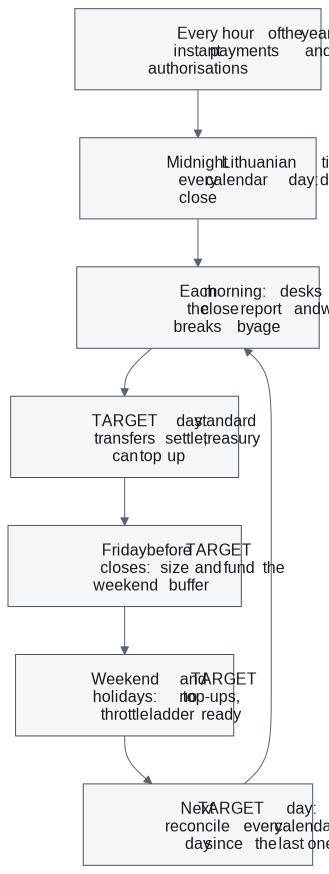
- Daily close. At midnight local time (Lithuanian time under the Lithuanian profile, UK time under the UK profile) on every calendar day the ledger moves to a new accounting day without interrupting service. The close produces the
close_report(section 08). - Morning review. Each break is assigned an owner. A break is a difference between the bank's books and an external record. No unexplained item in suspense may be older than one business day.
- Friday sizing. Treasury runs this task before TARGET closes under the Lithuanian profile, or before the last settlement cycle of the week under the UK profile. It sizes the buffer for the whole closed period as the larger of two figures: the largest outflow of past closed periods plus a margin, and a stressed outflow equal to a share of instant-eligible balances, set by the board in the risk appetite (planning assumption: 25%). Until 12 months of history exist, only the stressed figure applies. The task records who approved the size.
- Low buffer. When the buffer runs low,
riskapplies the throttle ladder of section 08, which refuses the riskiest instant payments in steps. Treasury on-call is paged. No top-up is possible until TARGET opens under the Lithuanian profile, or until the next UK business day under the UK profile (section 08).
The desks and who is on call
A desk is a team that works a queue. Each queue is a filtered view of states that already exist in the blocks, sorted by deadline. The staffing of each desk is in section 13.
| Desk | Hours (target) | Works on | What the system gives it |
|---|---|---|---|
| Payment operations | Business hours, on call otherwise | Payments in Unknown or awaiting review, inbound recalls, returns, investigations; under the UK profile, Direct Debits to be returned unpaid, and Direct Debit Guarantee refund cases with their indemnity claims | Payment queue by deadline; one timeline per payment (section 04) |
| Card operations | Extended hours, on call otherwise | Disputes, stand-in advices, forced debits | Dispute queue with scheme deadlines (section 05) |
| Financial crime | Business hours, duty officer on call daily | Alerts, screening hits, suspensions, reports | Case queues with working-hour timers, alert ageing (section 06) |
| Customer support | Long chat hours; lost-or-stolen line at all hours | Questions, complaints, life events | Masked customer view, case creation, protective actions |
| Treasury | Business hours, on call at all hours | Position alerts, funding approvals, Friday sizing | Position dashboard, close report |
| Engineering on call | All hours, primary and backup | Alerts, dead letters, jobs in NeedsReview | Runbooks, incident timers, just-in-time access (section 11) |
Alert backlogs. An unworked alert backlog is a common supervisory finding. When the oldest alert passes its review target, the head of compliance is paged, the sign-up cap in onboarding is tightened and additional reviewers are assigned, so that growth is limited by review capacity. The mechanism, and the rule that a backlog does not change a detection threshold, are in section 06.
Lost-or-stolen line. The helpdesk vendor answers a telephone line at all hours from a written script. The agent's screen offers three actions only: block the card, revoke the devices and place a protective debit block through accounts. It shows no balance, changes no limit and moves no money. Identity verification is light: the agent asks questions that customers answers with yes or no without disclosing data, then calls back on the number on file. Each use is written to audit and counted as a key risk indicator.
Staffing per duty. Each duty has at least two named, trained people before public launch. A rota that covers all hours has at least four, so that no one is on call more than one week in four (planning assumption). The rota is held as data in the console, so the pager identifies who is on call and the person responsible at 03:00 on a given Sunday can be established.
The daily operations checklist
Each line is a scheduled task with an owner and a due time. Completing it records in audit who reviewed the item and what was observed (D14.2).
| Check | Owner | Due (target) |
|---|---|---|
Daily close finished, close_report read | Treasury | 09:00 |
| Reconciliation breaks by age, each with an owner | Treasury, payment operations | 10:00 |
Payments in Unknown or awaiting a person; recalls near deadline | Payment operations | 09:30 |
| Card disputes and scheme deadlines this week | Card operations | 10:00 |
| Sanctions list update arrived, customer rescreen ran | Financial crime | 09:00 |
| Open alerts and hits by age against capacity | Financial crime | 10:00 |
| Instant position forecast and known large items | Treasury | 09:00, 15:00 |
Dead letters, jobs in NeedsReview, expiring certificates | Engineering on call | 09:00 |
| Regulator files due today or tomorrow | Reporting | 09:00 |
| Statement, interest and fee runs finished | Payment operations | 09:00 |
Incidents: from detection to regulator notice
Alerts and runbooks are in section 10 and security playbooks in section 11. This section adds the roles: who leads, who decides that an incident is major and who notifies the regulator.
The sequence shows one incident on the money path, where customers or card terminals are waiting, from first alert to final report.
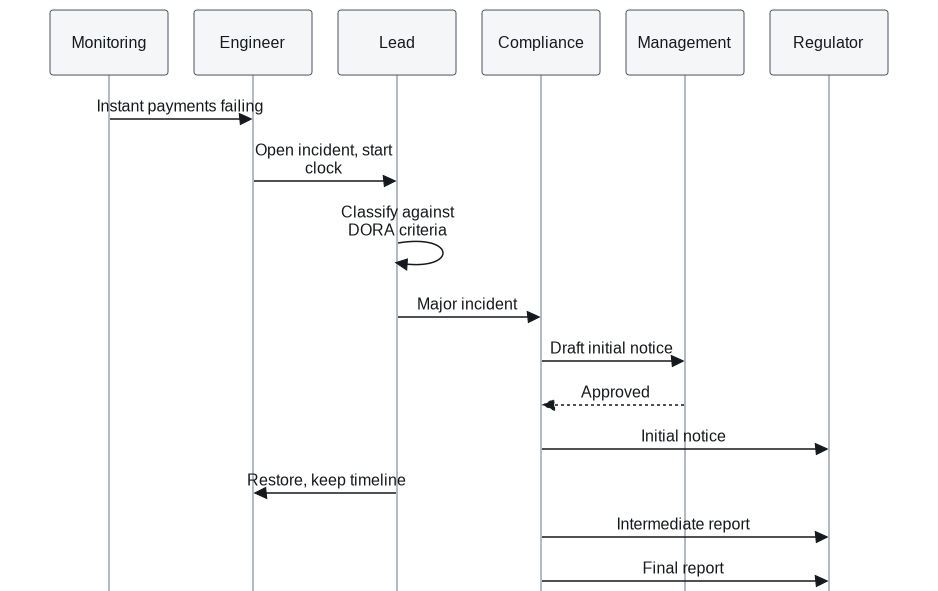
The diagram shows the Lithuanian profile. The reporting clocks of the Digital Operational Resilience Act (DORA) are set out in the "DORA operations" section of section 10; under the UK profile the clocks follow the FCA and PRA incident reporting rules, also in section 10, and the roles in the sequence are unchanged. A personal-data breach is subject to a separate 72-hour clock (section 12). The incident record in the console holds:
- the questions that classify the incident;
- clocks that start from the moments named in the law;
- report drafts built from the timeline;
- the approval step.
The head of compliance submits each notice after a member of the management body has approved it, and a named deputy approves in that member's absence. The submission channel to the regulator belongs to the reporting arrangements of section 10.
Complaints
A complaint is any expression of dissatisfaction in any channel. A helpdesk rule prompts the agent to mark a conversation as a complaint when words such as "complaint" or "unfair" are used, or when the customer does not accept the outcome of a dispute. The mark opens a case of type complaint. The case holds identifiers only: the customer, the linked payment or card, the category, the owner, the acknowledgement, the deadline and the outcome.
Compensation takes the form of a refunded fee (entry kind fee_waiver) or a manual adjustment through backoffice-api. A second person approves it above a set amount (section 03).
Under the Lithuanian profile, for complaints about payment services, PSD2 Art 101(2)[5] requires a reply on paper or another durable medium within 15 business days of receipt. In exceptional cases outside the bank's control, a holding reply with reasons is sent and a final reply follows within 35 business days. These are the defaults in the case tool, which warns the owner before each deadline.
Deadlines are held as data per complaint category. Under the Lithuanian profile the case tool applies the periods of 15 and 35 business days to every category, including complaints outside payment services; the cost is that such complaints may be answered sooner than national law requires. A shorter period in Lithuanian law would be entered as a setting and is listed under Assumptions and dependencies. The final reply states how to reach the out-of-court dispute body. Consumer disputes with financial market participants are settled out of court by the Bank of Lithuania under Article 47(1) of the Law on the Bank of Lithuania, following the rules approved by Resolution No 03-23 of its Board of 26 January 2012 (Bank of Lithuania, rules for requests and complaints, paragraph 9[10]). Complaints about a closure or refusal are routed to financial crime, which replies in wording that avoids tipping off the customer. Complaints by category and root cause are included in the monthly management pack.
Under the UK profile, payment-service complaints are answered within 15 business days, or 35 business days in exceptional cases (Payment Services Regulations 2017, regulation 101[27]), and other complaints receive a final response within eight weeks (DISP 1.6[25]). Both periods are held as deadlines per complaint category in the case tool. A final response summarises the complaint, states whether it is accepted and, where redress is offered, how the offer was reached, or gives the reasons for rejection. It informs the customer of the right to refer the complaint to the Financial Ombudsman Service within six months, indicates whether the bank consents to waive the relevant time limits in the wording of DISP 1 Annex 3R, and includes the service's contact details, website address and leaflet (Financial Ombudsman Service, how to settle complaints[30]). The case tool holds these elements as required fields of the final-response template, and a response cannot be sent while a field is empty. The out-of-court body is the Financial Ombudsman Service, whose award limit is GBP 455,000 for complaints referred from 1 April 2026 about acts from 1 April 2019, and GBP 205,000 for earlier acts. The case records any referral to the Financial Ombudsman Service and its outcome, so that referrals and upheld decisions appear in the management pack and in the Consumer Duty board report.
Governance: three lines of defence
The supervisor requires that the functions that take risks are not the only ones that check them.
| Line | Who | Job | What the system gives them |
|---|---|---|---|
| First | Product, engineering, operations, treasury, support | Run the bank and own its risks and controls | Dashboards and queues for their area, key risk indicators with limits, the checklist |
| Second | Compliance and the money laundering reporting officer, risk, information security, data protection | Set rules, monitor, test controls and challenge the first line | Read access to every queue, case, decision, break and report run without a request to the first line; a control-testing view that samples evidence |
| Third | Internal audit | Provide independent assurance to the board that the first two lines work | Read-only access to audit, the evidence store and report lineage; every extract is logged |
The persons who hold the control functions at the licence application, and the supervisor's acceptance of them, are treated in section 13; the console holds each control function as a role with a holder and a deputy as dated data, so that a change of holder is a data change.
The two-person table of section 11 adds one rule here: the person who approves a risk-reducing action (an unfreeze, a limit rise or a rule change) must not sit in the proposer's reporting line.
Board and management reporting. A single pack is produced from the reporting data store of section 08, and every figure traces to ledger entries. It covers customers and balances, payment failures, fraud losses and fallback share, alert ageing, breaks by age, use of the liquidity floor, incidents, complaints, vendor service levels, and open audit and supervisory findings. Management receives it monthly. The board receives it in full each quarter (target).
Outsourcing governance. ICT suppliers fall under DORA. Other outsourcing falls under the EBA's guidelines on third-party risk, which replace the 2019 outsourcing guidelines (as reported). Every vendor passes five steps, each recorded against its row in the provider register that section 10 owns:
- Classification as critical or important, or not.
- Due diligence.
- Agreement of a contract with the clauses that DORA Article 30 requires.
- For a critical vendor, approval by the management body and notification of the Bank of Lithuania where the rules described in section 10 require it.
- Review against service levels measured from the bank's own data, and the exit test of section 13.
Steps 3 and 4 describe the Lithuanian profile. Under the UK profile the same five steps are recorded against the PRA and FCA outsourcing and third-party rules described in section 10; from 18 March 2027 step 4 includes notification to the regulators before a material third-party arrangement is entered into or significantly changed (FCA PS26/2[31]).
Model risk. Name matching, the customer risk score, monitoring scenarios, fraud scores and later the credit scorecard each have a row in the model register in risk (section 07). The row records the owner, version, data used, limits and review date. A new or changed model is validated before release by a person who did not build it. Live results are compared with outcomes weekly. A model past its review date returns to shadow mode, which the release pipeline enforces.
Product and change approval. A committee of risk, compliance, finance and product approves any new product and any change to a price, limit, rule or customer-facing text. The approval reference is stored with the product version in accounts (section 03), or with the limit or rule version in risk. A version without a reference cannot be activated.
Business continuity beyond technology
Section 10 covers the loss of a data centre. This section covers the loss of people, premises or a supplier. Each critical function has a row in a continuity register. The row records the longest tolerable interruption (target), the minimum number of people, the named backups, the arrangements for remote working, and the manual fallback if the console, the helpdesk tool or a key supplier is unavailable. Under the UK profile the register's critical functions are mapped to the important business services and impact tolerances held in section 10.
Every desk works through a web console behind the corporate sign-in, so the whole bank can operate remotely, as during a pandemic. This is tested yearly (target). A status page on a separate host informs customers when the app is unavailable. A tabletop exercise, a structured walk-through of a hypothetical crisis, is held twice a year (target), once with the loss of a key supplier.
Customer life events
These events are infrequent, slow and sensitive. Each is a case type with a checklist, and each relies on the restrictions and holds of section 03.
| Event | What the system must support |
|---|---|
| Death of a customer | The account is restricted (deceased) and the money held (estate) immediately. Cards and standing orders stop. Heirs are paid only with two approvals, once their documents are verified. The accepted documents are a checklist held as data in the case type; the list under each profile is an assumption listed below. |
| Power of attorney | The holder of the authority, and its scope, are recorded as dated data with evidence. The authority ends on revocation or death. |
| Vulnerability | A care flag changes the treatment of the customer; its effects are data. The reason is special-category data and is held in customers only (section 12). |
| Seizure order | A seizure restriction and hold are placed. Only the named role can release them. Under the Lithuanian profile, bailiffs' orders are accepted through PLAIS (section 01). Under the UK profile, an order served on the bank is entered in the case by the named role. The intake procedure is an assumption listed in section 03 for the Lithuanian profile and in section 06 for the UK profile. |
| Closure with money left | The account remains open as a closing tail that accepts late credits. Money that cannot be returned remains recorded as owed to the customer. |
| Dormant account | A timer moves an unused account to the Dormant state of section 03. The customer is re-verified before money leaves. The period is a profile setting. Under the Lithuanian profile the default is 24 months, the inactivity period used in the deposit insurance exclusion cited in section 03 (planning assumption). |
| Unpaid negative balance | After the period in the terms, a recovery case opens. A write-off above a set amount needs a second approver (section 03). |
The wind-down plan
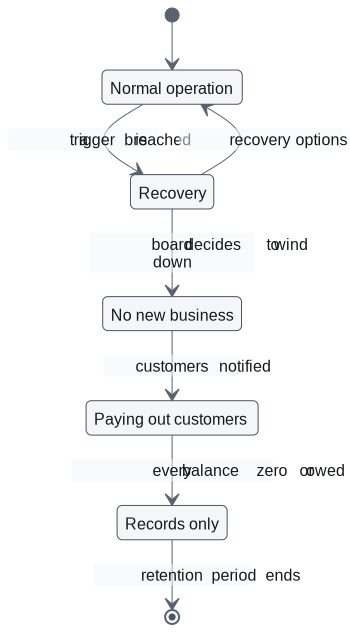
A supervisor expects a plan for an orderly stop of the bank. Under the Lithuanian profile, in bank mode the law requires a recovery plan, reviewed at least once a year and after any material change (BRRD Art 5[6]). The resolution authority draws up the resolution plan, using data supplied by the bank. The bank prepares a full recovery plan and does not rely on any simplified obligations available to a small bank under BRRD Art 4; the cost is more preparation than a simplified plan would need. In EMI (electronic money institution) mode a wind-down plan is prepared on the stages of the diagram below; the content expected by the supervisor is an assumption listed below. The finance lead drafts both plans and the management body approves them. The system requirements are small if decided now and very large if first addressed in a crisis.
Under the UK profile, in bank mode a recovery plan is required; from 1 April 2026 a small domestic deposit taker reviews it at least every two years, although new and growing banks are expected to review it more often (PRA PS10/26[37]), so the annual review is retained. Every non-systemic bank keeps a solvent exit analysis and must be able to produce a solvent exit execution plan (PRA SS2/24[38]). A resolution pack is also required, and a small firm supplies information for the bank insolvency procedure (PRA SS19/13[39]). The stages "No new business" and "Paying out customers" in the diagram serve as the execution steps of a solvent exit. In EMI mode the safeguarding records described in section 08 take the place of the depositor file, and the resolution pack required under the FCA safeguarding regime since 7 May 2026 (FCA PS25/12[32]) is produced from them.
The diagram shows the stages through which the bank's settings can move.
The system must be able to:
- Stop new business. Two settings,
onboarding_enabledandwind_down, provide this and sit besidelicence.mode(section 01). No customer is onboarded and no card is issued. Interest and fees follow the plan. - Pay out every customer. The bank sends a payout file to nominated accounts or to a receiving bank. Customers who cannot be reached are tracked as money owed.
- Produce the depositor or safeguarding file. Under the Lithuanian profile, in bank mode this is the depositor view of section 03, which supports payout within seven working days (Indėlių ir investicijų draudimas[7]). Its file format is treated in section 08. In EMI mode it is the safeguarding reconciliation of section 08. Under the UK profile, in bank mode the depositor view produces the FSCS Single Customer View file and the exclusions view, which must reach the FSCS within 24 hours of deposits becoming unavailable (section 08).
- Keep records readable after the bank stops. Records are archived in open formats, with their keys, so that they can be read without the live platform. They are kept for the period set in
retention_policies(section 12).
Testing and certification with outside parties
Before launch, the longest waits are the test calendars of other organisations. They are managed as one named effort with an owner, run alongside the build of section 13. Each item has a dated task, a test log and a stored sign-off. The prerequisites of each item are listed in the "Outside tests and approvals" part of section 13. This table adds the owner and the lead time.
| Item | Owner | Lead time |
|---|---|---|
| CENTROlink admission, certificates and connectivity tests | Payment operations | Decision within 15 business days of a complete file (Rules §22[1]); the testing period is set by the Bank of Lithuania's test calendar and is planned in section 13 |
| SEPA scheme adherence, including payee verification | Payment operations | Set by the outside party's calendar; planned in section 13 |
| Card scheme and processor certification, including 3-D Secure | Card operations | Set by the outside party's calendar; planned in section 13 |
| Apple Pay and Google Pay approvals | Card operations | Set by the outside party's calendar; planned in section 13 |
| Penetration test, once the build is frozen | Security | Planned |
| Faster Payments onboarding, UK profile | Payment operations | 9 to 12 months end to end, as stated by Pay.UK |
| Confirmation of Payee participation, UK profile | Payment operations | Set by the outside party's calendar; planned in section 13 |
| Bacs access through the sponsor, covering inbound Direct Credits and paying-side Direct Debit, and CHAPS access through the sponsor, UK profile | Payment operations | Set by the outside party's calendar; planned in section 13 |
United Kingdom profile
| Aspect | Lithuanian profile | UK profile |
|---|---|---|
| Governance regime | Bank of Lithuania fit-and-proper assessment | Senior Managers and Certification Regime (SM&CR) |
| Conduct | PSD2 as transposed, EU consumer law | Payment Services Regulations 2017, FCA Consumer Duty, the FCA's Banking Conduct of Business sourcebook (BCOBS) and complaints rules (DISP) |
| Complaint deadlines | 15 business days for payment services; the same period applied to others by default | 15 business days for payment services; eight weeks for others |
| Out-of-court body | Bank of Lithuania | Financial Ombudsman Service |
| Account closure notice | At least two months for an indefinite framework contract (PSD2 Art 55(3)) | At least 90 days with specific reasons for contracts from 28 April 2026 |
| Operating calendar | TARGET days; instant rail every day | UK business days (weekdays other than bank holidays in England and Wales); Faster Payments every day; the Bacs three-day cycle on Bacs processing days |
| Wind-down artefacts | Recovery plan, deposit insurance file | Recovery plan, solvent exit analysis, resolution pack, Single Customer View file |
Senior managers. Under SM&CR a bank must have separate, pre-approved individuals as Chief Executive (SMF1), Chief Finance (SMF2) and Chair (SMF9), the three functions that PRA rules make mandatory for every bank. Every dual-regulated firm also needs Compliance Oversight (SMF16), and the money laundering reporting officer is SMF17. Chief Risk (SMF4) and Head of Internal Audit (SMF5) apply where proportionate, and Chief Operations is SMF24. The chair of the risk committee (SMF10) is a required function only for a significant firm and the chair of the audit committee (SMF11) only for a firm with securities admitted to trading, so neither is mandatory for a small new bank (PRA SS28/15[15], paragraphs 2.6 to 2.7 and Table A). Firms with assets of GBP 250 million or less have lighter requirements. The console holds each senior management function as a role with its holder, deputy and assigned duties as dated data, and every scheduled task of D14.2 and every approval of a risk-reducing action names the function accountable for it. The regime is under reform: phase 1 rules were finalised on 22 April 2026, and on phase 2 the PRA and FCA consulted on 22 October 2026 (closing 22 January 2027), with final policy expected in 2027 once the enabling legislation is passed. The role catalogue is therefore configuration: it provides for SMF4, SMF5 and SMF24 from launch, so that the regulators' expectation of a new bank and the outcome of the reform change holders and catalogue entries only. The staffing consequence and the roles in post at application are in section 13. Whistleblowing arrangements under SYSC 18 become mandatory for deposit takers with assets of GBP 250 million or more and are guidance below that size (SYSC 18.1[20]).
Consumer Duty. Principle 12 and PRIN 2A set four outcomes: products and services, price and value, consumer understanding and consumer support. PRIN 2A.8 requires an annual board report. The management pack adds indicators for each outcome from the reporting data store, and the annual report is assembled from the same data (D14.6). The FCA's consultation CP26/23 proposes to replace the standalone board report with reporting through the firm's ordinary board reporting (FCA CP26/23[22]); until the final rules, expected in the first quarter of 2027, the report remains required. Treatment of vulnerable customers follows FCA guidance FG21/1 and uses the existing care flag.
Account closure. For indefinite framework contracts entered into on or after 28 April 2026, regulation 51B of the Payment Services Regulations 2017 requires at least 90 days' written notice with sufficiently specific reasons; older contracts keep two months, and exceptions include financial crime cases. The closure case reads the contract date from accounts, sets the notice timer and requires reason text before the notice is sent. A closure under a financial crime exception is routed to financial crime (section 06). Under the Lithuanian profile the same timer defaults to two months, the minimum notice that PSD2 Art 55(3)[9] sets for termination of an indefinite framework contract by the provider where the contract allows it; a longer period in Lithuanian law would be entered as a setting.
Dormant accounts. Participation in the Dormant Assets Scheme is voluntary, and a bank account counts as dormant after 15 years without customer-initiated activity (Dormant Bank and Building Society Accounts Act 2008, section 10[35]). The dormancy timer of the life-event table uses this period as its profile setting.
What does not change. The desks, queues, checklist, case tool, three lines of defence, two-person rule, lost-or-stolen line, wind-down settings and the annual wind-down rehearsal are identical in both profiles. The profile changes deadlines, calendars, role names and report content, all of which are data.
Key design decisions
D14.1 Operations work only through the staff console and its queues
Decision: every operational action is a console screen backed by an API call, a queue or an approval. Staff do not edit the database directly or use a spreadsheet for operational work.
Rationale: the system checks and logs a console action, and the action is open to review. A direct database edit has neither, and spreadsheets diverge from the ledger.
Alternative considered: controlled read-write database access for rare fixes. It is rejected because each such fix would bypass the checks and the log.
Cost: each new need waits for a screen to be built. The break-glass role of section 11 covers genuine emergencies.
D14.2 Every recurring duty is a scheduled, tracked task
Decision: the checklist, Friday sizing, control tests, model and vendor reviews and drills are job-runner tasks with an owner, a due time and evidence.
Rationale: a duty that depends on memory is missed at the first holiday, whereas a tracked task is evidence that the duty was performed.
Alternative considered: a procedures manual and team calendars. They instruct staff but cannot evidence performance.
Cost: the task list needs upkeep, and every duty needs an evidence view.
D14.3 The second and third lines get independent, read-only access by design
Decision: compliance, risk, security and internal audit have their own read-only roles, granted without a request to the first line.
Rationale: a control function that must request data from the people it checks is not independent.
Alternative considered: the first line sends extracts on request. This is rejected because the first line would then select what the controllers see.
Cost: more people with wide read access, so their access is logged and reviewed as well.
D14.4 The wind-down plan is tested like a disaster-recovery drill
Decision: once a year (target), in the staging environment, the exercise stops new business, produces the payout and depositor or safeguarding files within one day, and reads archived records without the live platform.
Rationale: a plan that is never exercised is unverified, and a rehearsal reveals missing data while it is inexpensive to add.
UK profile: the rehearsal also produces the Single Customer View file and exclusions view for a chosen cut-off time, whose regulatory limit of 24 hours matches the one-day target, and walks through the execution steps of the solvent exit analysis.
Alternative considered: an annual paper review. It cannot show that the files can be produced.
Cost: a few days of engineering and finance time a year.
D14.5 A protective-actions-only emergency channel exists outside the app
Decision: a telephone line outside the app, open at all hours, lets a customer block cards, revoke devices and freeze the account.
Rationale: every self-service path depends on the customer's device, which may be the stolen item. A line that cannot move money or disclose data is acceptable with a light identity check. Under the Lithuanian profile, PSD2 also requires a way to report loss or theft at all times and free of charge (Art 70(1)(c) and (d)[5]), so the line is free to call or offers a free call-back. A further notification channel required by Lithuanian law would be added as a console-backed channel offering the same three protective actions; this is listed under Assumptions and dependencies.
UK profile: regulation 73(1)(c) and (e) of the Payment Services Regulations 2017 impose the same duty: appropriate means of notification must be available at all times, and a notification option must be free of charge (regulation 73[28]).
Alternative considered: web-only reporting fails the customer without a working device. A full-service telephone line would require strong identity checks that a caller without the app cannot meet.
Cost: paid night staffing through the helpdesk vendor.
D14.6 Consumer Duty outcomes are measured from the reporting data store
Decision: under the UK profile, the indicators for the four Consumer Duty outcomes and the annual board report are produced from the reporting data store of section 08, alongside the management pack, with each figure traceable to cases, ledger entries and events.
Rationale: the outcomes concern complaints, closures, fees, response times and the treatment of flagged customers, all of which already exist as records in the blocks. Producing the report from the same data as the management pack keeps the board's view of conduct consistent with its view of operations.
Alternative considered: a separate conduct reporting tool fed by manual extracts. It is rejected because the figures would not trace to records and would diverge from the management pack.
Cost: outcome indicators need definitions and an evidence view. If the final rules that follow CP26/23 replace the standalone report with ordinary board reporting, the indicators remain in the management pack.
Failure modes and mitigations
| Failure | Effect | Response |
|---|---|---|
| Alert backlog passes the review target | Missed reports, supervisory finding | Ageing alerts, section to head of compliance, admission cap |
| Weekend buffer too small | Instant payments throttled until Monday | Stressed sizing, throttle ladder, approved Friday task |
| One person holds a duty and is ill | Task missed | Two people per duty, rota in the console, missed tasks page the lead |
| Fraudster uses the lost-or-stolen line | Unwarranted freeze | The line allows protective actions only. The customer lifts the freeze in the app with strong customer authentication |
| Regulator notice late | Breach of the incident reporting duty of the profile | Clocks in the incident record, drafts from the timeline, named deputy signatory |
| Complaint passes its FCA deadline (UK profile) | Breach of DISP or regulation 101, referral to the Financial Ombudsman Service | Deadlines per category in the case tool, warnings before each deadline, ageing in the management pack |
| Closure notice shorter than 90 days (UK profile) | Breach of regulation 51B, complaint | Notice timer set from the contract date in accounts, reason text required before sending |
| Sponsor settlement funds insufficient over a weekend or a four-day holiday run (UK profile) | Outbound Faster Payments refused | Friday sizing against the sponsor's terms, throttle ladder, treasury on-call |
| Senior management function vacant (UK profile) | Accountability gap, supervisory finding | Named deputy in the role catalogue, vacancy raised as a key risk indicator |
Security and privacy considerations
Staff roles, the two-person rule and audit are in section 11. Read-only control roles see masked data by default. The reason behind a care flag does not leave customers (section 12). Financial-crime case notes never reach a reply to a customer.
Phasing
- Phase 1:
- desk queues, the checklist as tasks and the rota;
- the lost-or-stolen line and complaints;
- incident records with clocks;
- read-only control roles and the continuity register;
- a wind-down rehearsal before public launch, and the outside tests;
- under the UK profile: the senior management role catalogue, Consumer Duty outcome indicators and board report, complaint and closure-notice timers, the Bacs entry-day check, the queue of unpaid Direct Debit returns, Direct Debit Guarantee refund cases, and the Single Customer View file in the rehearsal.
- Phase 2: business customers' life events, credit models in the register, loan collections. Under the UK profile, operation as a settling Faster Payments participant, with Net Sender Cap sizing in the Friday task.
- Phase 3: oversight of banking-as-a-service partners.
Assumptions and dependencies
The operating model in this section rests on the following assumptions, each confirmed at the stated point. Each affected value is a setting, a checklist or a document, so none blocks the start of the build.
| Assumption | Confirmed by | When | If it does not hold |
|---|---|---|---|
| Lithuanian profile: national law sets no complaint reply period shorter than 15 business days, no notification channel for loss or theft beyond PSD2 Art 70, and no account closure notice longer than two months. | Counsel | Before the licence application | The complaint deadline per category, the closure notice timer or the list of notification channels is changed as a profile setting; an added channel offers the three protective actions of D14.5 through the console. |
The documents accepted for payout to heirs are as the checklist of the estate case type records them. | Counsel | Before friends and family | The checklist of the estate case type is amended as data. |
| Lithuanian profile: a dormancy period of 24 months is consistent with Lithuanian law and the account terms. | Counsel | Before public launch | The period is changed in the profile setting read by the dormancy timer. |
| Lithuanian profile: resolution-planning data requests are met from the reporting data store of section 08 without new record types. | The Bank of Lithuania as resolution authority | Before public launch | The requested fields are added to the reporting data store and to the annual rehearsal of D14.4. |
| In EMI mode under either profile, a wind-down plan built on the stages "No new business", "Paying out customers" and "Records only", with the safeguarding records as the payout basis, has the content the supervisor expects. | The Bank of Lithuania; under the UK profile the FCA | Before the licence application | The plan document is extended by the finance lead; the settings onboarding_enabled and wind_down and the rehearsal of D14.4 are unchanged. |
| UK profile: statutory deadlines counted in business days run on the calendar of weekdays other than bank holidays in England and Wales. | Counsel | Before friends and family | The business-day calendar setting used by the case timers is changed, which shortens the complaint and notice timers. |
Sources
- CENTROlink Operating Rules, as amended 30 May 2023
- Regulation (EU) 2022/2554, DORA
- EBA Guidelines on third-party risk management
- Delegated Regulation (EU) 2025/301, incident reporting
- Directive (EU) 2015/2366, PSD2
- Directive 2014/59/EU, BRRD
- Indėlių ir investicijų draudimas, deposit insurance
- ECB, T2 operating days
- Directive (EU) 2015/2366, Article 55
- Bank of Lithuania, Rules for the Examination of Requests and Complaints, paragraph 9
- Pay.UK, Faster Payments System Principles v11, January 2026
- Pay.UK, Bacs System Principles v18, January 2026
- Bank of England, payment settlement
- Bank of England, CHAPS
- PRA SS28/15, April 2026 update
- FCA, Senior Managers Regime
- PRA PS12/26, SM&CR review phase 1
- FCA PS26/6, SM&CR review
- Bank of England, SM&CR phase 2 proposals, October 2026
- FCA Handbook, SYSC 18
- FCA Handbook, PRIN 2A.8
- FCA CP26/23, Consumer Duty scope and proportionality and consultation text
- FCA FG21/1, fair treatment of vulnerable customers
- FCA Handbook, BCOBS
- FCA Handbook, DISP 1.6
- Financial Ombudsman Service, award limits
- Payment Services Regulations 2017, regulation 101
- Payment Services Regulations 2017, regulation 73
- Payment Services Regulations 2017, regulation 2
- Financial Ombudsman Service, how to settle complaints
- FCA PS26/2, operational incident and third-party reporting
- FCA PS25/12, safeguarding regime
- Bank of England, RTGS daily timetable
- SI 2025/688, account termination notice
- Dormant Bank and Building Society Accounts Act 2008, section 10
- Dormant Assets Act 2022
- PRA PS10/26, recovery plans review
- PRA SS2/24, solvent exit planning
- PRA SS19/13, March 2026 update
- PRA Rulebook, Depositor Protection 12, Single Customer View