07. Fraud, limits and credit risk
Purpose and scope
A bank is exposed to two principal categories of financial crime. Fraud is the theft of funds from a customer or from the bank. Money laundering is the use of the bank to move proceeds of crime obtained elsewhere, and is covered in Knowing the customer.
The two differ in timing. A fraudulent card transaction is submitted to the bank at a specific moment, and the merchant waits for the authorisation response. Funds that have left the bank are rarely recovered, so fraud must be stopped at the time of the transaction. Money laundering is assessed mainly after the event, on patterns observed over days, by compliance. Fraud control is therefore part of the payment flow itself (Overview, point 5).
| Fraud type | Example |
|---|---|
| Account takeover | A customer enters credentials on a fraudulent bank website; the criminal signs in on a new device and sends EUR 4,900 to a new payee |
| Authorised push payment (APP) scam | A caller convinces the customer that the account is compromised, and the customer transfers savings to a "safe account" |
| Card-not-present fraud | Leaked card details are used to buy gift cards online at 03:00 from another country |
| Mule account | A person is paid to lend an account; scam victims pay in and the funds leave within minutes |
| Stolen identity | An account is opened with a stolen passport and a face-swap video |
Amounts are shown in euro; under the UK profile the same example applies in sterling.
Onboarding controls detect the last two types in part (section 06). A mule account also exhibits distinctive behaviour once funds start to move.
Components
This section covers three components: risk, lending (Phase 2) and an operational-risk register. risk reads the feature store, a set of precomputed behavioural measures such as the number of new payees in the last 24 hours, held on the data platform (Platform and data).
The diagram shows the callers of risk, the data it reads and the destinations of its output.
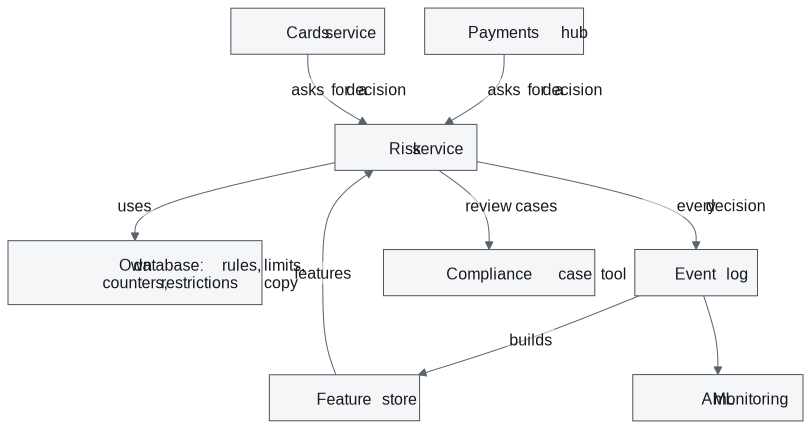
risk is the single decision point, which prevents divergent decisions elsewhere. It does not own account restrictions: accounts owns freezes, seizures and debit blocks, and ledger enforces the debit block (Ledger and accounts). risk keeps a copy built from accounts events and uses it solely to select an outcome and its reason codes.
How it works
The decision call
When a customer initiates a payment, payments creates the order in AwaitingSca and obtains strong customer authentication (SCA) through identity. The approval is bound to the amount and the payee. The order then moves to Checking (Payments), and payments calls risk over gRPC, the internal call protocol, with a deadline. The request carries identifiers only and no names (Overview, point 10):
- the payment: ID, amount, payee account identifier, type, the payee-check result and, for cards, the merchant category;
- the customer: customer ID, risk band from
onboarding, account age; - the device: device ID bound by
identity, whether the device is new, and the age of the last SCA.
risk adds account restrictions from its copy and loads features itself. It returns one of four outcomes with a list of reason codes:
| Outcome | Meaning | Transfer | Card purchase |
|---|---|---|---|
allow | Transaction consistent with normal behaviour | payments places a hold in ledger and continues | Approved |
challenge | Probably legitimate; additional proof required | Returns to AwaitingSca for a step-up, in which the customer confirms again by fingerprint or face, often after a scam warning | Soft decline requesting 3-D Secure or chip and PIN |
review | Human assessment required | Held in Review with a fraud review case; the customer sees a neutral "Processing" status. No ledger hold is placed yet; funds are checked again on release | Declined with a reason code, and a fraud review case is opened, because a card authorisation cannot wait for a person |
block | Transaction must not proceed | Rejected with a reason code that may be communicated to the customer, unless tipping-off rules prohibit it | Declined |
A reason code is a stable short identifier, for example LIMIT_DAILY_EXCEEDED, NEW_PAYEE_HIGH_AMOUNT or UNKNOWN_BAND. Staff see each code together with its evidence. For some codes the customer receives a plain-language sentence, which never indicates a suspicion of money laundering (tipping-off, section 06).
Time budget
The values below are internal targets and not legal requirements; they are taken from the system map. The target is the response time that risk meets for 99 per cent of requests. The deadline is the time at which the caller stops waiting and applies its fallback.
| Decision | risk target | Deadline at the caller |
|---|---|---|
| Card authorisation | 40 ms | 60 ms |
| Instant credit transfer (SCT Inst), outgoing | 50 ms | 80 ms |
| Standard credit transfer (SCT), outgoing | 300 ms | 1 s |
| 3-D Secure exemption for an online card payment | 100 ms | Set in the processor contract (Cards) |
The transfer rows name the rails of the Lithuanian profile; under the UK profile the instant row applies to outgoing Faster Payments with the same values.
The 3-D Secure exemption is a separate risk call, made when the card network asks whether the payment may skip the customer's 3-D Secure step. It is not part of the card authorisation.
These times are contained within larger budgets. The bank's total response to the card processor has a target of 150 ms and a hard stop at 300 ms. The processor itself allows about two seconds for its callback (one vendor's documented figure[4]); the contractual figure is fixed in the processor agreement (Cards). For an outgoing instant payment, the bank's own steps before the hand-over to the rail gateway (sepa-gateway under the Lithuanian profile, fps-gateway under the UK profile) take 250 ms at the 99th percentile, with a hard stop at 1 s.
Under the Lithuanian profile, the 10-second legal limit for an instant payment (Regulation 2024/886[6]) and the internal sent_at clock are described in Payments, which also gives the Faster Payments timing of the UK profile. A step-up, a review or a cooling-off wait all take place before that clock starts and therefore cannot cause a payment to enter Unknown.
If a feature lookup is slow, risk skips it and records the omission, as in Monzo's design[1].
The rule engine
The rule engine is designed as follows:
- A rule is a named check with a severity:
allow,challenge,revieworblock, in ascending order. - Every rule is evaluated, and every hit is retained with its evidence: rule name and version, values observed and threshold.
- The most severe result prevails. A single
blocktakes precedence over any number ofallowresults. - The customer's risk band selects the rule set. An unknown band results in
block(UNKNOWN_BAND) and not in an empty rule set, so that a data error cannot disable protection.
All inputs used by a decision are stored, and a rule depends on no other input. risk can therefore replay any decision and obtain the same result, either to investigate a complaint or to test a new rule against the previous month's traffic. Each stored decision records the subject, the outcome and its reasons, the rule set applied, all values the rules evaluated, any features skipped for speed, and the processing time. The event ID of the decision also serves as the key that prevents an event from being decided twice.
Features
A feature is a numeric measure of behaviour. Following Monzo, three kinds are used:
- Just-in-time: computed during the call, for example the amount relative to the customer's average.
- Near-real-time: maintained from the event log and therefore a few seconds old.
- Batch: computed overnight, for example a model score.
Live decisions and model training read the same values. Each feature carries a fingerprint of its definition, and a model trained on an earlier definition is rejected. If Phase 1 slips, the live feature store is the first item removed, and risk operates on rules and counters alone (Delivery plan).
Limits and counters
All monetary caps are held in risk, including card caps: per transaction, daily, monthly and cash. cards holds only the customer's own switches for online, contactless and cash use (Cards). A limit is a single row specifying the scope (product and risk band), the payment type, the kind of cap, the amount, the start date and the version. Customers may lower their own limits immediately; a raise requires a step-up and is bounded by the ceiling of the customer's risk band. The limits in force at launch for the standard risk band are EUR 5,000 per transfer, EUR 10,000 per day and EUR 30,000 per month for outgoing transfers, EUR 2,500 per card purchase, EUR 5,000 per day for card spending and EUR 500 per day for cash withdrawals (planning assumption); the higher risk band receives half of each value, and under the UK profile the same figures apply in sterling. The risk owner approves the limit rows under four-eyes control before the friends and family launch and reviews them each quarter together with the fallback bounds. Cost: a small share of legitimate large payments requires a limit raise before execution.
Limit counters are held in the database of risk and not in the feature store. Counters that are several seconds old would allow two payments made one second apart to both pass a daily limit. A counter is updated in the same transaction that stores an allow.
Money can also move without a request to risk. risk therefore adds every forced hold, forced debit and late settlement to the counters from ledger events. A counter is released only when the payment ends without a debit: Rejected, or a card Reversed or Expired. A hold released at Unknown does not release the counter, because the payment may still settle. Under the UK profile the hold is kept at Unknown, and the counter likewise remains until the outcome is established.
The sole exception to the rule that all caps are held in risk is the set of fallback counters described below, which apply only while risk is unavailable.
risk also decides when a second authentication step may be omitted (an SCA exemption) and maintains the counters. identity carries out the decision. The Phase 1 list of exemptions is in Cards. Two further limits are held here:
- Stand-in spend per card, pushed to the processor. Stand-in is the processor's authorisation on the bank's behalf when the bank cannot respond. Account restrictions and card states other than Active are also pushed, so that stand-in declines those cards (Cards).
- A threshold on the amount a customer owes as a result of forced entries. Forced entries are a card clearing without a hold or a late settlement (Ledger and accounts).
Forced entries are always booked. When the amount owed exceeds the threshold, risk declines further card use and lowers the stand-in limits for that customer until the debt is repaid.
Models advise, policy decides
A model converts features into a score and a fraud type, for example account takeover with a score of 0.93. It does not decide. A separate policy maps scores and rule hits to an outcome. The approach follows Monzo and Stripe's Radar[2], which scores in under 100 ms.
A new model starts in shadow mode, in which it scores live traffic without affecting any customer outcome. A rule may use the model only after a comparison with confirmed outcomes, namely customer reports, agent decisions, chargebacks and police reports, each stored as a label with the date on which it became known. The first permitted use is to trigger challenge, and use for block follows much later.
Every model and threshold set that affects customers has an entry in a model register within risk. An entry records the purpose, the owner, the version, the data used, the validator and the validation date, known limitations and the review date. The release pipeline rejects any model validated only by its builder, and returns a model past its review date to shadow mode. The validator and the validation frequency are specified in Running the bank.
Scam interventions in the app
The device cannot reveal an APP scam, because the customer is genuine. The available controls are targeted friction. risk decides and app-api only displays:
- Payee check. A
no matchfrom the payee check on a new payee raises the severity; the check is Verification of payee under the Lithuanian profile and Confirmation of Payee under the UK profile (Payments). - Targeted warning. For a large amount to a new payee, the app shows a warning for the matching scam type, and the customer must confirm to continue.
- Cooling-off. For the highest-risk combination (new device, new payee, large amount), the order waits before submission to the rail gateway, because instant payments are final once sent. The customer sees a cancel button, and cancelling releases the hold. The wait is the setting
risk.cooling_off, with a default of 4 hours and an upper bound of 24 hours (planning assumption); the risk owner changes it as versioned data under D07.2. Cost: a legitimate payment that matches the combination is delayed by the length of the wait. - Call-back. A
reviewmay conclude with an agent telephoning the customer on the number on file.
Fraud review cases
A review opens a fraud review case. It is one case type in the single case tool in compliance, worked through the staff console (Knowing the customer). Its states are Open, InReview, CustomerContact, then Released or Blocked. An Expired case becomes Blocked. Under the UK profile the hold is bounded by the statutory delay period described under United Kingdom profile below.
The agent's decision is returned to payments through its API. A block moves the order to Rejected. A release moves it from Review to Checking and carries the case ID. risk records the agent's decision as an override for that order and does not raise the same reason codes again; funds and limits are still checked. Without the override the same signals would return the order to Review. A release above a threshold requires a second person (four-eyes approval, Overview point 9).
Decision call overview
Example: a customer pays EUR 4,900 to a new payee from a new device. The customer completes one SCA and one step-up, after which the hold is placed.
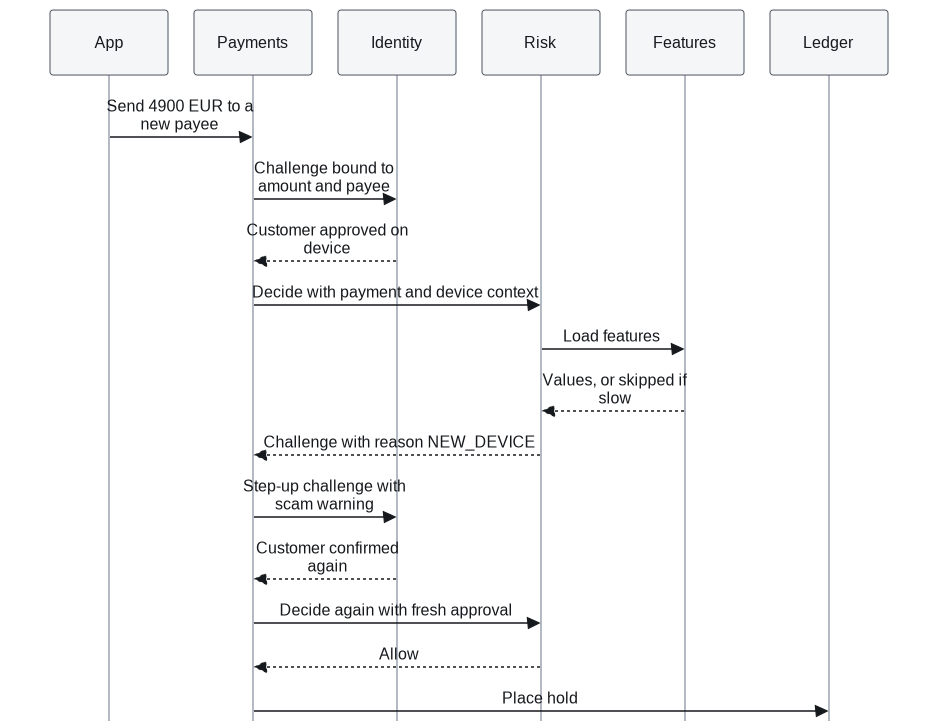
The second call is a new decision, and the first remains stored.
When risk is slow or down
The caller does not wait beyond its deadline. The fallback for each payment type is held as data next to the limits:
| Payment type | Fallback when no answer is received in time |
|---|---|
| Card authorisation | Approve up to the fallback amount (target EUR 30) if card state, card switches and funds pass checks. The ledger's debit block still applies at the hold. cards counts fallback approvals per card per day (target 3) and declines beyond that |
| SCT Inst (Faster Payments under the UK profile) | Send only to payees paid before, up to a low amount and a daily total per customer. payments keeps that total in a fallback counter, which risk reconciles on recovery. Otherwise reject with a retry code |
| SCT, standard | Wait until shortly before the settlement cut-off, then decide as for SCT Inst |
| New payee, any type | Not approved by fallback |
Fallback decisions carry the code FALLBACK and are scored again once risk has recovered. Fraud identified later is referred to an agent. The bounds limit the loss from an outage of one hour to an amount agreed in advance, as with Monzo's Stand-in.
Who pays: refund and liability
Under the Lithuanian profile, three articles of PSD2, the EU Payment Services Directive (Directive 2015/2366[5]), determine who bears a loss. The rules of the UK profile are set out under United Kingdom profile below.
| Rule | Effect for the customer |
|---|---|
| Art 73 | A payment that the customer did not authorise (takeover, stolen card) is refunded by the end of the next business day, unless the bank has reasonable grounds to suspect fraud by the customer and reports them in writing to the authority |
| Art 74 | The customer bears at most EUR 50 of the loss, unless the customer acted fraudulently or with gross negligence |
| Art 71 | The customer may report the payment within 13 months |
Art 73 does not cover payments that the customer approved, as in APP scams. For every disputed payment the bank retains the authorised flag, the reason codes, the warnings shown and the customer's responses, irrespective of the final rule.
Lending in Phase 2
Lending exposes the bank's own funds to credit risk. An EMI may not lend (Licence and regulation), so on the EMI route lending remains switched off. On the default route, a direct bank licence, lending is possible from the grant of the licence. In both cases it is built in Phase 2.
The credit decision
When a customer applies for an overdraft or a loan, lending runs the following flow:
- Eligibility. Age, residence, product rules, risk band and absence of account restrictions.
- Data. Account history from
ledgerand, where permitted, credit bureaus and registers. Each source is reached through a bureau adapter and is named in the decision record. Under the Lithuanian profile the design assumes the Loan Risk Database of the Bank of Lithuania and one commercial bureau (see Assumptions and dependencies). - Affordability. The assessment determines whether the customer can still meet repayments after essential costs if interest rates rise.
lendingtakes income less essential costs and existing debt payments, and tests the result at a higher stress interest rate. Under the Lithuanian profile, the Responsible Lending Regulations of the Bank of Lithuania capped debt payments at 40% of income at the actual interest rate and at 50% at a rate of at least 5%. Resolution 03-146 (22 October 2025) replaced the two limits with a single 50% cap, tested as if the rate were at least 6%, in force from 1 August 2026 for new housing loans to natural persons (notification to the European Systemic Risk Board[10]).lendingapplies the single 50% cap at the 6% stress rate to consumer credit as its default (see Assumptions and dependencies). At an income of EUR 2,000, a 50% cap permits at most EUR 1,000 a month in debt payments. The cap and the stress rate are configuration settings. - Score and policy. A scorecard estimates the probability of default. Policy converts it into approve, decline or refer, with a limit and a price.
- Decision record. All of the above is stored.
The decision as explainable data
A credit decision is a single immutable record, structured so that it can be explained to the customer:
| Field | Content | Purpose |
|---|---|---|
decision_id, application_id, policy_version, model_version | Identifiers and the rules and model applied | Replay and audit |
inputs | Every value used, with its source (the bank's ledger, a named bureau, the customer's statement) | The customer may ask which database was used (Art 19; under the UK profile Consumer Credit Act 1974 s.157[38], under which the bank also names the credit reference agency without being asked when it declines on the basis of the agency's data) |
affordability | Income, costs, debt payments, stress rate, result | Documents the calculation behind the outcome |
outcome | approve, decline or refer | The outcome |
reasons | Ordered codes with explanatory text, such as AFFORDABILITY_FAIL | The explanation provided to the customer |
human_review | When requested, by whom, result | The right to human review (Art 18; UK GDPR Articles 22A to 22D under the UK profile) |
Under the Lithuanian profile, the articles cited are those of the consumer credit directive that applies from 20 November 2026 (Directive 2023/2225[8]). Lithuania's implementing law is reported as in force on the same day.
Human review is a credit-review case in the same case tool. The officer's outcome is recorded as a new record referring to the original. Under the Lithuanian profile, the AI Act classifies credit scoring as high-risk, with obligations from 2 December 2027 under the Digital Omnibus on AI (Regulation 2026/1744[9]). The model register and the decision records provide the required logging from the outset.
Servicing on top of the ledger
lending owns the repayment schedule, accounts owns the loan account, and the monetary balances are held in ledger. Disbursement debits the loan receivable account and credits the current account. An overdraft is a limit on the current account: ledger permits a negative balance only within the limit set by lending.
Arrears progress through Current, Late, InArrears, Default and WrittenOff. Each transition is an event, with reminders sent through comms. In Phase 2 lending also takes over unpaid negative balances arising from forced entries, which accounts handles in Phase 1.
The IFRS 9 accounting standard requires the bank to provision for expected credit losses. Under the UK profile it applies as a UK-adopted international accounting standard; section 395 of the Companies Act 2006[39] permits a company to prepare its individual accounts either under those standards or as Companies Act accounts (UK GAAP), and the design assumes UK-adopted standards (Treasury and reporting). lending therefore records, for each loan, its stage (one of three), the probability of default, the loss given default and the exposure at default. reporting aggregates these values. The provisioning method and the stage cut-offs are configuration of reporting, set by the finance lead and agreed with the auditor before lending starts (see Assumptions and dependencies).
Operational risk in brief
Systems, vendors and staff may also fail. The risk register is held as data, with one row per risk recording its owner, likelihood, impact and controls by control_id, the key shared with the registers in sections 01 and 11. Key risk indicators (KRIs) are measures with thresholds, for example fallback decisions per week or customer debit positions open for longer than 5 days (target). Ownership and board reporting are described in Running the bank.
United Kingdom profile
| Aspect | Lithuanian profile | UK profile |
|---|---|---|
| Unauthorised payments | PSD2 Art 71, 73 and 74; customer bears at most EUR 50 | Payment Services Regulations 2017: refund by the end of the business day after the bank becomes aware of the payment (reg. 76); notification within 13 months of the debit date (reg. 74); under reg. 77 the payer bears at most GBP 35 for a lost, stolen or misappropriated instrument, nothing after notification, where the loss was not detectable or where the bank did not require SCA, and all losses where the payer acted fraudulently or with gross negligence |
| Authorised push payment fraud | No mandatory reimbursement | Mandatory reimbursement for Faster Payments and CHAPS, up to GBP 85,000 per claim (D07.7) |
| Delay of an outbound payment | Review hold bounded by configuration | Statutory outer limit: end of the fourth business day after receipt, on grounds established by the end of the business day after receipt |
| Consumer credit (Phase 2) | Directive (EU) 2023/2225 as transposed | Consumer Credit Act 1974 and FCA CONC |
| Automated decisions and AI | GDPR Art 22; AI Act | UK GDPR Articles 22A to 22D; no AI statute |
Authorised push payment fraud. For Faster Payments and CHAPS payments between UK accounts made on or after 7 October 2024, a consumer, micro-enterprise or charity that falls victim to authorised push payment fraud is reimbursed up to GBP 85,000 per claim, within 5 business days or, where the clock is stopped, with an outcome within 35 business days (Payment Systems Regulator[21]). For CHAPS the requirement is applied through the Bank of England's CHAPS reimbursement rules. Claims may be made within 13 months of the last payment made as part of the scam, and the cost is split 50:50 between the sending and the receiving firm (PS25/5[22]). An excess of up to GBP 100 is optional. The exceptions are first-party fraud and gross negligence against the consumer standard of caution. The gross negligence exception and the excess are not applied to vulnerable consumers, whereas first-party fraud remains an exception for every consumer; the burden of proof lies with the firm (PS25/5). The design response is D07.7.
Delay power. The statutory power to delay an outbound payment on suspicion of fraud, until the end of the fourth business day after receipt, is described in Payments (D04.7). The grounds for suspecting fraud or dishonesty by a person other than the payer must be established by the end of the business day following receipt, and the delay may last only as long as is needed to contact the customer or a third party (regulation 86(2A) to (2D)[18]). The profile setting payments.review_max_hold is therefore an outer limit on the Review hold, computed from the time of receipt, and the fraud review case records the grounds and the time at which they were established. A Review entered for another reason, and a cooling-off wait, remain within the ordinary execution time unless such grounds are recorded. comms sends the notification due by the end of the next business day, which states the reason for the delay and what the customer can provide to resolve it and is withheld where giving it would be unlawful. The case records any charges and interest that the customer incurs as a consequence of the delay, for which the bank is liable whether or not the order is ultimately executed (regulation 94A[19]), and escalates before the limit is reached. The delay power applies only to an authorised payment executed wholly within the United Kingdom in sterling and not initiated by or through a payee (regulation 85(1A)[17]), so payments applies it to Faster Payments and CHAPS orders and to no other rail. The regulation permits the delay in order to establish whether the order should be executed and prescribes no outcome at the limit. A case still undecided at the limit therefore follows the existing transition to Blocked: the order is refused and the customer is notified under regulation 82[16], on the basis of a term in the customer agreement that permits refusal while the recorded grounds remain unresolved (see Assumptions and dependencies). Residual risk: a legitimate payment is refused and must be submitted again.
Credit. The Consumer Credit Act 1974 remains in force; its information requirements and automatic sanctions are to move to FCA rules (as reported), and the government has stated only that the reform proceeds when Parliamentary time allows (HM Treasury[33]). Document templates and sanction handling in lending are therefore versioned configuration that follows the Act until FCA rules replace it. lending applies the creditworthiness assessment of CONC 5.2A, which requires a reasonable assessment before a regulated credit agreement is entered into or a limit is significantly increased, covering both credit risk and the customer's ability to repay from income without further borrowing and without a significant adverse effect on the customer's financial situation (CONC 5.2A.4R, 5.2A.10R and 5.2A.12R); the Lithuanian debt-payment cap is disabled by configuration. The assessment draws on a credit reference agency where necessary (CONC 5.2A.7R), and lending connects to two agencies through the bureau adapter so that a decision does not depend on one supplier, at the cost of a second supplier contract. Overdraft pricing is validated against CONC 5C.2.1R: a single annual interest rate, no fixed daily or monthly fees, and an unarranged rate no higher than the arranged rate. A lending job implements CONC 5D.2.1R, which requires the periodic monitoring of each customer's overdraft use and the early identification of repeat use, and the arrears states offer the forbearance and due consideration required by CONC 7.3.4R.
Automated decisions. No UK AI statute is in force, and none is expected before late 2027 (as reported). The FCA applies its technology-neutral rules, including the Consumer Duty and the Senior Managers regime, and plans no AI-specific rules. UK GDPR Articles 22A to 22D permit solely automated significant decisions, other than on special category data, provided that the customer receives information and may make representations, obtain human intervention and contest the decision; the decision records and credit-review cases provide these safeguards. PRA SS1/23 on model risk (as updated April 2026) binds only banks with internal-model approval for capital, and the model register follows its principles by choice.
Fraud data sharing and the corporate offence. Membership of Cifas, which operates the National Fraud Database, is contractual and is not a legal requirement (as reported by the operator). The bank applies for membership before public launch, so that onboarding and mule detection can consult the database and confirmed cases can be filed; the cost is the membership fee, within the cost envelope of section 13, and the evidential standard that each filing must meet. The offence of failure to prevent fraud, in force since 1 September 2025, applies to an organisation that met two or more of three conditions in the preceding financial year: turnover above GBP 36 million, a balance sheet total above GBP 18 million and more than 250 employees (Economic Crime and Corporate Transparency Act 2023, s.201[32]). A deposit-taking bank is expected to exceed the balance sheet condition early, so the three measures are key risk indicators in the risk register, and the fraud prevention procedures are documented from launch as the reasonable procedures on which the statutory defence relies.
Direct Debit. The bank pays Bacs Direct Debits from launch as paying bank (Payments, D04.8). risk evaluates each collection before the debit is posted on entry day. A collection that the customer disputes, including one obtained by fraud, is refunded immediately under the Direct Debit Guarantee and recovered from the originator's bank through an indemnity claim; the refund is a case type in the existing case tool, and the amount due from the other bank is held in the ledger until the claim is settled (Ledger and accounts). The reimbursement rules for authorised push payment fraud do not extend to Direct Debit.
Unchanged. The outcomes, the rule engine, the limits, the time budgets and the fallbacks are identical in both profiles.
Key design decisions
D07.1 One decision service on the money path
Decision: payments and cards call risk synchronously for every outgoing payment and card authorisation. All monetary caps are held in risk.
Rationale: This provides one set of limits, one audit trail and one replay capability. Fraud succeeds within seconds, so a later batch job is too late.
Alternative considered: Checks inside payments and cards. This is simpler initially, but the limits diverge over time.
Cost: risk requires the 99.95% monthly availability of the money path, and every caller requires a fallback.
D07.2 Rules as versioned data, tested on past traffic
Decision: Rules, limits and thresholds are versioned data with an author and an approver. They are replayed against stored decisions before release.
Rationale: Fraud patterns change within days, and an untested rule can block thousands of legitimate customers.
Alternative considered: Rules in code. They are slow to change and not readable by compliance staff.
Cost: A rule format, a replay tool, four-eyes approval and staged rollout.
D07.3 Bounded fallback when the decision is late
Decision: After the caller's deadline, a documented and bounded fallback for each payment type applies, and the decision is scored again later.
Rationale: An outage results in a known, bounded loss and avoids both open exposure to fraud and a halt in payments.
Alternative considered: Always decline. A single slow dependency would stop all payments.
Cost: Some fraud passes and some legitimate payments fail during outages. The risk owner reviews the bounds each quarter.
D07.4 Models advise, policy decides
Decision: Models produce scores. A readable policy converts them and rule hits into outcomes. New models run in shadow mode first.
Rationale: Every outcome can be explained, and policy can change without retraining.
Alternative considered: A model that outputs the action directly. It is opaque and slow to adjust after an attack.
Cost: Two layers to maintain, and shadow mode delays the use of an effective model by several weeks.
D07.5 Lending waits for Phase 2 and the bank licence
Decision: lending is built in Phase 2. Phase 1 provides only the design preparation for it, for example the ledger's overdraft rule.
Rationale: Credit requires capital, a licence, data agreements and a monitored model, whereas fraud control is required from the first day of operation.
Alternative considered: An overdraft at launch. An EMI may grant only narrow, short-term credit tied to payment services, and none is planned (section 01). On the bank route a launch overdraft would be possible, but it is deferred to keep Phase 1 small.
Cost: No borrowing at launch, and less data available when lending starts.
D07.6 Credit decisions are explainable and reviewable by a person
Decision: Every credit decision is a record with inputs, sources, versions and reasons. A human review creates a new record.
Rationale: The consumer credit directive provides this right (Art 18), and the AI Act adds obligations.
UK profile: The decision is unchanged, whereas its basis differs. The safeguards of UK GDPR Articles 22A to 22D and the Consumer Duty require the same records and human review, and no AI statute adds obligations.
Alternative considered: Opaque models explained after the fact. The explanation would be an approximation.
Cost: Explainable models may have slightly lower predictive accuracy, and review requires trained staff.
D07.7 Authorised push payment reimbursement as scoring, a case type and ledger accounts (UK profile)
Decision: Under the UK profile, risk scores inbound as well as outbound Faster Payments. A reimbursement claim is a case type in the single case tool in compliance, in two roles. As sending firm, the case carries the clocks of 5 business days and, when the clock is stopped, 35 business days, and the intake window of 13 months from the last payment; the bank pays the customer in full less any excess, records the claim in Pay.UK's Reimbursement Claims Management System and books the receiving firm's 50% share as a receivable. As receiving firm, the case opens on the other firm's notification, restricts the payee account and any remaining funds at once, carries a clock of five business days for paying the contribution, and returns recovered funds to be shared between the two firms. Both roles feed the compliance-monitoring data that the scheme requires. Pay.UK offers the claims system as RCMS Core, which provides the directory of firms and the mandatory monthly reporting, and as RCMS Core plus Claims, which adds the claims workflow through a web interface or an API; a claim is managed in the system only where both firms have taken Core plus Claims, and otherwise bilaterally (Pay.UK[26]). The bank registers with Pay.UK during Faster Payments onboarding and takes Core plus Claims. Staff operate the web interface at launch, and the case holds the claims system's reference or, for a bilateral claim, the other firm's reference; an adapter in compliance that drives the API replaces the manual entry once claim volumes justify it. Cost: each claim is entered twice by staff until the adapter exists.
The inbound score is computed within the inbound response budget from data already in memory and does not delay the accept response; where it is not ready in time, the payment is accepted and scored afterwards. A high inbound score has three possible actions, selected by rule: rejection with the scheme reason code, acceptance with an account_restriction on the credited amount pending a fraud review case, or acceptance with the payee customer's next outbound payments routed to Review. A restriction on credited funds is limited in time and reviewed by a person, because the payee's provider must otherwise make funds available on receipt.
The ledger holds accounts for reimbursement expense and for the amounts due from or to the other firm (Ledger and accounts, Treasury and reporting).
Rationale: The bank bears half of each reimbursed loss as sending firm and half as receiving firm. The inbound score therefore feeds mule detection and the decisions on the payee customer's onward payments. The warnings shown, the customer's responses and the payee-check result, which are retained for every disputed payment, provide the evidence that the firm must produce to rely on an exception. The case reads the customer's vulnerability flag, because neither the consumer standard of caution exception nor the excess applies to vulnerable consumers.
Alternative considered: Handling claims outside the platform through the scheme's system alone. The bank would lose the link between a claim, its payment decision and the ledger entries, and could not replay the decision.
Cost: An inbound scoring path, a case type worked in two roles, a manual procedure in the claims system followed by an adapter, and ledger accounts that reporting must reconcile with the other firms.
Failure modes and mitigations
| Failure | Effect | Response |
|---|---|---|
risk is slow or unavailable | Payments and card purchases cannot be decided | Fallback per type, coded FALLBACK, scored again later; alert on the fallback share |
| A new rule blocks legitimate payments | Customers cannot pay, support is overloaded | Replay before release, staged rollout, one-step rollback, a KRI on block rate |
| Feature store is stale | Bursts of payments pass unnoticed | Features carry an age and are skipped when too old; limit counters do not depend on the store |
| A model drifts | Scores no longer reflect actual outcomes | Weekly comparison to labels; one switch makes policy ignore the model |
| Restrictions copy lags | risk allows a payment from a recently frozen account | ledger enforces the debit block itself and refuses the hold |
| Credit model is biased or wrong | Unfair refusals, regulatory risk | Explainable inputs, human review, monitoring by outcome group, independent validation |
| Reimbursement claim misses its clock (UK profile) | Breach of the reimbursement rules | Case clocks with escalation; stop-the-clock recorded with its reason |
| Receiving-firm contribution not paid within five business days (UK profile) | Breach of the reimbursement rules; adverse compliance-monitoring data | Clock on the receiving-firm case from the other firm's notification; escalation at 50% and 80%; payable booked when the case opens |
Review hold reaches the statutory maximum (UK profile) | Payment delayed beyond the permitted period | Escalation before the limit; maximum computed from the time of receipt; grounds and their time recorded on the case |
| Mule account receives scam proceeds (UK profile) | Half of the reimbursed loss borne as receiving firm | Inbound scoring; rejection, restriction of the credited amount or Review of onward payments, selected by rule |
Security and privacy considerations
riskholds customer IDs and not names (Overview, point 10). Its retention job deletes device identifiers according to theretention_policiestable owned bycompliance(Privacy and data protection).- Fraud and credit decisions are automated decisions about individuals. GDPR[7] Art 22(1) and 22(3) give a right to human intervention, and Art 35(3)(a) requires an impact assessment for such profiling. National application under the Lithuanian profile, and the safeguards of UK GDPR Articles 22A to 22D under the UK profile, are treated in Privacy and data protection.
- Rule, limit and model changes and review decisions are staff actions through
backoffice-api. They require four-eyes approval, are written toauditsynchronously, and fail closed. Decision rows reachauditthrough the outbox (Security).
Phasing
Phase 1: risk with four outcomes, reason codes, stored context, rule engine, limits and counters, SCA exemption decisions and documented fallbacks. Fraud review cases in the compliance case tool. The live feature store, which is on the cut line (Delivery plan). Scam warnings. Models in shadow mode with the model register. A first risk register.
Phase 2: lending (overdraft, consumer loans, affordability, decision records, credit-review cases, servicing, arrears, IFRS 9 data). The first model permitted to affect outcomes (challenge only). Rules for SEPA Direct Debit and business accounts.
Phase 3: Rules and limits per partner; network analysis for mule accounts.
UK profile: Phase 1 adds inbound scoring of Faster Payments, reimbursement claim cases worked through the claims system's web interface, with the ledger accounts, rules for Bacs Direct Debit collections with Direct Debit Guarantee refund cases, and the statutory maximum on Review holds. Phase 2 applies the CONC rules to lending; the SEPA Direct Debit rules do not apply.
Assumptions and dependencies
The design in this section rests on the following assumptions, each confirmed at the stated point. Every affected value is a configuration setting or a rule selection, so none of them blocks the start of the build.
| Assumption | Confirmed by | When | If it does not hold |
|---|---|---|---|
| Lithuanian profile: PSD2 Articles 71, 73 and 74 are the liability rules at public launch, and the refund duty for impersonation fraud in the Payment Services Regulation applies only after its transition period. | Counsel, on publication in the Official Journal | Before public launch | The reimbursement case type and ledger accounts of D07.7 are enabled for the Lithuanian profile before launch, with the scope and clocks of the regulation as configuration. |
| Lithuanian profile: the consumer credit law transposes Articles 18 and 19 of Directive 2023/2225 as reported, the single 50% cap at a 6% stress rate is an acceptable affordability test for consumer credit, and the Loan Risk Database and one commercial bureau are the required data sources. | Counsel and the Bank of Lithuania | Phase 2 planning | The cap and the stress rate are changed in configuration (the earlier 40% limit can be restored), a further bureau adapter is added, and the customer explanation texts are revised. |
The expected credit loss method and stage cut-offs chosen for IFRS 9 need only the per-loan fields that lending records: stage, probability of default, loss given default and exposure at default. | The finance lead and the auditor | Phase 2 planning | Further per-loan fields are added to lending and the aggregation in reporting changes; decisions and servicing are unaffected. |
| UK profile: the reimbursement cap of GBP 85,000, the optional excess, the claim clocks and the 50:50 split remain as set in PS25/5 when the functions of the Payment Systems Regulator pass to the FCA. | The Payment Systems Regulator and the FCA | Before public launch | The cap, the excess, the clocks and the share are configuration of the case type and are changed without a release; a higher cap raises the reimbursement expense planned in section 13. |
| UK profile: Pay.UK admits the bank to RCMS Core plus Claims, and registration completes before the first customer payment. | Pay.UK | Scheme onboarding | The bank takes RCMS Core for reporting and manages claims bilaterally with the other firm, with the case holding that firm's reference; a late registration delays the friends and family launch. |
| UK profile: a term in the customer agreement permits the bank to refuse a delayed order whose grounds for suspicion remain unresolved at the end of the fourth business day. | Counsel | Before friends and family | The Expired transition of a delayed order is set by profile to release for execution, with a second-person review required before the limit. |
| UK profile: the bank may restrict funds already credited to an account suspected of receiving scam proceeds, for a limited period and subject to review by a person. | Counsel | Before friends and family | The inbound rule set is limited to rejection with the scheme reason code and to Review of the payee customer's onward payments; restriction of credited funds is disabled. |
Sources
- Monzo, how we built a reactive fraud prevention platform
- Stripe, how we built Radar
- Monzo, processing payments in Stand-in
- Adyen, relayed authorisation
- Directive (EU) 2015/2366, PSD2
- Regulation (EU) 2024/886, Instant Payments Regulation
- Regulation (EU) 2016/679, GDPR
- Directive (EU) 2023/2225, consumer credit
- Regulation (EU) 2026/1744, Digital Omnibus on AI
- Bank of Lithuania, notification of Resolution 03-146 to the European Systemic Risk Board
- The Lithuanian consumer credit law, as reported by secondary sources
- Addleshaw Goddard, PSD3 and the EU Payment Services Regulation, September 2026 (secondary)
- Payment Services Regulations 2017, regulation 74 (UK)
- Payment Services Regulations 2017, regulation 76 (UK)
- Payment Services Regulations 2017, regulation 77 (UK)
- Payment Services Regulations 2017, regulation 82 (UK)
- Payment Services Regulations 2017, regulation 85 (UK)
- Payment Services Regulations 2017, regulation 86 (UK)
- Payment Services Regulations 2017, regulation 94A (UK)
- Payment Services (Amendment) Regulations 2024, SI 2024/1013 (UK)
- Payment Systems Regulator, APP fraud reimbursement protections
- Payment Systems Regulator, PS25/5 consolidated policy statement
- Payment Systems Regulator, consumer standard of caution guidance
- Pay.UK, Faster Payments System Principles v11
- Pay.UK, authorised push payment reimbursement policy
- Pay.UK, RCMS contracting and functionality
- Bank of England, CHAPS
- Financial Services and Markets Bill (UK Parliament)
- HM Treasury, streamlined payment systems regulation, consultation response
- Cifas, National Fraud Database (operator)
- Failure to prevent fraud offence guidance (UK)
- Economic Crime and Corporate Transparency Act 2023, s.201 (UK)
- HM Treasury, Consumer Credit Act reform consultation
- FCA Handbook, CONC 5.2A
- FCA Handbook, CONC 5C
- FCA Handbook, CONC 5D
- FCA Handbook, CONC 7.3
- Consumer Credit Act 1974, s.157 (UK)
- Companies Act 2006, s.395 (UK)
- UK Endorsement Board, list of UK adoptions
- UK financial services regulators' approach to AI in 2026 (secondary)
- FCA, Mills Review of AI in retail financial services
- ICO, safeguards for automated decision-making
- ICO, Data (Use and Access) Act 2025 for organisations
- ICO, consultation on draft automated decision-making guidance
- PRA SS1/23, model risk management principles (as updated April 2026)