09. Apps, web, back office and open banking
Purpose and scope
This layer is the part of the bank that customers see, so a delay in the ledger is experienced as a failure of the bank. It has three purposes: to make the outcome of a money movement unambiguous to the customer, to prevent a third party from acting as the customer, and to allow staff to assist customers without becoming a risk themselves.
The second purpose is the most demanding. Account takeover typically proceeds through credentials: a stolen password, a diverted text message or a new device registered in the customer's name. identity (the sign-in service) and device binding, which ties an account to the customer's own phone, are therefore the most security-critical parts of this section.
Under the Lithuanian profile, regulation adds three obligations; the UK counterparts are set out in the United Kingdom profile section below. Strong customer authentication (SCA) requires two checks of different kinds, linked to the exact amount and payee; the rules are in Delegated Regulation 2018/389, the regulatory technical standard (RTS) (RTS[1]). Licensed outside providers must be able to read accounts and initiate payments with the customer's consent. Instant payments must be offered on every channel on which ordinary transfers are offered (Regulation 2024/886[2]).
Components
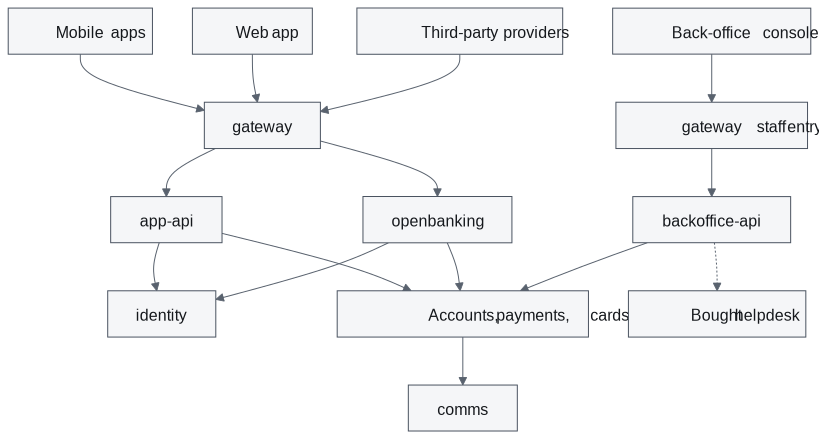
This section covers four customer and staff touchpoints: the mobile apps, the web app, the back-office console and the public website. Six blocks serve them.
| Block | Description | Business rules |
|---|---|---|
gateway | Public entry point: encryption (TLS), attack filter (web application firewall), rate limits, routing | None |
app-api | Server built for the apps (a backend-for-frontend) | None |
backoffice-api | Server built for the staff console | Access rules only |
identity | Customer sign-in, device binding, SCA, sessions, consents | Authentication rules |
openbanking | Dedicated interface for outside providers, called TPPs (third-party providers) | None: translates and forwards |
comms | Push, SMS, email, in-app messages, documents | Delivery rules only |
A backend-for-frontend is a server built for one kind of client: the phone requires a single call for the whole home screen, the core exposes small, precise calls, and this server joins the two. All public traffic enters through gateway. The staff entry point is separate and private. The public website consists of static pages that contain no customer data. The diagram shows how the blocks connect.
How it works
The customer app
The app launches with these screens:
- Onboarding (section 06).
- Home: balance, recent transactions, pots.
- Send money.
- Cards: freeze, limits, Apple Pay and Google Pay (section 05).
- Pots, statements and in-app chat.
- Settings: devices, language, consents.
The phone holds the screens, a few local checks (such as the check digits of an account number, the IBAN, or under the UK profile the format and modulus check of a sort code and 8-digit account number), the secure key and a read-only copy of recent data. The server makes every decision, so a modified app cannot move money that the core refuses to move.
Sending money
Before the customer signs a payment, payments runs the payee check, which under the Lithuanian profile is the verification of payee check (VoP). The payee's bank compares the name entered by the payer with the name on the payee's account. The regulation makes the check free of charge and requires it before the payer authorises. The outcomes are match, close match, no match and verification not possible, which the internal payee-check contract carries as described in section 04. The app presentation of the UK check, Confirmation of Payee, is described in the United Kingdom profile section. The diagram shows the successful path; amounts are shown in euro, and under the UK profile the same example applies in sterling.
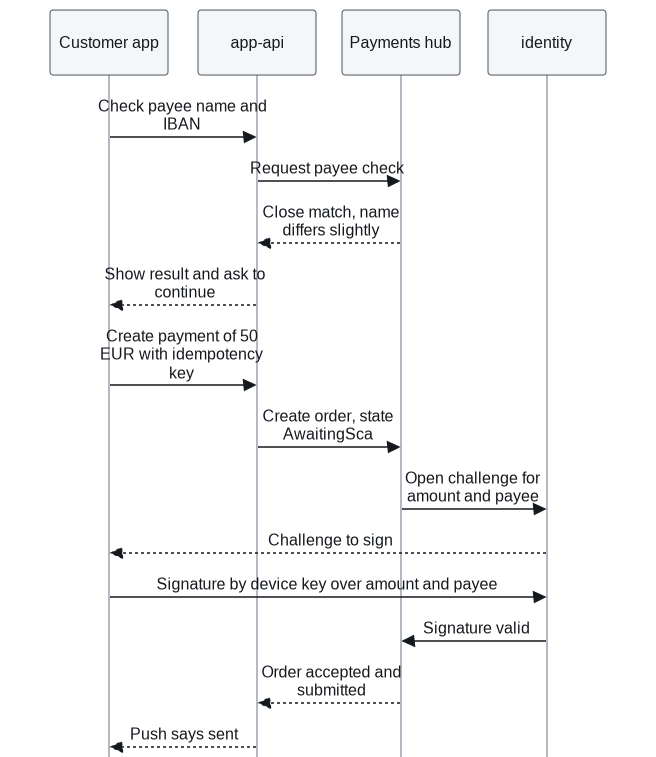
Four design details apply:
- Dynamic linking. The app shows the amount and the payee before the key is used, and the signature covers both. If malware replaced the payee, the signature would no longer match.
- Idempotency key. A single unique value identifies one intention to pay. The app generates it when the customer taps Send and reuses it on every retry, so a retry does not result in a second payment.
- Risk decision. After signing,
paymentsrequests a verdict fromrisk(section 07).allowlets the payment continue.challengerequests one further confirmation in the app.reviewkeeps the order under the neutral status "Processing"; under the UK profile, where the bank delays an outbound payment on suspicion of fraud, the customer is also notified within the period described in section 04.blockrefuses it. The refusal states a reason only when the code is marked safe to disclose, and no reason that would indicate a money-laundering suspicion. - Time limit. The app shows "Sending", and a push message confirms the final state. Under the Lithuanian profile the 10-second limit for an instant payment is set by law and enforced by
payments(section 04); under the UK profile the 15 seconds within which the Faster Payments scheme requires an attended customer to be informed of the outcome of a Single Immediate Payment are a scheme service level, and the statutory execution limit is the end of the next business day (section 04).
Poor networks and real-time updates
The app does not create a payment offline. It caches the last balance as read-only data, labelled "as of 14:32". On a timeout it shows "Checking" instead of "failed" and queries app-api for the payment by its idempotency key. A payment is final only when the server reports it as such.
Push messages, sent through comms, wake the phone and carry no sensitive data. While the app is open, the server also keeps a connection open and signals that something has changed. The connection is a server-sent event stream, chosen because it runs over the same HTTPS path as the standard API and needs no additional protocol at gateway; the cost is that the stream carries traffic in one direction only, which is sufficient for a change signal. The signal carries only IDs, and the app then fetches the details over the standard API. If streaming fails, the app polls at short intervals while a payment is in flight.
Web app and design system
Scope at launch. The web app has a narrower scope than the mobile apps. It offers sign-in, balances, transactions, statements, payees, freezing a card and sending payments, instant ones included. It does not onboard customers, show full card details or bind devices.
Approval. A browser has no secure hardware key, so the web app uses decoupled approval: the customer starts the action in the browser and signs on the bound phone, which shows the amount and the payee.
Appearance and languages. One shared set of colour, spacing, type and motion rules (the design tokens) feeds the web app and both phone apps. Accessibility rules are part of the tokens: contrast, text size, screen-reader labels and tap targets. Lithuanian and English are provided at launch under the Lithuanian profile, and English under the UK profile; contracts, notices and support are offered in the same languages. Every string is a catalogue entry, and the build fails if one lacks a translation.
Accessibility. Under the Lithuanian profile the European Accessibility Act applies to consumer banking services provided after 28 June 2025 (Directive 2019/882[10], Article 2(2)(d)). Annex I, Section IV, point (e) requires identification methods, electronic signatures, security and payment services to be perceivable, operable, understandable and robust, and requires information to be understandable at a level of complexity no higher than B2 of the Common European Framework of Reference for Languages. The apps and the web app are built to these requirements. Conformance is tested against the Web Content Accessibility Guidelines 2.1 at level AA, the bank's own test standard, on every release, and customer-facing text is written to level B2. The same build and tests are applied under the UK profile, so that one accessibility standard holds for both; the cost is an accessibility test stage in each release.
API design
- Versioning: the major version is part of the path (
/v1). Within a version, only fields are added.app-apireturns a minimum app version, so that a vulnerable old build can be forced to update. - Idempotency: every write carries an
Idempotency-Keyheader. The server stores the response for 24 hours (target) and replays it on a repeated request. The same key with a different body is an error (pattern[12]). - Errors: one format throughout: a
codesuch aspayment.insufficient_funds, aretryableflag, arequest_idand per-field codes. Free text is not used. - Pagination: by cursor, with at most 50 items a page. Page offsets are not used, because new transactions would shift the sections while a client reads them.
gateway terminates the encrypted connection, applies the firewall and the rate limits (per address, device and customer), checks token signatures and routes the request. It holds no business logic and no data. It passes traffic on over mutual TLS, in which both sides prove their identity (Overview, point 9).
identity
identity holds credentials, sessions and device data. It does not hold the customer's personal record: names and documents remain in customers (Overview, point 10). Device data and IP addresses are nevertheless personal data, so identity encrypts them under its own key (an exception listed in section 12).
Registration starts in onboarding. When the checks pass and customers holds the record, identity creates a credential for that customer ID and binds the first device.
Sign-in. The server sends the app a nonce, a one-time random value. The app signs it with the device key. The phone verifies the user (fingerprint, face or device PIN) and does not transmit the PIN. A failure does not indicate which check failed. The following are the initial targets:
| Setting | Target |
|---|---|
| Failed attempts before lock | 5, then 30 minutes |
| Second lock within a day | Locked until recovery |
| App idle lock | 5 minutes |
| Absolute session | 12 hours |
| Sensitive action (new payee, limit or device change) | SCA within the last 5 minutes |
| Session token | 32 random bytes, only a hash stored |
Under the Lithuanian profile the RTS sets the 5-attempt cap and the 5-minute inactivity timeout. The remaining values are targets of the bank. Under the UK profile the same values are used as targets. The retained text of Article 4(3)(b) and (d) sets the same five-attempt cap and five-minute timeout (legislation.gov.uk[19]); the FCA's technical standards, which replaced it, keep both values in Article 4(3)(b) and (d) (FCA 2020/70[15]).
Devices. identity keeps one record per bound phone: its public key, platform, attestation result, state, dates and any reason for revocation. The diagram shows the life cycle of a device.
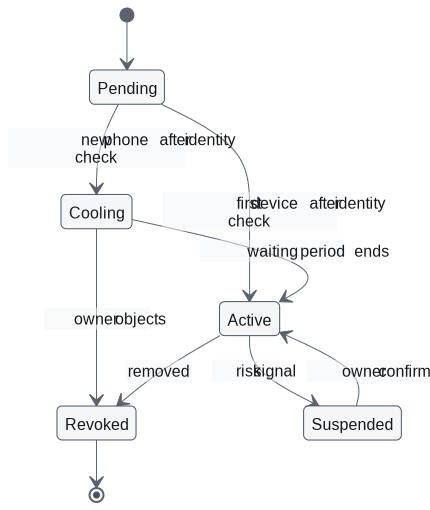
Re-binding a new phone is a leading route to account takeover and is therefore subject to an extended process:
- The customer repeats the identity check through
onboarding, which in Phase 1 is the document and liveness check. A stolen password or SIM is not sufficient. Re-binding accepts only an identification method thatonboardingaccepts for a new customer, so an electronic identity scheme or the EU digital identity wallet (Regulation 2024/1183[6]) becomes available for re-binding when its adapter is admitted under section 06, and not before. - If the old phone still works, it must approve the change.
- The new device remains in
Coolingfor 24 hours (target). The old device and the email address receive an alert with a "this was not me" button. Payments are capped at a low amount and limited to existing payees. - When the waiting period ends, the old device is revoked.
No staff member can shorten the waiting period.
Recovery and integrity. If the customer has lost the phone and has no old device, the same steps apply with a longer cooling period. No password exists, so no emailed reset link exists. At binding and at sign-in the app presents a platform attestation: proof from Apple or Google that the app is genuine and the phone has not been tampered with. identity records it. A rooted or tampered phone is a risk signal that causes risk to lower the limits (section 07); it does not result in an automatic ban. A customer without a smartphone is not served at launch; a separate authentication device for such customers is outside Phases 1 and 2, and the cost is that this group cannot open an account.
Exemptions. Under the Lithuanian profile the regulation permits a bank to omit the second check in some cases: small contactless payments (up to 50 EUR), small online payments (up to 30 EUR), trusted payees, recurring payments and payments assessed as very low risk. The exact list for Phase 1 is in section 05; for transfers, the only exemption used is the recurring-payment exemption for standing orders. risk decides and keeps the counters, and identity enforces. Moves between a customer's own pots require only a valid session: Article 15 of the RTS permits a provider to omit SCA for a credit transfer where payer and payee are the same person and both accounts are held with the same provider, and Article 15 of the FCA's technical standards is in the same terms (FCA 2020/70[15]). Phase 2 adds more exemptions. The UK exemptions are described in the United Kingdom profile section.
Consents. Each consent is a row in an append-only table recording who, what kind, which version, when granted, which channel and a hash of the evidence. Withdrawal adds a new row and does not edit the old one.
Back-office console
Four groups use the console: support, compliance analysts (section 06), operations (repairs, returns, reconciliation breaks) and finance (section 08). Staff sign in through the company's identity provider with a hardware-backed factor. Rotas, complaints and the care of vulnerable customers are covered in Running the bank.
Access. A role determines the kind of work a person may perform. Additional rules determine which customers: a case must be assigned to the person. A second person must approve (the four-eyes rule) when staff unfreeze an account, raise a limit, adjust the ledger manually, change a payee, override a device rule or export customer data.
Logging. The console writes every view of customer data to audit before the screen opens. If audit cannot be reached, the view is refused (fail closed). The record holds the user, the customer ID, the field names (not values), the stated reason (ticket or case ID) and the time. Example: an agent opens a customer profile to assist with a blocked card. The console requests the ticket number and displays the phone number masked. It records agent, fields, ticket and time. Viewing a full document image requires prior approval by a team lead.
Tipping-off. Staff must not disclose to a customer that a report about the customer exists. The console shows such cases only as "Under review". The rule and its legal basis are in section 06.
Support. The bought helpdesk handles queues and canned replies. The bank's console is attached to it as a side panel and calls backoffice-api for each permitted view. In-app chat is verified: the app opens it with a signed token that names the customer ID, so the agent asks no security questions. No screen holds a PIN or card number.
Lost or stolen phone. Every self-service route requires the phone, so the helpdesk vendor also operates a telephone line that is open at all hours. A caller who cannot use the app may perform three protective actions only:
- block a card (one-way, as in section 05);
- revoke devices;
- ask
accountsto place a debit block.
The caller first passes a low-assurance check: questions that customers verifies without showing the answers to the agent, and a call-back to the number on file. The line does not move money, raise a limit or reveal data, and each use is logged to audit. Re-binding remains on the extended path. Staffing is covered in section 14. PSD2 Art 70(1)(c) and (d)[3] require a means of reporting loss or theft that is available at all times and free of charge, which this line provides under the Lithuanian profile. The same line is operated under the UK profile, where regulation 73(1)(c) and (e) of the Payment Services Regulations 2017 impose the same duty (regulation 73[24]).
comms
comms keeps reviewed, versioned templates for each language and channel. It selects push, in-app message, email or SMS by message type and customer setting. Security alerts override marketing opt-outs, and a failed alert is retried on another channel. Each message is a row that records its template, channel, state (Queued, Sent, Delivered or Failed) and the vendor's receipt.
Message rows and the helpdesk vendor's chats follow the retention schedule. comms deletes its own rows, and the bank's adapter deletes helpdesk records through the vendor's interface (section 12). Statement PDFs are generated from data in accounts. The following are stored as versioned documents with a delivery record, each remaining available to the customer in the in-app inbox: the contract and its terms, the fee information, every notice of a change to terms or fees, account statements, and replies to complaints. Any other message that states a customer's rights or obligations is treated in the same way, which stores more documents than the minimum the law may require. They are kept for the periods of the retention schedule in section 12.
No sensitive data is sent by SMS or email, including balances and account numbers; the text states only that a message is waiting in the app. A lock-screen push reads "New card payment". Customers may enable the display of amounts.
openbanking
A customer may use a budgeting application provided by another company. The customer selects the option to connect the bank, is redirected to the bank's app and approves access to balances. The budgeting application can then read them until the customer withdraws consent or the re-confirmation period ends. The same route allows an online shop to initiate a payment from the customer's account.
Outside providers (TPPs) use openbanking for three purposes: reading balances and transactions, initiating a payment, and confirming whether funds are available. Under the Lithuanian profile, a TPP proves its identity with a digital certificate issued only to licensed firms. By common practice, the bank requires one for the connection and accepts one to sign requests. openbanking checks the certificate and the TPP's authorisation, and refuses a revoked certificate immediately. The authorisation number in the certificate is the number in the public register of the TPP's home Member State (RTS Article 34(2)). The check uses the central register that the European Banking Authority (EBA) keeps under PSD2 Article 15, which lists payment institutions, account information service providers and electronic money institutions and can be downloaded in full as a machine-readable file (EBA[11]). Credit institutions acting as TPPs are held in a separate EBA register, which is checked in the same way. openbanking refreshes its copy daily; a withdrawal made during the day is caught through the revocation of the certificate. The rule is RTS Article 34[1], which requires qualified certificates, a kind issued under the EU's electronic-identification rules (eIDAS).
The customer is redirected to the bank's app, where identity runs SCA with the same device key and shows the TPP's name, the amount and the payee. The bank supports the redirect and decoupled flows, in which the customer always approves in the bank's app. The embedded flow, in which the TPP handles the customer's credentials, is not supported. The diagram shows a TPP initiating a payment.
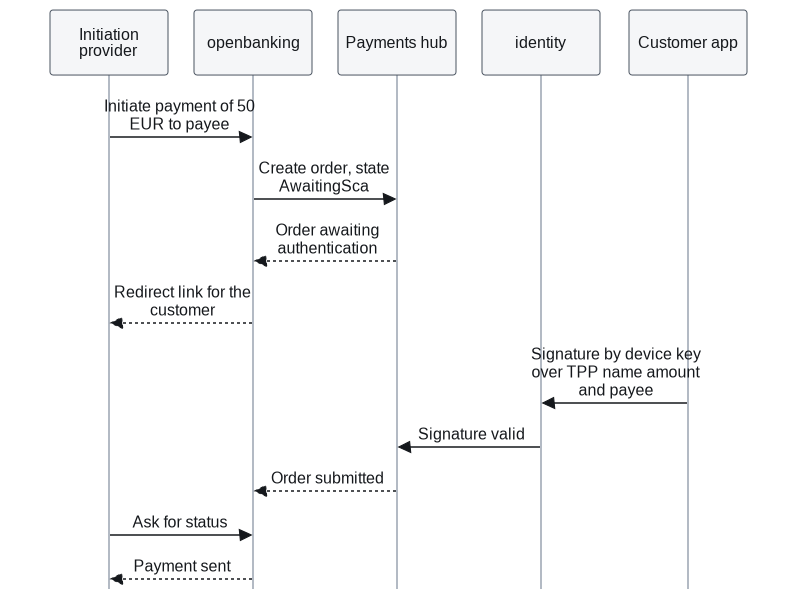
Every step after order creation follows the path used by the app, including the risk check. Under the Lithuanian profile, access through an account information service provider is exempt from SCA except on the first access and where more than 180 days have elapsed since SCA was last applied (Article 10a of the RTS, inserted by Delegated Regulation 2022/2360[9] and applicable from 25 July 2023). The dedicated interface and its fallback follow RTS Articles 30 to 33[1].
Fallback. Article 33(4) of the RTS requires a contingency mechanism through which a TPP may use the customer interface while the dedicated interface is unavailable. Under Article 33(6) the supervisor exempts a bank from it where the dedicated interface meets the availability and performance obligations of Article 32, has been designed and tested to the satisfaction of TPPs, has been widely used for at least three months for all three services, and has had its problems resolved without undue delay. The bank applies for this exemption once three months of use can be evidenced. Until it is granted, the contingency mechanism is an identified TPP entry to the web app's sign-in and API path, on which the TPP presents its certificate and the customer authenticates as in the web app; its cost is a second, rarely used path that must be tested with each release.
United Kingdom profile
| Aspect | Lithuanian profile | UK profile |
|---|---|---|
| Legal basis for SCA | Delegated Regulation 2018/389 | Payment Services Regulations 2017, regulation 100, and the FCA's SCA technical standards |
| Third-party interface standard | Berlin Group NextGenPSD2 | UK Open Banking Standard |
| Account identifier in the apps | IBAN | Sort code and 8-digit account number |
| Payee check shown to the customer | Verification of payee, before each transfer | Confirmation of Payee, at least when a payee is created or changed |
| Instant outcome shown to the customer | Within 10 seconds, a statutory limit | Within 15 seconds for a Single Immediate Payment, a scheme service level |
Authentication. Strong customer authentication is required by regulation 100 of the Payment Services Regulations 2017, with the detail in the FCA's technical standards. Instrument FCA 2025/62 amended only Article 11, on contactless payments, and the related guidance from 19 March 2026; the other exemptions and their thresholds were not changed (FCA Handbook Notice 136[13]). The device-bound key, dynamic linking, sessions and re-binding are unchanged. The exemptions relevant to the channels are those for trusted beneficiaries (Article 13), recurring transactions (Article 14), credit transfers between a customer's own accounts with the same provider (Article 15), low-value remote payments (Article 16) and transaction risk analysis (Article 18), together with the account-information exemptions of Articles 10 and 10A (FCA 2020/70[15]). Article 16 allows a remote payment of up to GBP 25 without SCA, provided that the cumulative amount since SCA was last applied does not exceed GBP 85 or that no more than five consecutive payments have been made. Article 18 sets exemption threshold values of GBP 85, GBP 220 and GBP 440, each tied to a reference fraud rate for card payments and for credit transfers. Under Article 10A, in force since 26 March 2022, access through an account information service provider is exempt once SCA has been applied on one earlier occasion, with no periodic reauthentication by the bank; the provider instead reconfirms the customer's consent every 90 days under Article 36(6) (FCA 2021/45[17]). For transfers the bank uses the same exemptions as under the Lithuanian profile, namely recurring payments and moves between a customer's own pots; risk holds the thresholds as parameters, and the card exemptions are in section 05.
Third-party access. Since PS21/19 the FCA requires a dedicated interface for personal payment accounts within the Payment Accounts Regulations 2015, equivalent SME accounts and consumer and SME credit card accounts; a new bank must publish the interface specification and a testing facility at launch and have a fallback interface within six months of launch unless exempted (FCA PS21/19[14], paragraphs 1.33 to 1.36). The conditions for the exemption from the fallback are those of Article 33(6) described above, and the exemption is granted by the FCA; Article 33(5), as amended, requires the fallback from no later than six months after the market launch of the interface (FCA 2021/45[17]). The bank applies once three months of wide use can be evidenced, and prepares the contingency mechanism described above for the six-month date in case the exemption has not been granted by then. Article 34 of the standards requires the bank to accept qualified certificates under the eIDAS Regulation as it applies in UK law and at least one other form of identification issued by an independent third party, to verify that the provider is authorised, and to publish the forms it accepts (FCA 2020/72[16]). The bank accepts the website authentication and seal certificates issued by the Open Banking Directory, known as OBWAC and OBSeal, as the other form. The certificate is not treated as proof of authorisation: openbanking checks the provider's authorisation status on each call through the Directory's own services, which draw on the FCA register, and caches the result for a short period (Open Banking Directory FAQs[18], page dated May 2024). Certificates issued under the EU's eIDAS rules do not identify a provider to a UK bank. The order made by the Competition and Markets Authority (CMA) in 2017 binds only the nine largest providers; a new bank adopts the Open Banking Standard in practice (Open Banking[20]). openbanking therefore exposes that standard over the same internal paths, with the same redirect and decoupled flows.
Account identifiers and Confirmation of Payee. The apps capture and display sort code and account number and show the derived IBAN only for cross-border use. The payment reference is limited at entry to 18 characters, so that nothing is truncated after the customer has confirmed the order (the limit is a setting of the UK profile, defined in section 04). The Payment Systems Regulator's Specific Direction 17 applies to a new participant from the day after it joins Faster Payments or CHAPS with its own sort code, so the Confirmation of Payee screens are required at launch; the bank must send and answer requests at least when a payee is created or its identifiers change (Payment Systems Regulator[22], paragraphs 3.4, 3.5 and 7.4). Confirmation of Payee returns match, close match (the actual account name is shown), no match or unavailable, together with a reason code that distinguishes, among other cases, a personal or business account mismatch, a switched account and an account that does not exist (Pay.UK[21]; the contract is in section 04). The app shows the outcome, the reason and the returned name before signing, requires an explicit confirmation on close match, no match or unavailable, refuses to save a payee whose account does not exist, and records the outcome on the order for fraud reimbursement (section 07).
Direct Debits. The mobile apps list the Direct Debit Instructions held against each account, with the originator's name, the reference, the status and the most recent collection, and show collections due where the sponsor's Bacs output makes them known before entry day. The customer can cancel an instruction, which is confirmed with the device key and takes effect in the instruction register immediately. A collection returned unpaid produces a notification. From a collection in the transaction list the customer can raise a claim under the Direct Debit Guarantee, which opens a refund case and shows the refund when it is posted. The apps hold no rule of their own: app-api reads the register and the cases from payments (section 04, D04.8).
Key design decisions
D09.1 Native mobile apps
Decision. iOS in Swift (SwiftUI), Android in Kotlin (Jetpack Compose).
Why. The apps depend on platform features: keys in the secure chip (Secure Enclave on iPhone, StrongBox on Android), fingerprint and face prompts tied to a key, app attestation (for example App Attest and Play Integrity) and wallet provisioning. Native code accesses them directly, on the day a new operating system is released.
Alternative considered. One cross-platform codebase (Flutter, React Native or Kotlin Multiplatform). It reduces the screen work by roughly half. It is not adopted, because keys, attestation, wallets and biometrics still require native modules, and these are the areas in which defects are most costly.
Cost. Two codebases and two skill sets, held together by one API contract, shared tokens and one test script per journey. The decision holds for a team of about eight engineers or more (planning assumption). Below that size one platform is delivered first and the second follows, in preference to a weak cross-platform app; the staffing plan is in section 13.
D09.2 Thin clients and a backend-for-frontend
Decision. Clients display and collect. app-api shapes data per screen and holds no business rules.
Why. A rule inside the app can be modified by an attacker and can differ between platforms. A single server-side rule gives one answer and one audit trail. A limit can also be changed without an app-store release.
Alternative considered. One general API without a backend-for-frontend would force many calls on poor networks. GraphQL, a query language that lets the client shape its own requests, makes access control and rate limiting harder on the money path. Neither is adopted.
Cost. Discipline. A change that requires a decision belongs in a core service, and app-api only calls it.
D09.3 Device-bound keys for SCA rather than SMS codes
Decision. A key created in the phone's secure hardware signs sign-in and payment confirmation. Using it requires a fingerprint, a face or the device PIN. SMS codes are not used.
The regulation requires two different kinds of check. The phone's key is a possession element. The fingerprint or face is an inherence element. The PIN is a knowledge element.
Why. SMS codes can be diverted by SIM swapping or entered on fake sites, and they are not linked to the amount and the payee. A device key does not leave the phone, and its signature covers both. The possession element is the key itself. Platform attestation is recorded as evidence that the app and the device are genuine; it is not relied upon as an authentication element.
Alternative considered. SMS or email codes are inexpensive and need no app. Hardware tokens are strong but costly to distribute. Neither is adopted.
Cost. No smartphone means no service at launch. Loss of a phone is a recovery event that must be handled reliably. Apple and Google attestation become dependencies. If one is unavailable, no new device can be bound, but no check is skipped.
D09.4 One staff console over APIs, no database access
Decision. All staff work uses one console over backoffice-api. No person has standing access to a production database.
Why. Each service owns its data (Overview, point 3). A console that read tables directly would bypass every rule and log. One console provides a single place for roles, four-eyes approval and logging.
Alternative considered. Per-team admin tools or database clients would be quicker to start. They are rejected because they leave gaps in the audit trail.
Cost. Every staff need becomes an endpoint and a screen. Engineers obtain emergency access only through "break-glass" access, which is time-limited, approved by a second person and recorded in audit.
D09.5 Open banking on a standard, sharing the core paths
Decision. openbanking implements Berlin Group NextGenPSD2, the common technical standard used by European banks for open banking. The version is the 1.3 series of the Implementation Guidelines, at the subrelease current when the build starts; subrelease 1.3.16 was published on 2 December 2025 (Berlin Group[8]). It calls the same internal services as app-api.
Why. A second payment implementation for outside providers would be a second source of defects and fraud exposure. A single path also provides the equal treatment that the rules expect.
UK profile: openbanking implements the UK Open Banking Standard in place of Berlin Group NextGenPSD2, behind the same internal calls, because a new UK bank adopts that standard in practice although the CMA order does not bind it (Open Banking[20]). The adapter layer in openbanking is selected by jurisdiction.profile; the rest of the decision is unchanged.
Alternative considered. A bank-specific API, or a bought open-banking gateway, would be quicker to start. Both are rejected: the first requires a new integration for every provider, and the second places another vendor on the payment path.
Cost. The bank follows the version changes of the standard. It also operates a fallback and meets performance targets equivalent to those of its own app.
D09.6 Buy helpdesk and message delivery
Decision. Helpdesk software and the delivery of push, SMS and email are procured (Overview, point 1). comms and the adapters are built in-house. The helpdesk holds tickets and chat, not account data.
Why. Ticket queues and carrier routes are commodity functions. The content, timing and recipients of messages remain under the bank's control.
Alternative considered. Both could be built in-house. This is not adopted, because it would require years of detailed work.
Cost. Two additional vendors in the DORA register of ICT providers (section 10; DORA Article 28[5]), which under the UK profile is kept as the supplier register, and customer text held in a vendor's system.
Failure modes and mitigations
| Failure | Effect | Response |
|---|---|---|
| Phone stolen | Thief holds a bound key | Fingerprint, face or PIN still required; customer revokes the device in the app or by phone; refund duties for unauthorised payments (PSD2 Article 73[3]; under the UK profile regulation 76[24] of the Payment Services Regulations 2017, with the payer's liability in regulation 77[24]) |
| Attacker binds a new phone | Account takeover | Fresh identity check, old-device approval, cooling period, low caps, alerts |
| Timeout after Send | Customer taps again | Same idempotency key returns the existing order |
| Push not delivered | Customer unaware | Refresh on open; the in-app inbox is the record |
app-api down | Apps cannot load | Cached read-only view; card stand-in continues to operate (section 05) |
| Attestation service down | No new bindings | Existing devices continue |
TPP floods openbanking | Slow for third parties | Per-TPP limits at gateway; own app on a separate path |
| Staff snooping | Privacy breach | Reason required, all views logged, alerts on unusual volume |
audit unreachable | Staff cannot open customer data | Fail closed; customer payments unaffected |
| Confirmation of Payee unavailable (UK profile) | No name check for a new payee | Outcome shown as unavailable; the customer must confirm explicitly before signing, and the outcome is recorded on the order; where the reason is that the account does not exist, the payee cannot be saved |
Security and privacy considerations
- Device private keys do not leave secure hardware. Only public keys are stored.
- The app stores no card number or PIN. Card details are shown only after SCA, through the processor's component (section 05).
- Logs at
gatewayandapp-apihold IDs and no message bodies containing personal data. See Security and Privacy.
Phasing
Phase 1 comprises:
- both apps and the narrow web app;
gateway,app-apiandbackoffice-api;identitywith device binding and cooling;- the staff console with four-eyes approval, view logging and views that do not reveal a report;
- the helpdesk with verified chat, and the lost-or-stolen line;
commswith statements;openbanking: account information, payment initiation, confirmation of funds and a test sandbox;- the static website, in Lithuanian and English;
- under the UK profile,
openbankingon the UK Open Banking Standard with its specification and testing facility published at launch, Open Banking Directory enrolment, Confirmation of Payee screens, sort code and account number entry, and the Direct Debit Instruction screens (list, cancellation and Direct Debit Guarantee claim), with the website in English.
Phase 2: business accounts with several users; SEPA Direct Debit mandate screens under the Lithuanian profile, loan and overdraft screens; more exemptions; passkeys on the web (sign-in without a password, using the phone or computer's own lock); more languages.
Phase 3: partner and banking-as-a-service APIs, building on openbanking.
Assumptions and dependencies
The design in this section rests on the following assumptions, each confirmed at the stated point. None blocks the start of the build.
| Assumption | Confirmed by | When | If it does not hold |
|---|---|---|---|
| Lithuanian profile: Lithuanian and English satisfy the language requirements of national law for contracts, notices and support. | Counsel | Before the licence application | A further language is added as a catalogue in the string system and as a template set in comms; the build check on missing translations then covers it. |
| Lithuanian profile: national law adds nothing to the accessibility requirements of Directive 2019/882 or to the loss-reporting duty of PSD2 Article 70 that the design does not already meet. | Counsel | Before the licence application | The added requirement becomes an accessibility test case or a change to the lost-or-stolen line's script and opening hours, within the cost envelope of section 13. |
| The supervisor accepts a launch service that requires a smartphone, with the lost-or-stolen telephone line as the only route that does not need one. | The Bank of Lithuania, or the PRA and FCA | Before the licence application | A separate authentication device is added to identity as a second kind of bound device, and the web app becomes usable with it; this moves into Phase 1 scope within the cost envelope of section 13. |
| The supervisor grants the exemption from the fallback mechanism under Article 33(6) once three months of wide use are evidenced. | The Bank of Lithuania, or the FCA | Before public launch | The contingency mechanism described under openbanking remains in service and is tested with each release; under the UK profile it must be live no later than six months after launch. |
| UK profile: Articles 4, 10, 10A, 13 to 18 and 33 to 34 of the FCA's technical standards stand as made in instruments FCA 2020/70, 2020/72 and 2021/45, with Article 11 alone changed since. | Counsel | Before the licence application | A changed threshold is a parameter in risk or identity; a changed certificate rule changes the list of accepted issuers in openbanking. |
| UK profile: enrolment in the Open Banking Directory as an account provider gives the bank the OBWAC and OBSeal trust chain and the authorisation-checking services on the terms published in May 2024. | Open Banking Limited | Scheme onboarding | openbanking checks authorisation against the FCA register directly and validates certificates against the issuer's revocation service; the adapter changes and the internal paths do not. |
| UK profile: the long-term framework that the FCA is to consult on under the Data (Use and Access) Act 2025 retains the UK Open Banking Standard as the interface for account information and payment initiation. | The FCA | Phase 2 planning | The adapter layer of openbanking selected by jurisdiction.profile is replaced or extended; the internal calls, SCA and consent records are unchanged. |
Sources
- Delegated Regulation (EU) 2018/389, SCA and secure communication
- Regulation (EU) 2024/886, Instant Payments Regulation
- Directive (EU) 2015/2366, PSD2
- Regulation (EU) 2024/1624, AML Regulation
- Regulation (EU) 2022/2554, DORA
- Regulation (EU) 2024/1183, European digital identity framework
- The Berlin Group
- Berlin Group, Open Banking and NextGenPSD2, subrelease 1.3.16
- Delegated Regulation (EU) 2022/2360, amending the SCA standards on the 90-day exemption for account access
- Directive (EU) 2019/882, European Accessibility Act
- EBA, register of payment and electronic money institutions under PSD2
- Stripe on idempotency
- FCA Handbook Notice 136, SCA technical standards amendment
- FCA PS21/19, changes to the SCA technical standards
- FCA 2020/70, Technical Standards on Strong Customer Authentication and Common and Secure Methods of Communication Instrument 2020
- FCA 2020/72, amendment of Article 34 on certificates
- FCA 2021/45, amendment (No 2) instrument 2021
- Open Banking Directory Services FAQs
- Regulation (EU) 2018/389 as retained in UK law, Article 4
- Open Banking, regulatory framework
- Pay.UK, Confirmation of Payee FAQs
- Payment Systems Regulator, Specific Direction 17, consolidated October 2026
- Pay.UK, Faster Payments System Principles v11, January 2026
- Payment Services Regulations 2017, regulation 73, regulation 76 and regulation 77