10. Platform, data and operations
Purpose and scope
This part specifies where services run, where data is kept, how services communicate state changes, how failures are detected and how changes are delivered. The description below uses the Lithuanian profile; the differences under the UK profile are set out in the United Kingdom profile section. Example: if one of the three Frankfurt data centres loses power at 23:40 on a Sunday while a card payment is in progress, the payment completes, because every record it requires was already copied to a second data centre.
Three requirements apply specifically to a bank. The loss of a saved record is a breach of the book of record. Under the Lithuanian profile, the Digital Operational Resilience Act (DORA) treats the bank's cloud as supporting critical functions, and in November 2025 the European supervisory authorities designated the large providers, AWS among them, as critical ICT third-party providers (ESAs list[2]). Finally, an auditor who asks who changed a payment limit in a given month requires an answer that no one could have edited.
Components
The platform consists of a small set of shared components: managed Kubernetes, which runs the services; a Rust service template; one PostgreSQL database per service; an event log; a job runner; the audit service; the data platform; and the delivery pipeline. AWS is assumed, with Frankfurt as primary region across three data centres (availability zones) and a smaller warm copy in Ireland under the Lithuanian profile, and London as primary region with the same layout and Ireland as recovery region under the UK profile. Each licensed entity has its own set of accounts.
The cloud is divided into separate accounts so that an error or a compromise in one cannot reach the others. A root account holds only policies, and each environment has its own set of accounts. The diagram shows the production accounts and the permitted direction of traffic.
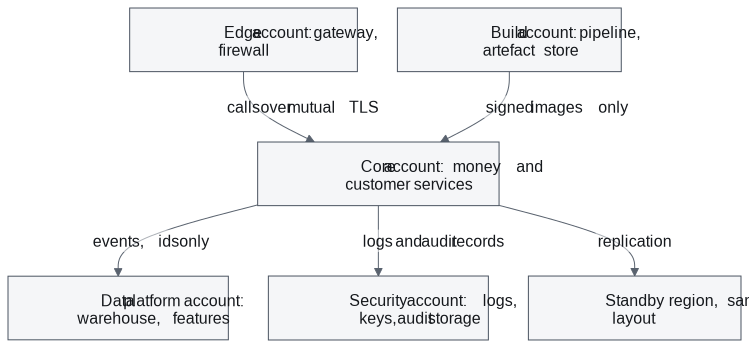
The platform contains no card-data zone: card numbers and PINs do not enter the bank's services (Cards), and the pipeline verifies this. Engineers who deploy services cannot delete anything in the security account.
How it works
The service template
- Health and metrics. Liveness and readiness checks; error counts and response time per call, outbox lag and job backlog.
- Tracing. One trace id spans the path from
gateway, the entry point for external requests, to the last database call, so that a single slow payment can be followed end to end. - Configuration. Configuration is read from a versioned store, which also carries the rule settings published by the compliance service (
compliance). Secrets come from key management and are not built into images. - Deadlines. A call that arrives with 800 ms remaining passes a shorter deadline to each downstream call. An expired deadline stops the work.
PostgreSQL per service
Each database runs as a managed cluster with copies in all three zones. For services whose records the bank cannot afford to lose, the database confirms a save only after a second data centre also holds a copy (synchronous replication). This meets the target of no committed data loss inside the region. The services concerned are:
- the book of record, the payments hub and the card service (
ledger,payments,cards): money and its movements; - the rail gateway (
sepa-gateway, the link to CENTROlink, under the Lithuanian profile;fps-gateway, the link to Faster Payments, under the UK profile): its inbox, its outgoing messages and their ids; accounts: restrictions such as a sanctions freeze or a seizure;screeningandcompliance: confirmed hits, cases and running report clocks;identity: device revocations, so that a lost phone remains revoked;treasury: funding orders, since losing one and retrying it under a new id would move 500,000 EUR twice (amounts are shown in euro; under the UK profile the same example applies in sterling);auditand the staff console's backend (backoffice-api): staff actions already carried out, and approvals.
Other services replicate changes with a short delay (asynchronous replication) and can rebuild the last seconds from events.
Backups are continuous, so that any second in the retention window can be restored (point-in-time recovery), and are copied to the standby region and to the security account. A backup is regarded as valid only once it has been restored: each week (target) a job restores every database into an isolated account and runs the service's consistency checks (for ledger, the trial balance must be zero).
During a rollout the old and new versions of a service run concurrently, so database changes must be compatible with both. A column is removed only in a later release, and the pipeline rejects any change that removes a column the running version still reads.
The event log and the outbox
The event log is Kafka-compatible: an ordered, durable sequence of messages that any number of readers consume at their own pace. A crash between saving a payment and announcing it could leave the payment recorded but never seen by compliance or treasury. A service therefore does not write to its database and, separately, to the log. It writes the message to an outbox table in the same transaction as the change, and a relay publishes it, so that both occur or neither does. The sequence diagram shows a payment being accepted and its event reaching other services.
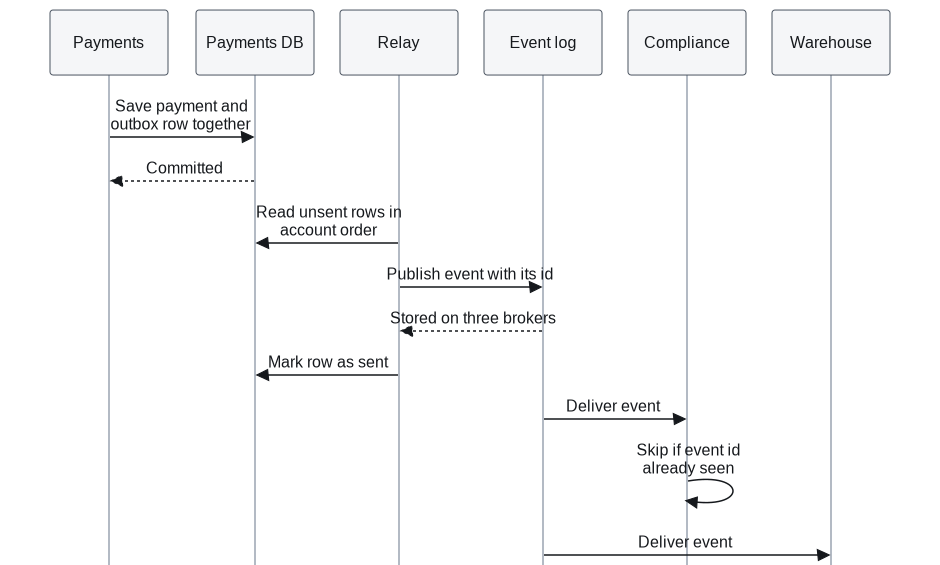
A topic is a named stream of messages; brokers are the servers that store them. Each outbox row holds the event's unique ID (which allows readers to skip repeats), its topic, the account ID, a per-account number (account_seq), the format version, the content and the time of sending. Ids are generated before saving, so their order does not match the order of saves. The service assigns account_seq under the row lock that already serialises the account, and the relay publishes each account's events in that order. A reader that receives number 41 after 39 rejects it and waits for 40.
The rules for the log are as follows.
- Topics per domain, such as
payments.paymentorledger.entry. Only the owning service writes to its topics. - Schemas versioned in a registry. Readers of the previous version must be able to read a new one.
- Delivery at least once. After a crash the relay may publish an event again, so every reader keeps a
processed_eventstable and ignores an event ID it has already handled. - Failing events. On a money topic a failing event stops its account: later events for that account wait, other accounts continue, and the owner is paged. Other topics park a failing event in a side queue (a dead-letter topic), flag it to its owner and continue. Readers can rewind and replay.
- Retention. Target: 14 days on the brokers, then archive storage under the
retention_policiesschedule owned bycompliance(Privacy).
Events carry ids and amounts and exclude names, addresses and document numbers (Overview, point 10). Payment events also carry a counterparty_id, a keyed hash of the other party's account identifier (an IBAN, or a sort code and account number under the UK profile) issued by payments, so that anti-money-laundering monitoring can count distinct senders without access to the identifier. When a customer's data must be erased after its retention period, only customers changes, and archived events remain lawful to keep.
The job runner and state machines
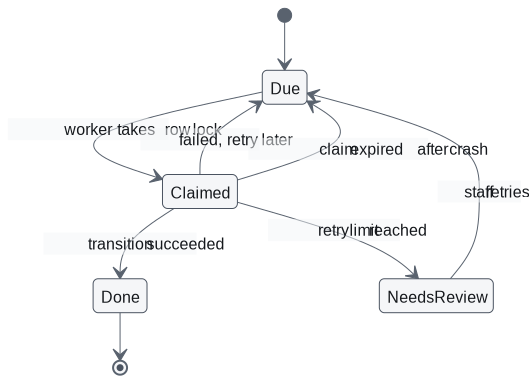
A payment, onboarding or dispute lasts from seconds to weeks. Each is held as a row with a state column in its owner's database, with the permitted transitions defined in code. The job runner is a work queue in the same database: a jobs table with job_id, kind, subject_id, run_after, attempts, claimed_by and claimed_until.
A worker claims a job by locking its row and skipping rows already held by another worker, so two workers cannot process the same payment. Starling reports having had to solve the same race. A stalled worker could resume after its claim expired and another worker took the job, so every claim carries a version number. The change is saved only if claimed_by and the version still match, and side effects outside the database use the job id as their idempotency key. A failed job is retried with increasing intervals; after a limit it moves to NeedsReview in the staff console.
The state diagram shows the life of one job.
The audit service
Services write audit records through their outbox, so that a slow audit service does not delay a payment. Staff actions are the exception: backoffice-api writes them synchronously and refuses the action if audit cannot record it (fail closed).
audit stores the records as an append-only chain. Each record holds seq, occurred_at, actor (a staff or service id), action, subject_id, reason, prev_hash and hash, where hash covers the record and the previous hash, so that editing any earlier record invalidates every later hash. Field names are recorded; personal-data values are not. Every hour (target) the newest hash is written to write-once storage in the security account, under a retention lock that cannot be shortened. This chain is separate from the ledger's chain of sealed pages (Ledger and accounts). Compliance staff query it in the console and can export a verifiable extract.
The data platform
Finance, risk and regulatory reporting require data from across services and do not query production databases. The data platform operates as follows.
- Events land in a raw warehouse zone. Copying row changes directly from a database (change data capture) is permitted only for named services, is excluded for
customers, and passes through the pseudonymiser first. - Customer ids are replaced by a pseudonym (a stable token) by default. Re-identification requires an approval recorded in
audit. - Tables shaped for one use (marts) serve finance (ledger balances by product and day), risk (exposures and losses) and regulatory reporting, and feed
reportingin Treasury and reporting. - A feature store serves precomputed behaviour figures to
risk(Fraud, limits and credit risk). Limit counters are not held here; they reside inrisk's own database. - Data quality checks run on every load: row counts match the source, the ledger trial balance sums to zero per currency, and key columns are not empty. A failed check stops dependent marts from refreshing.
- Lineage traces any number in a regulatory return to its source events.
Monzo reports that warehouse balances disagreed with its backend because teams used different clocks. Every mart therefore uses the business_date and recorded_at set by ledger.
Observability and on-call
Logs carry ids and exclude names, IBANs and customer free text; the template filters known personal-data fields, and a scanner samples logs for leaks.
The service-level objectives (written targets for the required behaviour of a service) for the money path follow. The 99th percentile denotes the latency within which 99 requests in 100 complete.
| Objective | Target |
|---|---|
| Ledger, payments and card authorisation availability | 99.95% per month |
| Incoming instant payment | answered within 2 s at the 99th percentile, hard deadline 4 s, in both profiles; under the Lithuanian profile the credit is posted when CENTROlink's settlement confirmation arrives (target: within 1 s of it), and under the UK profile the posting point is set in Payments |
| Outbox lag on money topics | under 2 s at the 99th percentile |
| Accounts stopped by a failing event on money topics | none stopped longer than 30 minutes |
| Replication lag of each database and of the log mirror to Ireland | under 30 s |
A declared loss of the primary region is measured against the two-hour recovery target and not the monthly availability target; every other outage counts against the 99.95%.
Alerts are raised on symptoms visible to customers and not on processor utilisation. Each alert has a runbook (documented steps for the person on call). The on-call arrangements for the platform and the surrounding desks, and the daily checklist, are in Running the bank.
Resilience and recovery
The loss of one zone has no customer-visible effect: databases fail over to their synchronous copy. The loss of the primary region (Frankfurt under the Lithuanian profile, London under the UK profile) is the dimensioning case: at most one minute of data is lost (valid only while replication lag stays under 30 seconds) and service is restored within two hours. Ireland holds asynchronous replicas, a mirrored log and the same code, scaled down, with reserved capacity for the money-path services (ledger, accounts, payments, sepa-gateway or fps-gateway, cards, risk, identity) at full year-one peak. Failover is a rehearsed manual runbook, because a false ledger failover has worse consequences than a short outage.
Ireland must also be able to read data and sign payments independently. The keys that protect the data keys (key-encryption keys) are multi-region keys, or every data key is wrapped twice (primary region and Ireland). Under the Lithuanian profile, a second CENTROlink signing certificate is enrolled for a hardware security module (a tamper-resistant key device) in Ireland and registered with the Bank of Lithuania before launch. A second private link to CENTROlink terminates in Ireland. The arrangement for the Faster Payments connection under the UK profile is described in the United Kingdom profile section below and in Security.
Customer-visible effect of a Frankfurt loss at 23:40 on a Sunday: card payments continue through the processor's stand-in mode; transfers are suspended until Ireland takes over, within two hours; and the lost records are rebuilt from external parties before transfers reopen.
Reopening after a region failover
The window of lost data presents a risk. A payment order, its idempotency record and its outbox row may be absent in Ireland after sepa-gateway has already sent the payment message (pacs.008) from Frankfurt. If the app then retries with the same key, Ireland would send the payment a second time. The window is not a single point in time: each database replicates with its own lag, and the copy of the raw-message store can lag by minutes. Reopening therefore follows fixed steps.
- Each service reports the time of its last replicated save. The window starts at the oldest of these times and is not assumed to be one minute.
- Outgoing payments remain closed while the window is rebuilt from external parties: a status request (
pacs.028) for every transaction id seen in the window plus a margin, CENTROlink's movement reports (camt.054) for incoming and outgoing payments, and the card processor's authorisation and advice log for the window (a contract term). - Incoming instant credits found this way are booked under
sepa:<instructing_bic>/<tx_id>/credit; card advices are booked in the same way. - The interbank transaction ID (
TxId) of every outgoing payment is derived from its idempotency key (the unique key the app sends with each request), so that CENTROlink refuses a resend as a duplicate (AM05). A negative status report with reasonAM05on an order the bank sent is not treated as a rejection. The order moves toUnknown, andpaymentssends apacs.028for the original transaction ID. Only that answer settles the order. - Missing ledger entries are re-booked under their original idempotency keys, on the current business date with their original value date.
- The business date rolls at midnight Lithuanian time under the Lithuanian profile and at midnight UK time under the UK profile. Sealing the old date (the daily close) waits until these steps are complete and signed off.
payments owns steps 2 to 4 (cards books the card advices), ledger owns steps 5 and 6, and treasury owns the sign-off that permits the close to run (Payments, Ledger and accounts).
Steps 2 to 4 name the ISO 20022 messages of the Lithuanian profile. Under the UK profile the sequence of steps is the same, and fps-gateway uses the Faster Payments equivalents for the status enquiry, the movement data and duplicate detection; those equivalents are defined in the scheme's restricted technical specifications, and fps-gateway maps them during scheme onboarding (Payments).
Test scope and frequency
All frequencies are targets.
| Test | How often | Pass criterion |
|---|---|---|
| Restore of every database from backup | weekly, automated | consistency checks pass, time recorded |
| Full region failover to Ireland, staging | quarterly, at full year-one peak load | within two hours, reopening steps pass, a test message signed and sent from Ireland |
| Zone failure in production | monthly, from Phase 2 | no money-path objective missed |
| Region failover in production | yearly, from Phase 2 | within two hours, one minute data loss at most |
| Chaos tests: kill instances, force database failovers | continuously in staging; weekly in production from Phase 2 | no customer-visible errors |
Chaos tests follow Starling's published practice of inducing failures in production under a controlled off switch.
For cards, the processor's stand-in sends the bank advices (notifications of approvals it granted) that are booked afterwards (Cards). A full second backup bank on another cloud, as Monzo built with Stand-in at about 1% of its primary cost, is deferred: it requires its own decision code and shadow testing.
The delivery pipeline
Small changes are merged into a single main line after review by a second person; authors cannot approve their own change. Builds are reproducible (the same commit yields identical bytes) and signed, and production refuses unsigned images. A rollout proceeds to one instance, then one zone, then all zones, and halts automatically when errors rise. No one holds standing write access to production. The emergency path requires one on-call approver, is recorded in audit and is reviewed on the next working day.
Environments and test data
No production personal data leaves production; other environments use synthetic customers. Each supplier adapter has a sandbox mode, and the bank builds a simulated CENTROlink that accepts and answers ISO 20022 messages (pacs.008, pacs.002, pacs.004) with programmable delays and rejections, in order to test the 10-second instant-payment rule. Under the UK profile the bank builds a simulated Faster Payments central infrastructure in the same manner, answering in the scheme's ISO 8583-based format with programmable delays, rejections and Qualified Accepts.
DORA operations
The on-call tool classifies incidents and runs the reporting timers; other sections refer to this section for these clocks. The reporting rules are a profile setting; the UK rules are described in the United Kingdom profile section. Under the Lithuanian profile, for a major incident the deadlines are as follows (Delegated Regulation 2025/301, Art 5[4]).
| Report | Deadline |
|---|---|
| Initial notice | within 4 hours of classifying the incident as major, and no later than 24 hours after becoming aware of it |
| Intermediate report | within 72 hours of the initial notice |
| Final report | within one month of the latest intermediate report |
A bank must meet the initial and intermediate deadlines even on a weekend or holiday (Art 5(5)); an electronic money institution may report on the next working day (Art 5(4)). Each notice is submitted through the channel that the Bank of Lithuania designates for DORA incident reports; in Phase 1 submission is manual, by the signatory named in Running the bank, and the on-call tool holds the report templates as versioned configuration and stores the submission reference on the incident record.
This section owns the DORA register of information on ICT (information and communication technology) providers, which serves as the supplier register in both profiles, held as data in a versioned repository keyed by vendor_id. Each row records the function supported, whether it is critical or important, the contract, the exit plan, data locations and subcontractors. The register of processing in Privacy refers to suppliers by that id. DORA also requires the bank to identify its information assets and ICT assets, to map those considered critical together with their configuration and interdependencies, and to maintain the corresponding inventories and update them periodically and after every major change (Article 8(4) and 8(6)). The ICT asset inventory is generated from infrastructure code where possible. The selection, approval and review of suppliers are described in Running the bank.
United Kingdom profile
| Aspect | Lithuanian profile | UK profile |
|---|---|---|
| Resilience regime | DORA | PRA SS1/21 and FCA SYSC 15A: important business services, impact tolerances, mapping, scenario testing, self-assessment |
| Outsourcing and third parties | DORA ICT register; EBA guidelines for other outsourcing | PRA SS2/21 on outsourcing and third-party risk management (as updated March 2026); notification to the regulators before entering into or materially changing a material arrangement |
| Incident reporting | Delegated Regulation 2025/301 deadlines | FCA PS26/2 and PRA PS7/26, which apply from 18 March 2027, before the earliest forecast authorisation: initial report within 24 hours of meeting a threshold, final report within 30 working days of resolution; major payment incidents within 4 hours of detection (Payment Services Regulations 2017, regulation 99) |
| Supplier register | DORA register of information | The same register, also feeding the annual register of material third-party arrangements, submitted through the FCA's RegData system |
| Regions | Frankfurt primary, Ireland recovery | London primary across three zones, Ireland recovery (subject to the supervisor's acceptance) |
| Simulated rail | Simulated CENTROlink | Simulated Faster Payments central infrastructure |
The platform design, the database and event-log rules, the job runner, audit, the data platform, the delivery pipeline and the targets are identical in both profiles. The UK entity runs its own deployment in its own cloud accounts, with London as primary region across three availability zones and Ireland as recovery region under the same replication design. Keys for the UK entity are held in HSMs in London and Ireland (Security). No UK data localisation law applies, and PRA SS2/21 expects a risk-based approach to data location; material outsourcing requires access, audit and information rights for the bank and its regulators, which the cloud and supplier contracts must carry. A Faster Payments participant that hosts its gateway in a public cloud must also comply with Pay.UK's Cloud Risk Policy and Cloud Code of Conduct, and it connects to the central infrastructure over circuits supplied through the scheme's infrastructure provider (FPS Principles[19], sections 9 and 12); the design assumes that these circuits can serve a connection point in each of the London and Ireland regions (see Assumptions and dependencies), and their lead time is carried in the Delivery plan. Transfers of personal data to Ireland are covered in Privacy.
Under PRA SS1/21 and FCA SYSC 15A a firm identifies its important business services, sets an impact tolerance for each, maps the resources that deliver them, tests against severe but plausible scenarios and keeps a self-assessment. The transitional period, by the end of which firms had to be able to remain within their impact tolerances, ended on 31 March 2025 (SS1/21, paragraphs 4.14 and 4.16), and the statement sets no separate timetable for firms authorised later. The bank therefore has the important business services, impact tolerances, mapping, scenario tests and self-assessment in place at authorisation. The proposed important business services are making payments, receiving payments, card authorisation and customer access to accounts. The existing targets are the proposed impact tolerances for payments and card authorisation: 99.95% monthly availability and restoration within two hours after the loss of the primary region. The mapping is generated from the supplier register, keyed by vendor_id, and from the infrastructure code, and the failover drills in the test table serve as scenario tests. In Phase 1 the Faster Payments sponsor is mapped as a resource of both payment services, because it authorises each debit and each credit in near real time (Payments): its authorisation lies inside the time budgets of the money path, and the impact tolerance for making and receiving payments is conditional on the availability and response-time commitments of the sponsor agreement, which the bank does not control.
The critical third parties regime has been in force since 1 January 2025. HM Treasury made the first designations, of Amazon Web Services EMEA SARL, Google Cloud EMEA Limited, Microsoft Ireland Operations Ltd and Oracle Corporation UK Limited, with effect from 13 July 2026, for oversight by the Bank of England, the PRA and the FCA (Bank of England[18]); the bank remains responsible for its own third-party risk. DORA is an EU regulation and does not apply to a UK-authorised entity, so the register is kept under the UK profile as the supplier register required by SS2/21 and the reporting rules.
Incident and third-party reporting follow FCA PS26/2 and PRA PS7/26, which apply from 18 March 2027 and therefore before the earliest forecast authorisation (FCA PS26/2[15]; PRA PS7/26[16]). An incident is reportable when it poses a risk of intolerable harm to consumers, a risk to the safety and soundness of the firm or of other market participants, or a risk to market stability, integrity or confidence in the UK financial system. The initial report is due as soon as practicable and at most 24 hours after the bank determines that a threshold is met, intermediate updates follow when material, and the final report is due within 30 working days of resolution and no later than 60 working days. One form in three phases is submitted through FCA Connect and shared with the PRA. A bank and a payment service provider are both enhanced reporting firms (SUP 15.18.3R), so the bank submits the initial, intermediate and final phases, whose fields are set out in SUP 15 Annex 15.1R. As a payment service provider the bank also reports a major operational or security incident within 4 hours of first detecting it (Payment Services Regulations 2017, regulation 99). The same policy statement disapplies the earlier EBA guidelines on payment incident reporting: the notification under regulation 99 is made by submitting the initial phase of the same report, and the 4-hour limit takes precedence over the 24-hour expectation (SUP 15.14.18CD, 15.14.18DD and 15.18.16G). The on-call tool therefore starts a 4-hour timer when an incident affecting a payment service is first detected and a 24-hour timer when a threshold is determined to be met, and the earlier deadline governs the initial phase. The incident record in the tool holds the fields of Annex 15.1R as versioned configuration of the UK rule set, so that a change to the form is a configuration change. The same regime requires notification to the regulators through FCA Connect before the bank enters into or significantly changes a material third-party arrangement, and an annual register of such arrangements through RegData.
Failure handling changes in one respect. Faster Payments participants must receive and respond to payments at all hours without exception, and during incidents or maintenance they use stand-in processing and answer with a Qualified Accept, whose share of payments is restricted (FPS Principles[19]). A loss of London therefore requires a stand-in responder for inbound payments that runs in Ireland independently of the primary region. A Qualified Accept is a commitment to credit the payee later, so the responder holds a continuously replicated list of account numbers with a status showing whether each can accept credits, rejects payments to unknown, closed or blocked accounts, answers the remainder with a Qualified Accept and writes each accepted payment to its own durable inbox. On recovery payments applies the inbox to the ledger under the normal idempotency keys, and a payment that cannot be applied is returned within the scheme's period (Payments). Residual risk: payments accepted in stand-in are outside the sanctions and deposit-cap checks until they are applied. In Phase 1 the sponsor's authorisation of each credit is still required, so the responder does not cover an outage of the sponsor. The reopening steps are unchanged in sequence. Incident classification uses the same tool with a UK rule set that holds the thresholds and clocks above.
Key design decisions
D10.1 One cloud, two EU regions, exit plan kept warm
Decision. The bank runs on one public cloud (AWS assumed), with Frankfurt as primary and Ireland as standby, and maintains a tested exit plan to a second provider.
Why. DORA requires a register of every ICT supplier contract, reported at least yearly (Article 28(3)). It requires tested exit strategies for ICT services supporting critical or important functions (Article 28(8)), and an assessment of the risk of reliance on too few suppliers (Article 29). These requirements are met through portable building blocks (Kubernetes, PostgreSQL, a Kafka-compatible log, infrastructure as code) and through the restoration of a recent backup on a second provider once a year (target). ICT suppliers fall under DORA; other outsourcing falls under the EBA's guidelines on third-party risk, which replace the 2019 outsourcing guidelines (as reported). DORA also requires the bank to inform its competent authority in a timely manner of any planned contractual arrangement for ICT services supporting critical or important functions (Article 28(3)); the cloud contract is therefore notified to the Bank of Lithuania as part of the licence application. The design assumes that the Bank of Lithuania sets no requirement on a bank's use of public cloud beyond DORA and the EBA guidelines (see Assumptions and dependencies).
UK profile: The UK entity runs on the same provider with London as primary region and Ireland as recovery region, and keeps the same exit plan and yearly restore on a second provider. The supporting obligations are PRA SS2/21 on outsourcing and third-party risk management, which requires access, audit and information rights for material outsourcing and imposes no data localisation, and PRA SS1/21 and FCA SYSC 15A, under which the bank must remain within the impact tolerance of each important business service. The design assumes that the supervisor accepts a recovery region outside the UK (see Assumptions and dependencies). If the supervisor requires a recovery region in the UK, the recovery design changes to a second UK location and the cost and latency are reassessed.
Alternative considered. Two active clouds from day one. This was rejected because it would roughly double operations work.
Cost. If the provider fails across the EU, recovery takes days and not hours. Three zones and a standby cost considerably more than day-one traffic requires; staging scales to zero at night and the standby runs at minimum size beyond its reserved money-path capacity.
D10.2 PostgreSQL everywhere
Decision. Every service, including ledger, uses managed PostgreSQL.
Why. A single engine requires a single set of backup, restore and on-call skills. Transactions make the outbox and the ledger's balance checks possible. One cluster per service handles the year-three peak target of 200 money-path requests per second in total (payments and card authorisations), or about 1,000 posting rows per second.
Alternative considered. Specialised stores: a purpose-built ledger database such as TigerBeetle, Cassandra as used by Monzo, or a separate cache for balances. Each adds an engine to operate and staff, for load that PostgreSQL carries.
Cost. Double-entry checks are implemented in the bank's own code, and the ledger will require partitioning later. A specialised ledger remains possible behind the ledger interface.
D10.3 Kafka-compatible log with an outbox
Decision. Everything that does not require an immediate answer travels as an event through a Kafka-compatible log, published from a transactional outbox. The log runs as the cloud provider's managed Kafka-compatible service, and services use only the open Kafka protocol, so that the log remains portable under the exit plan of D10.1.
Why. compliance can be unavailable for an hour and catch up without affecting payments, and events can be replayed. Nubank, Wise and Monzo use a log in this way.
Alternative considered. Direct service calls for everything, which would make payments wait on every reader, or database triggers writing to a shared queue, which would tie every service to one database. Self-run brokers on the bank's own Kubernetes clusters were also considered and rejected, because they add broker upgrades, storage management and an on-call duty to a platform team that already operates Kubernetes and PostgreSQL.
Cost. Every event is delivered at least once, so every reader must be idempotent (handling a message twice has the same effect as handling it once), and the log has a significant running cost. The managed service carries a higher unit price than self-run brokers and follows the provider's upgrade schedule.
D10.4 State machines on a job runner
Decision. Long processes are state machines in the owning database, advanced by the bank's own job runner.
Why. State resides in the same transaction and backup as its data and can be read by an auditor, consistent with Starling's use of the database as its work queue.
Alternative considered. A workflow engine such as Temporal. It would hold process state outside the owning database and its backup.
Cost. Timers, retries and the review queue are written in-house. The decision is revisited when a process requires many parallel branches.
D10.5 Kubernetes
Decision. Managed Kubernetes for all services.
Why. Twenty services require the same rollout, scaling and network rules, and Kubernetes runs identically on other providers (D10.1).
Alternative considered. A simpler container service from the cloud provider. It is cheaper but ties the bank to one cloud.
Cost. A platform engineer from day one, and Kubernetes upgrades of its own.
D10.6 Rust for services
Decision. Rust for every backend service, in one workspace with shared types for money, ledger entries and identifiers (Overview, point 7).
Why. Rust allows the code to be written so that an impossible state, such as a payment that is both settled and rejected, cannot be represented; money is held as whole cents tied to a currency. There are no garbage-collection pauses on the card path, and Rust ports of the ledger, payments and card libraries already exist.
Alternative considered. Kotlin or Go, as used by most neobanks, which incur garbage-collection pauses; or the earlier OCaml experiments, one of which required a compiler that the bank would have had to build itself.
Cost. Fewer engineers know Rust than Kotlin or Go, so hiring is slower. Compile times are long and builds are cached.
Failure modes and mitigations
| Failure | Effect | Response |
|---|---|---|
| One availability zone lost | Brief retries | Automatic database failover, no committed data lost |
| Frankfurt region lost | Transfers down, cards on stand-in | Failover to Ireland within two hours, then the reopening steps before transfers resume |
| Payment sent in the lost window and retried | Risk of paying twice | Same transaction ID from the idempotency key; the duplicate refusal moves the order to Unknown; status checks before reopening |
| Outbox relay stuck | Other services fall behind | Lag alert, restart, events delivered in order |
| Reader bug | On money topics that account's events wait; elsewhere events park as dead letters | Section the owner, fix, replay |
| Bad schema change | Old version fails during rollout | Pipeline blocks incompatible changes, rollout halts |
| Backup unreadable | Recovery impossible | Weekly restore tests detect it early |
| Audit chain broken | Evidence questioned | Compare with the newest hash in write-once storage, raise an incident |
| Provider stops service in the EU | Bank cannot operate | Execute the exit plan, restore on the second provider |
| London region lost (UK profile) | Inbound Faster Payments still require an answer at all hours | Stand-in responder in Ireland answers with Qualified Accepts and records each payment; failover within two hours, then the reopening steps |
| Disruption beyond an impact tolerance (UK profile) | Breach of the operational resilience rules | Incident raised in the on-call tool, supervisor notified under the UK rule set, lessons recorded in the self-assessment |
Security and privacy considerations
Network rules, workload identity and key management are described in Security. Pseudonymisation, the retention schedule, retention_hold and erasure are described in Privacy; each service holding personal data runs its own retention job against that schedule, including comms for its delivery logs and the helpdesk records. For this section: audit storage, backups and logs reside where deployers cannot change them, and the data platform holds no names or document numbers.
Phasing
- Phase 1: three-zone Kubernetes and PostgreSQL, the service template, the event log with outbox and registry, job runner,
audit, warehouse with finance and regulatory marts, the online part of the feature store (near-real-time behaviour figures forrisk), monitoring, pipeline, a scaled-down Ireland standby with reserved money-path capacity, its own signing certificate and CENTROlink link, the reopening runbook, weekly restore tests, a staging failover drill, simulated CENTROlink, the DORA register. - Phase 1, UK profile: London primary and Ireland recovery regions (subject to the supervisor's acceptance), keys in HSMs in both, the Faster Payments stand-in responder in Ireland, simulated Faster Payments, the important business services with their impact tolerances, mapping and self-assessment in place by authorisation, the sponsor mapped as a resource of the payment services, the UK incident rule set with its 24-hour and 4-hour clocks, and the supplier register prepared for the notification and annual register of material third-party arrangements.
- Phase 2: model-training features in the feature store, zone and chaos tests in production, a yearly production region failover, a ledger partitioning plan.
- Phase 3: cells per customer group if scale requires, separate clusters for partner traffic, a review of a second backup path for cards and payments.
Assumptions and dependencies
The design in this section rests on the following assumptions, each confirmed at the stated point. None blocks the start of the build, because each fallback changes the location of a component or the frequency of a test and leaves the service design unchanged.
| Assumption | Confirmed by | When | If it does not hold |
|---|---|---|---|
| Lithuanian profile: the Bank of Lithuania sets no requirement on a bank's use of public cloud beyond DORA and the EBA guidelines, and accepts Frankfurt as primary region with Ireland as recovery region. | The Bank of Lithuania | Before the licence application | The additional condition is applied to the hosting design of D10.1. A restriction on location moves the affected region to another EU region of the same provider, which the infrastructure code supports, and the cost is reassessed within the cost envelope of Delivery plan. |
| Lithuanian profile: a yearly restore of a recent backup on a second provider, with the portable building blocks of D10.1, satisfies the requirement for a sufficiently tested exit plan (DORA Article 28(8)). | Counsel | Phase 0 exit | The yearly test target in D10.1 is extended to starting the money-path services on the second provider and is run more often; the platform team's test schedule and the second provider's standing cost increase within the cost envelope of Delivery plan. |
| Lithuanian profile: the Bank of Lithuania accepts a second connection point in Ireland for one participant; the second signing certificate that it requires is an assumption listed in Security. | The Bank of Lithuania | Scheme onboarding | The Ireland region uses the single certificate, with its key replicated between the HSMs of both regions, and the single link is re-terminated in Ireland as a step of the failover runbook. The two-hour recovery target for transfers is then retested in the staging failover drill before friends and family. |
| UK profile: the PRA and the FCA accept Ireland, a region outside the UK, as the recovery region of the UK entity. | The PRA and FCA | Before the licence application | The recovery region moves to a second UK location, including the HSM, the recovery connection point and the stand-in responder, and the cost and latency are reassessed (D10.1). |
| UK profile: Pay.UK permits a directly connected participant to operate a second connection point and a stand-in responder in Ireland, the Cloud Risk Policy permits the recovery connection to terminate in a region outside the UK, and the scheme's circuits can be delivered to serve both regions. | Pay.UK and the scheme's infrastructure provider | Scheme onboarding | The recovery connection point and the stand-in responder are placed in a second UK location while the remaining services recover in Ireland; the responder's replicated account list and inbox are unchanged. |
Sources
- DORA, Regulation (EU) 2022/2554
- ESAs list of designated critical ICT third-party providers
- EBA Guidelines on third-party risk management
- Delegated Regulation (EU) 2025/301, incident reporting
- Instant Payments Regulation (EU) 2024/886
- Monzo: tolerating full cloud outages with Monzo Stand-in
- Monzo: banking with thousands of microservices
- Starling Bank architecture talk
- Chaos testing at Starling Bank
- Nubank architecture
- Transactional outbox pattern
- PRA SS1/21, operational resilience: impact tolerances for important business services
- FCA operational resilience insights and observations
- PRA SS2/21, outsourcing and third-party risk management
- FCA PS26/2, operational incident and third-party reporting and its policy statement text
- PRA PS7/26, operational incident and third-party reporting
- FCA, reporting operational incidents
- Bank of England, critical third parties designated, July 2026
- Pay.UK, Faster Payments System Principles v11, January 2026