01. The licence and the rules that shape the system
Purpose and scope
The licence determines the product, the regulatory reports and the design of the ledger. Consider a customer holding EUR 5,000 at the point of the bank's failure. Amounts are shown in euro; under the UK profile the same example applies in sterling. Under a bank licence the state-backed deposit insurer repays the customer up to EUR 100,000 under the Lithuanian profile, or the FSCS up to GBP 120,000 under the UK profile. Under an EMI licence the money is held in a separate account, safeguarded but not insured. The supervisor will require the bank to state which regime applies on the day of the application.
Further obligations apply to every payment. Under the Lithuanian profile, a rent payment of EUR 650 from a customer to a payee who banks elsewhere in the euro area is a single operation from the customer's perspective, yet it is subject to at least a dozen bodies of rules, including the following:
- The payment must be confirmed within 10 seconds.
- The payee name entered by the payer must be checked against the name on the payee's account.
- The payer must be authenticated with two factors.
- The payer's name must have been screened against EU sanctions lists at least once in that calendar day, and again after the lists last changed.
- The customer's money must be either insured or safeguarded.
Under the UK profile the same payment runs on Faster Payments and is subject to a corresponding set of UK rules, which the United Kingdom profile section below lists.
Each rule is the reason for which a service of the system exists; this document calls such a service a block. A rule identified late leads to a block added late, and a ledger designed without a deposit-insurance view requires structural rework. This section is therefore placed first. It owns no block. It lists the rules, identifies the block that each rule requires, and refers to the section that covers that block.
Components
This section covers licence options and owns no blocks. The options differ in the activities the bank may perform. The table below lists the options under the Lithuanian profile; the UK options are set out in the United Kingdom profile section. Facts marked "as reported" are taken from law-firm guides and not from the legal text; those on which the design depends are listed under Assumptions and dependencies. The payment institution and the full bank are included to show the range of options. The plan is based on the EMI and the specialised bank.
| Licence | What it lets the bank do | Capital | Who grants it |
|---|---|---|---|
| Payment institution | Payment accounts and payments. No deposits, no e-money. | 125,000 EUR for the main payment services | Bank of Lithuania |
| Electronic money institution (EMI) | Issues e-money and offers payments. Cannot take deposits or pay interest. Customers can redeem at face value at any time. Lending only in narrow cases tied to payments; none is planned. | 350,000 EUR to start, plus own funds of at least 2% of e-money outstanding | Bank of Lithuania |
| Specialised bank | Deposits, lending and payments. Investment services and fund management are limited or absent (as reported). Same prudential rules as a full bank. | 1 million EUR (as reported; Sorainen[18], Ecovis[19]) | The application is submitted to the Bank of Lithuania, which proposes a draft decision to the ECB; the ECB decides (SSM Regulation Art 14[8]) |
| Full bank | All banking powers. | 5 million EUR (CRD Art 12(1)[7]) | As for the specialised bank |
The legal basis for the first two rows is PSD2 Art 7 (payment institution capital), EMD2 Arts 4, 5, 11 and 12 (EMI capital) and EMD2 Art 6 (EMI credit), in PSD2[2] and EMD2[1]. For the last two rows, Article 12 of the Capital Requirements Directive (CRD) sets the initial capital of a credit institution at EUR 5 million and allows a Member State to authorise particular categories of credit institution with initial capital of no less than EUR 1 million; the Lithuanian specialised bank is such a category (as reported). Under Article 14 of the SSM Regulation the national authority's draft decision to grant a licence is deemed adopted unless the ECB objects within ten working days, a period that may be extended once.
Two terms are used throughout. E-money is a claim on the issuer, stored electronically, that the holder can redeem at face value; it is not a deposit. Safeguarding is the obligation of an EMI to keep customers' funds apart from its own, using a separate account at a credit institution or low-risk assets, or by covering the funds with an insurance policy or guarantee. Safeguarding is due within five business days after the e-money is issued (EMD2 Art 7[1], PSD2 Art 10[2]).
Deposit insurance is a separate mechanism, called deposit protection under the UK profile. The Lithuanian scheme is run by a state-owned insurer, which pays each depositor up to EUR 100,000 per institution within seven working days, with currencies and interest added together. E-money is explicitly excluded (insurer's page[16]). The same EUR 5,000 is therefore insured under a bank licence and safeguarded but not insured under an EMI licence.
The first diagram shows the two licensing routes. The default is a direct bank licence; the EMI stage comes first only where D01.1 permits it.
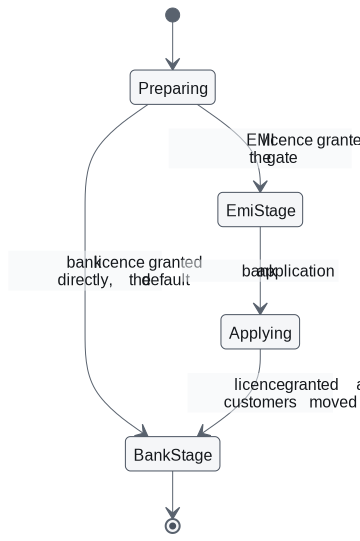
In the EMI stage the accounts hold safeguarded e-money, with no deposits and no interest. In the bank stage the same accounts become deposit accounts with insurance, interest and, later, lending. On the upgrade date a customer's EUR 5,000 changes from e-money to a deposit, and the customer accepts new terms in the app. The design assumes that the customer's IBAN remains unchanged, because the licensed entity and its participant code remain the same (see Assumptions and dependencies). D01.5 describes how the migration is run.
The second diagram shows the bodies that supervise the bank or receive reports from it under the Lithuanian profile; the UK counterparts are listed in the United Kingdom profile section.
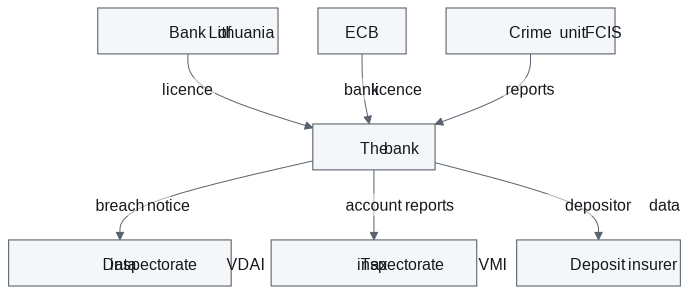
The Bank of Lithuania is the supervisor with which the bank has the most frequent contact. It licenses an EMI, assesses a bank application, receives the regulatory reports and operates CENTROlink, its payment system for euro payments. The ECB decides on a bank licence. The card scheme is not a regulator, but its rules are binding on the bank.
How it works
The table below maps each body of rules under the Lithuanian profile to the blocks it requires and to the section that covers them; the United Kingdom profile section carries the corresponding UK table. The system map describes the role of each block.
| Rules | What they require | Block it forces | Section |
|---|---|---|---|
| CENTROlink and SEPA scheme rules (rules[14]) | Participation in the payment system with the bank's own bank code, certificates and tests. A prefunded settlement account maintained at a level that keeps instant payments available. | sepa-gateway, treasury | 04, 08 |
| Instant Payments Regulation (2024/886[4]) | Confirmation within 10 seconds. Verification of the payee's name before authorisation, free of charge. Daily rescreening of customers against sanctions lists. | payments, ledger, risk, screening | 04, 03 |
| PSD2 and the strong customer authentication standard (2018/389[3]) | Two factors from different categories (knowledge, possession, inherence). A code bound to amount and payee. At most 5 failed attempts. Refund of unauthorised payments by the next business day (Art 73[2]). | identity, openbanking, cards | 09, 11, 05 |
| Anti-money-laundering (AML) law (2024/1624[5]) | Customer due diligence, risk rating, transaction monitoring, reporting of suspicion, a prohibition on disclosure to the customer, and record keeping. | onboarding, screening, compliance, audit | 06 |
| Sanctions | Freezing of the assets of listed persons and reporting to the financial crime unit. A confirmed freeze ends only on delisting or with the authority's authorisation. The instant path reads the freeze flag at once. | screening, accounts, ledger | 06, 03 |
| Deposit insurance | The total held by each depositor across accounts and currencies, and the eligible part of it. | accounts, ledger, reporting | 03, 08 |
| Safeguarding (EMI stage) | Segregation of customer funds and daily reconciliation of the ledger against the safeguarding accounts. | treasury | 08 |
| Prudential reporting (bank stage) | Reports demonstrating that the bank holds sufficient capital and liquidity to absorb losses. | reporting, treasury | 08 |
| Payment account duties (Directive 2014/92/EU[6]) | The switching service is a duty of every payment service provider and therefore applies in both licence modes (Arts 1(3) and 10). The payment account with basic features is a duty of credit institutions, either all of them or a sufficient number as each Member State decides, and an application is decided within 10 business days and refused only on the grounds of Art 16(4) to (6) (Arts 1(4) and 16). The bank supports switching in both modes and, in bank mode, offers the basic account and limits refusal to those grounds whether or not Lithuanian law designates it. Cost: one additional product version and a restricted refusal route in onboarding. | accounts, onboarding, comms | 03, 06 |
| DORA, the EU digital operational resilience law (2022/2554[10]) | A register of ICT supplier contracts, tested exit plans and backups, and incident reports on short deadlines. | Platform, audit | 10, 11 |
| GDPR, the EU data protection law (2016/679[9]) | A single authoritative store for personal data. Breach notice within 72 hours (Art 33). A risk assessment before profiling (Art 35). Rights in respect of automated decisions (Art 22). | customers, retention jobs | 12 |
| Consumer credit directive 2 (CCD2) and the AI Act (CCD2[11]) | Affordability checks, a record of data sources, human review of automated credit decisions. | lending, risk | 07 |
| PCI DSS 4.0.1 (PCI SSC[17]) | The card industry's security standard. | cards | 05, 11 |
| Lithuanian specifics (as reported) | Reporting of opened and closed accounts to the tax inspectorate within 3 business days. Acceptance of bailiffs' seizure orders through PLAIS, the system used by bailiffs to freeze account funds. Support for national electronic identities. | reporting, compliance, accounts, ledger, onboarding | 08, 03, 06 |
Retention periods are held as a setting and are not listed in this table. The retention_policies table, owned by compliance, holds them (06). The current Lithuanian period is 8 years (as reported). From 10 July 2027 the EU AML Regulation sets 5 years, extendable by up to 5 (Art 77[5]).
Five of these obligations have the greatest influence on the design under the Lithuanian profile:
- The 10-second rule. It removes batch windows. The ledger must place and commit a hold in a synchronous call at any hour, so
paymentsandledgerare on the money path. Payments explains which moment counts as the legal time of receipt. - Daily sanctions screening of customers. This is a legal requirement for a euro-area bank today. The whole customer base is rechecked at least once per calendar day, and again immediately after new measures are published. Instant payments themselves are not screened individually (04 cites the article).
- Deposit insurance. It is a ledger design question.
accountsmust be able to determine at any time the total held by a depositor and the eligible part of it. - PLAIS seizures. A court officer freezes part of a customer's funds. The ledger records the amount as a seizure hold that the customer cannot clear.
- Tipping-off. An alert or a suspicious activity report must leave no visible trace for the customer. This limits what
commsand the support console may disclose (06 gives the legal basis).
The following table lists the dated EU and Lithuanian obligations from now to 2028. A date marked "as reported" comes from a secondary source.
| Date | What happens | Source |
|---|---|---|
| 9 Jan 2025 | In force: euro-area banks must receive instant payments and screen customers daily | Regulation 2024/886[4] |
| 9 Oct 2025 | In force: euro-area banks must also send instant payments and check the payee's name | Regulation 2024/886[4] |
| 17 Jan 2025 | DORA applies | Regulation 2022/2554[10] |
| 1 Nov 2026 | Restated CENTROlink rules in force, as reported | Bank of Lithuania news[15] |
| 20 Nov 2026 | Consumer credit directive 2 applies | CCD2 Art 48[11] |
| 24 Dec 2026 | National digital identity wallet due, as reported | Regulation 2024/1183[13] |
| 31 Dec 2026 to 30 Jun 2027 | Existing indirect CENTROlink contracts end, as reported | Bank of Lithuania news[15] |
| 1 Jan 2027 | Direct participants may sponsor indirect ones, as reported | Bank of Lithuania news[15] |
| 9 Apr 2027 | EMIs and payment institutions in the euro area must send and receive instant payments | Regulation 2024/886[4] |
| 10 Jul 2027 | EU AML Regulation applies, retention changes | Regulation 2024/1624[5] |
| 2 Dec 2027 | AI Act duties for high-risk systems such as credit scoring apply | Regulation 2026/1744[12] |
| 24 Dec 2027 | Banks must accept the digital identity wallet on request, as reported | Regulation 2024/1183[13] |
| From 2028 | The EU AML authority directly supervises 40 of the highest-risk financial institutions or groups | AMLA[20] |
| Not yet dated | PSD3 and the Payment Services Regulation. The Council adopted its first-reading position on 29 Oct 2026. Parliament's second reading and publication are pending, so it is not yet law (as reported) | Taylor Wessing[21], background on the 2025 political agreement |
United Kingdom profile
| Aspect | Lithuanian profile | UK profile |
|---|---|---|
| Setting | jurisdiction.profile = lt | jurisdiction.profile = uk |
| Supervisors | Bank of Lithuania; ECB for the bank licence | PRA and FCA for a bank; FCA for an EMI |
Licence mode emi | EMI licensed by the Bank of Lithuania | EMI authorised by the FCA |
Licence mode bank | Specialised bank | Bank authorised by the PRA with FCA consent, entered through mobilisation (authorisation with restrictions) |
Minimum capital, emi | EUR 350,000 plus own funds of at least 2% of e-money outstanding | EUR 350,000 plus own funds of 2% of average outstanding e-money |
Base capital, bank | EUR 1 million (as reported) | EUR 5 million; for a small specialist bank the higher of EUR 1 million and GBP 1 million (the PRA rule states these thresholds in euro) |
| Decision period | 12 to 24 months after filing (planning assumption; reported cases range from 9 to 24 months) | Bank: 6 months from a complete application, 12 from an incomplete one. EMI: 3 and 12 months |
Customer money, emi | Safeguarding under Lithuanian law | Safeguarding under the FCA regime, including the supplementary regime in chapter 15 of the FCA's Client Assets sourcebook (CASS 15) |
Customer money, bank | Deposit insurance up to EUR 100,000 | FSCS protection up to GBP 120,000, with a Single Customer View file |
| Operational resilience | DORA | PRA SS1/21, FCA SYSC 15A and PRA SS2/21 on outsourcing |
| Conduct | PSD2 as transposed, EU consumer law | Payment Services Regulations 2017, Consumer Duty, the FCA's Banking Conduct of Business sourcebook (BCOBS) and complaints rules (DISP) |
| Governance | Bank of Lithuania fit-and-proper assessment | Senior Managers and Certification Regime (SM&CR) |
| Market access | The EEA, through passporting | The UK only |
Entities and market access. One licensed legal entity runs under exactly one profile, in its own deployment with its own ledger, databases, keys and cloud accounts. Passporting between the UK and the EEA ended in both directions on 31 December 2020; a Lithuanian licence passports across the EEA and does not reach UK residents, and a UK authorisation gives no access to the EEA. A group that serves both markets therefore runs two authorised entities and two deployments of the same code.
Bank route. A UK bank is dual-regulated: the PRA is the lead authority for the deposit-taking permission and grants it only with FCA consent (Financial Services and Markets Act 2000, section 55F[27]), and the statutory clock starts when either regulator receives the application. Entry is through the New Bank Start-up Unit, operated jointly by both regulators, in three stages: an optional pre-application stage with formal written feedback and no statutory timeline, the assessment stage, and an optional mobilisation stage. The statutory decision period is six months from a complete application and 12 months from receipt of an incomplete one. The PRA already measures itself against four and ten months, the periods that the Financial Services and Markets Bill would make statutory; the Bill completed its Lords stages on 15 September 2026 and was in Commons committee in November 2026, so the six- and twelve-month periods remain the law (Financial Services and Markets Bill[26]). The assessment stage typically takes 8 to 12 months after submission (as reported). Mobilisation is authorisation with restrictions, during which total deposits are limited to GBP 50,000; regulatory guidance states that it should take no longer than 12 months, and the application for the variation of permission that lifts the restriction must be submitted at least three months before the end of the 12-month mobilisation period. A recent entrant spent about 18 to 20 months in mobilisation (as reported).
Capital. The base capital requirement is a floor, and the capital actually required is set by the prudential regime described in Treasury, finance and reporting, including the simplified regime for Small Domestic Deposit Takers.
Application fee. The FCA Handbook places an application by a deposit acceptor in pricing category 7 (FEES 3 Annex 1[65]), for which the fee is GBP 28,150 at the rates in force since 2 July 2026 (FEES 3 Annex 1A[66]). The same annex notes that a firm seeking PRA authorisation may also pay a regulatory transaction fee to the PRA under chapter 4 of the Fees Part of the PRA Rulebook. No reliable public figure exists for the total cost of authorisation of a recent UK bank; the delivery plan carries that cost in its envelope.
EMI route. The FCA must decide an EMI application within three months of receiving a complete application and within 12 months of an incomplete one (Electronic Money Regulations 2011, regulation 9[34]). E-money is not a deposit and is not covered by the FSCS, so safeguarding is the only protection of customer funds. Since 7 May 2026 the supplementary regime in CASS 15 requires internal and external safeguarding reconciliations at least once each reconciliation day, a resolution pack, a monthly safeguarding return and an annual safeguarding audit; the audit is not required of a firm that has held no more than GBP 100,000 of relevant funds over a period of at least 53 weeks (FCA PS25/12[38]). An EMI must not award interest or any other benefit related to the length of time e-money is held (Electronic Money Regulations 2011, regulation 45[37]), and may grant credit only in connection with payment services and never from safeguarded funds (regulation 32[36]).
Regimes that apply from authorisation. Under PRA SS1/21 and FCA SYSC 15A the bank identifies important business services, sets impact tolerances, maps the resources behind each service, tests against severe but plausible scenarios and keeps a self-assessment; the transitional period ended on 31 March 2025, so the design applies the rules in full from the date of authorisation (Platform and data). DORA is an EU regulation and does not apply to a UK-authorised entity. The Consumer Duty requires good outcomes on products and services, price and value, consumer understanding and consumer support, with an annual board report. Under SM&CR the holders of the senior management functions are approved before taking up their roles; Running the bank lists the functions and owns governance and conduct. Under the FSCS each depositor is protected up to GBP 120,000 per firm, payout is targeted within seven business days (Depositor Protection 9.3), and the bank must deliver its Single Customer View and exclusions view to the FSCS within 24 hours of deposits becoming unavailable or of a request by the PRA or the FSCS (Depositor Protection 12.1 and 12.2).
Effect on the design. The setting jurisdiction.profile (D01.6) selects the supervisors, the rule rows, the rail gateway and the reports; licence.mode keeps its meaning. Under the UK profile the compliance register carries the UK rows below, licence.restrictions holds the mobilisation deposit cap and is enforced by accounts and risk, the depositor view produces the Single Customer View file, and the supplier register in section 10 also supports the operational resilience mapping. The ledger, the account model, the payment state machine, the register mechanics and the four-eyes controls do not change. In failure handling, a mobilisation that exceeds the guidance extends the period of capped deposits, which the delivery plan treats as a runway risk (13).
| Rules | What they require | Block it forces | Section |
|---|---|---|---|
| Faster Payments scheme rules (FPS Principles[57]) | Receipt of all payment types at all hours; the payer is told the outcome of an attended payment within 15 seconds; the participant holds, or is eligible to hold, at least one unique sort code | fps-gateway, payments, treasury | 04, 08 |
| Bacs scheme rules (Bacs System Principles[58]) | Indirect access through a sponsoring direct participant; a three-day cycle of input, processing and entry; under the Direct Debit Guarantee the payer's bank refunds immediately and recovers from the originator through the indemnity claim process | payments, treasury | 04, 08 |
| Payment Systems Regulator Specific Direction 17, Confirmation of Payee (consolidated October 2026[60]) | A payee name check, sent and answered, when a payee is set up or changed, for Faster Payments and CHAPS. The direction applies to a new participant from the day after it joins with its own sort code, and since 22 October 2026 it has no expiry date | payments | 04 |
| Authorised push payment (APP) fraud reimbursement (Payment Systems Regulator[61], PS25/5[62]) | Reimbursement within 5 business days, up to GBP 85,000 per claim, with the cost split equally between sending and receiving firm | risk, ledger, compliance | 07 |
| Payment Services Regulations 2017 (reg. 86[63]) and the FCA's SCA standards | Strong customer authentication; a power to delay an outbound payment on suspicion of fraud until the end of the fourth business day after receipt | identity, payments, risk | 09, 04 |
| Money Laundering Regulations 2017 (SI 2017/692[67]) and the Proceeds of Crime Act 2002 | Customer due diligence, suspicious activity reports to the National Crime Agency, a prohibition on tipping off, records kept for five years after the end of the relationship (regulation 40[68]) | onboarding, screening, compliance, audit | 06 |
| Financial sanctions (UK Sanctions List[70]) | Screening against the UK Sanctions List, freezing, and reporting to the Office of Financial Sanctions Implementation (OFSI) | screening, accounts, ledger | 06 |
Depositor protection, bank (PRA Rulebook[45]) | Single Customer View and exclusions view within 24 hours; marking of eligible deposits | accounts, ledger, reporting | 08 |
Safeguarding, emi (PS25/12[39]) | Segregation, reconciliations, resolution pack, monthly return and annual audit | treasury, reporting | 08 |
Prudential and statistical reporting, bank | COREP and FINREP through FCA RegData; statistical returns through BEEDS | reporting, treasury | 08 |
| Operational resilience and outsourcing (SS1/21[48]) | Important business services, impact tolerances, mapping, scenario testing; incident and third-party reporting under FCA PS26/2 and PRA PS7/26, which apply from 18 March 2027, before the earliest forecast authorisation | Platform, audit | 10 |
| UK GDPR and Data Protection Act 2018 as amended by the Data (Use and Access) Act 2025 | Breach notice without undue delay and within 72 hours of becoming aware (Information Commission (ICO)[69]); safeguards for automated decisions | customers, retention jobs | 12 |
| Consumer Duty, BCOBS and DISP (PRIN 2A[54]) | Outcome monitoring, an annual board report, complaint handling within the DISP and payment-services time limits | comms, compliance | 14 |
| Consumer Credit Act 1974 and FCA CONC (Phase 2) | Creditworthiness assessment and the overdraft pricing rules | lending, risk | 07 |
PCI DSS applies under both profiles unchanged. Under the UK profile the starting retention period in retention_policies is five years after the end of the relationship under regulation 40 of the Money Laundering Regulations, and transaction records of a continuing relationship need not be kept beyond ten years.
Key design decisions
D01.1 Target licence and staged route
- Decision: The default route is a direct application for a Lithuanian specialised bank licence, with direct CENTROlink participation. The EMI route is taken first only if, by the end of Phase 0, counsel confirms three conditions. First, an EMI can reach CENTROlink directly or through an available sponsor participant, and
sepa-gatewayabstracts which. Second, the safeguarding accounts and an operating account can be obtained. Third, the EMI is forecast to reach customers at least 9 months before the bank licence (planning assumption). The choice is recorded as an amendment to this document. The EMI-only modules, namely daily safeguarding reconciliation and the EMI report set, are designed in Phase 0 and built only if the EMI route is chosen.
- Rationale: Only a bank may take deposits, pay interest and lend, and these are on the roadmap. Deposit insurance also increases customer trust in the product. An EMI licence is faster and cheaper to obtain, but it introduces a second regime and a customer migration, so the EMI stage must justify itself. A bank licence is slow to obtain. Law-firm notes report about 9 months (6 to 12) in 2018 (Sorainen[18]) and 10 to 11 months in 2019, and a newer vendor guide gives 12 to 24. The plan assumes a decision 12 to 24 months after filing (planning assumption; reported cases range from 9 to 24 months).
- UK profile: The default route is an application to the PRA and FCA for bank authorisation, entered through mobilisation, with Faster Payments access as set out in section 04. An FCA-authorised EMI stage is taken first only under the same three conditions, read for the UK. First, the EMI can reach Faster Payments directly or through a sponsor, and the rail gateway abstracts which. Second, safeguarding accounts and an operating account at a commercial bank can be obtained, which a UK EMI needs even where it holds a Bank of England settlement account. Third, the EMI is forecast to reach customers at least 9 months before the restrictions on the bank are lifted (planning assumption). The statutory decision period is shorter for an EMI, at three months against six for a complete application. A bank in mobilisation is subject to the deposit cap, however, so the bank route reaches the public only when the restrictions are lifted, which the delivery plan forecasts at 22 to 40 months from funding (planning assumption). Cost: a non-bank firm that seeks its own Bank of England settlement account first passes an FCA supervisory assessment, and the Bank advises planning for at least 12 months after the FCA activities; Pay.UK states 9 to 12 months for Faster Payments onboarding.
- Alternative considered: Remaining an EMI permanently is rejected because it precludes lending and interest. Launching nothing until the bank licence is granted is rejected because it implies a year or more without customers; the three conditions define when an EMI stage is worth its cost.
- Key function holders: Under either route and either profile, the members of the management body and the holders of the key functions are in post before the licence decision. This is the stricter reading of the supervisor's expectation, so the plan does not depend on which reading the supervisor applies. Cost: their salaries are carried through the assessment period, as the staffing plan in section 13 provides.
- Cost: The EMI route entails two regulatory regimes for a period, plus a customer migration. The form of access open to an EMI under the CENTROlink rules in force from 1 November 2026, direct or sponsored, is the first of the three conditions above and is settled in section 04 (D04.1) before the route is chosen. A sponsor needs 12 months in the system and 100,000 payment orders, and sponsored participants receive SCT and SCT Inst only, not SDD (as reported). This constitutes a business risk.
D01.2 Licence mode is configuration
- Decision: One setting,
licence.mode, takes the valueemiorbank. It switches the named behaviours below, and no service contains a licence branch outside them.customer_money_regimeis read from the product version, so customers who have not accepted the upgrade remain on e-money terms.
- Rationale: The two licences differ in a small number of well-defined respects. These are named once and both modes are tested.
- UK profile:
licence.modekeeps the same two values and switches the same behaviours.customer_money_regimeselects safeguarding under the FCA regime or, asdeposit_insurance, FSCS protection with the Single Customer View file.daily_safeguarding_reconcovers the reconciliations of the CASS 15 supplementary regime.prudential_report_setselects the EMI own-funds and monthly safeguarding returns or the PRA set, including COREP, FINREP and Bank of England statistical returns. The rail access line takes the Faster Payments access model in place ofcentrolink_access(section 04).interest_on_balancesandlending_enabledremain off inemimode, because a UK EMI must not award interest on e-money and may grant credit only in connection with payment services (Electronic Money Regulations 2011, regulations 45 and 32). One setting is added for thebankmode:licence.restrictionsholds the mobilisation limits, namely the cap on total deposits and the per-customer balance limit and maximum number of invited customers derived from it (see Failure modes and mitigations), whichaccountsandriskenforce until the variation of permission that lifts the restriction is recorded.
- Alternative considered: Two code branches are rejected because they double the testing effort.
- Cost: Both modes must be exercised continuously in tests. A change of customer-money regime is a legal event and therefore requires four-eyes approval (two different people) and a dated record.
The setting switches these behaviours:
licence.mode                  emi            bank
customer_money_regime         safeguarding   deposit_insurance
interest_on_balances          off            on
lending_enabled               off            on (Phase 2)
daily_safeguarding_recon      on             off
depositor_view                tested, off    on
prudential_report_set         emi own funds  full bank set
centrolink_access             sponsored or direct                direct
onboarding_enabled            on             on (off in wind-down)
wind_down                     off            off (on only by board decision)
onboarding_enabled and wind_down are independent of licence.mode. They are the wind-down hooks described in Running the bank.
A technical negative balance in emi mode is handled within the same setting. A forced entry is booked as in bank mode, because the amount is already owed to a third party (section 03). The resulting negative balance is recorded as a receivable of the institution and is covered from its own funds on the same business day, so that safeguarded funds do not finance it; debits from the account are blocked, no interest or fee is charged on it, and the next incoming funds repay it. No negative balance is offered or agreed in emi mode. Residual risk: such a balance may be classified as credit, which an EMI may grant only in the narrow cases tied to payments noted in the licence table (EMD2 Art 6); the treatment above is the same under either classification, and its cost is a same-day call on own funds.
D01.3 Every rule is traced to a control: a compliance register kept as data
- Decision: A compliance register holds one row per obligation. It resides in the
compliancedatabase and is read byreporting. It links bycontrol_idto the operational-risk register in section 07 and the control-gap list in section 11, so that a single list of controls is maintained instead of three. Section 10 owns the ICT supplier register that DORA requires.
- Rationale: Compliance staff work from rules and engineers work from code. The register links the two. It identifies the control that meets a given article and the location of the evidence, and a row without a control is a visible gap.
- Alternative considered: A spreadsheet maintained by the compliance function is rejected because it becomes outdated within weeks.
- Cost: The register requires a named owner and a scheduled review. A change in a rule requires a change in a row, a test and, in some cases, a release.
The following diagram shows the life of one row.
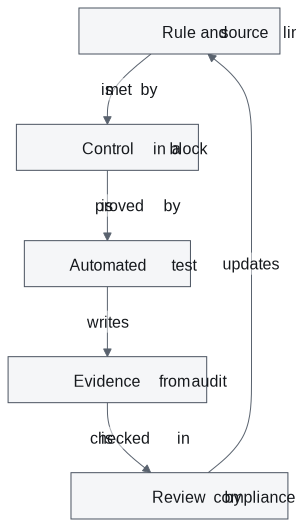
Each row records the rule, its source, its owner, the control that meets it, the test that proves it, the location of the evidence and the date of the last review. It also carries the dates from which the rule applies. A confidence column records the reliability of the source, so that a fact known only from a secondary source cannot be treated as confirmed. A jurisdiction column takes the value lt, uk or all; each deployment loads the rows for its own profile together with the rows marked all, such as PCI DSS, and a control that meets an obligation under both profiles is referenced by both rows.
D01.4 Dates in motion are settings
- Decision: Thresholds and effective dates are rows in a
rule_parametertable withname,value,effective_from,effective_toandsource.complianceowns the table and publishes each change as a versioned configuration through the config store (10). Services read their local copy for the business date and do not read the table. Retention periods are held inretention_policiesand not in this table.
- Rationale: Several rules are expected to change during the build. Examples are the frequency of customer rechecks against sanctions lists; the small-payment limits that permit an exemption from a second authentication step; the interest rate at which a loan must still be affordable; the European Payments Council's payment rulebook, reissued every two years each October (as reported); and the date on which the AI rules apply, which has already moved once.
- UK profile: Each row of
rule_parameteralso carries the profile to which it applies. Rules that take effect before the earliest forecast authorisation, such as the incident and third-party reporting rules of 18 March 2027, are loaded as current values. UK values still in motion are the statutory decision periods, which the Financial Services and Markets Bill would shorten to four and ten months; the Consumer Duty board report, which CP26/23 proposes to replace with reporting through the firm's ordinary board reporting, with final rules expected in the first quarter of 2027 (FCA CP26/23[56]); the second phase of SM&CR reform, on which the PRA and FCA consulted on 22 October 2026 (closing 22 January 2027), with final policy expected in 2027 once the enabling legislation is passed; and the transfer of the Payment Systems Regulator's functions to the FCA, provided for in the same Bill, which was in Commons committee in November 2026 and takes effect only on commencement.
- Alternative considered: Constants in code, with one release per change, are rejected because a missed release constitutes a breach.
- Cost: A wrong parameter is a production incident. Changes require four-eyes approval and a test that replays the previous month's decisions under the new value.
D01.5 The upgrade is run as a customer programme
- Decision: The EMI-to-bank switch has five parts. Each customer receives a dated notice and accepts new terms, which are recorded in
consents. Customers who have not accepted remain on e-money terms until they accept or leave.treasurymoves the safeguarded funds, and the move is rehearsed in staging. Customers receive the depositor information they need before they are insured. Finance and compliance sign off a reconciliation before and after the switch.
- Rationale: The legal nature of the money changes, so the ledger switch alone does not constitute the upgrade. A change to the framework contract must be proposed to the customer no later than two months before its proposed date of application, and a customer who rejects it may terminate the contract free of charge before that date (PSD2 Art 54[2]). The dated notice is therefore sent at least two months before the switch.
- UK profile: The upgrade moves customers from an FCA-authorised EMI to a PRA-authorised bank. Because a bank in mobilisation is subject to the deposit cap, e-money balances are converted into deposits only after the restrictions are lifted; until then the friends-and-family cohort of the bank and the EMI customers run side by side. The same five parts apply: the depositor information describes FSCS protection, and
treasurycloses the CASS 15 safeguarding records with a final reconciliation. Where the bank is a separately authorised entity, the upgrade is a transfer of customers and balances between two deployments, rehearsed as a full-copy migration (13); the five parts then apply to the transfer andlicence.modedoes not change in either deployment. Where the EMI entity itself is authorised as a bank, e-money balances are assumed to be outside the deposit cap until converted. The plan takes this second case as the default, because it keeps one deployment and one change oflicence.mode, and retains the transfer between two entities as the fallback (see Assumptions and dependencies). In both cases the change of terms is notified no later than two months before it takes effect (Payment Services Regulations 2017, regulation 50[64]).
- Alternative considered: A single cut-over night for all customers is rejected because it would place non-responding customers under new terms.
- Cost: Two customer cohorts exist side by side for several weeks. The EMI stage also requires two safeguarding accounts and an operating account at a credit institution. New EMIs often find these difficult to open, so they lie on the critical path in the delivery plan.
D01.6 Jurisdiction profile is configuration
- Decision: One setting,
jurisdiction.profile, takes the valueltorukand is fixed for the life of a deployment. It selects the supervisors and their reports, the base currency, the account identifier, the rail gateway (sepa-gatewayorfps-gateway), the payee check adapter, the customer-money regime under each licence mode, the rows of the compliance register and ofrule_parameter, the sanctions lists and the cloud regions. It sits besidelicence.mode, which keeps its meaning under both profiles. One licensed legal entity runs under exactly one profile in its own deployment, with its own ledger, databases, keys and cloud accounts; a group that serves both markets runs two entities and two deployments of the same code.
- Rationale: The two jurisdictions differ in their supervisors, payment rails, customer-money regimes and reporting, whereas the ledger, the account model, the payment state machine and the controls are common. Concentrating the differences in configuration and a small set of adapters and modules keeps one code base and one test suite. Separate deployments follow from the absence of passporting between the UK and the EEA, which requires a separately authorised entity in each market.
- Alternative considered: A single multi-jurisdiction deployment serving both entities is rejected because it would mix two legal entities' ledgers, keys and supplier contracts under one operational resilience perimeter. Separate code bases per jurisdiction are rejected because they double the build and testing effort.
- Cost: Both profiles must be exercised continuously in tests, in combination with both licence modes. Every new rule row and parameter carries a profile, and a change to a common block is tested against both. The profile is set at deployment and cannot be changed at run time.
Failure modes and mitigations
| Failure | Effect | Response |
|---|---|---|
| A rule changes and is not noticed | The bank is non-compliant without detection | Register owner, quarterly review, last_reviewed on a dashboard |
| A secondary source was wrong | The system is built to a rule that differs from the law | The confidence column, and a counsel check before a row is marked confirmed |
| EMI cannot reach CENTROlink directly | Launch depends on a sponsor | sepa-gateway abstracts the choice, and the sponsor route is tested early |
| Licence switch completed only in part | Some accounts are safeguarded and some insured, and balances disagree | A dated, four-eyes switch with a reconciliation before and after |
| UK profile: mobilisation exceeds the 12-month guidance | Deposits remain capped and public launch is delayed | Runway planned to the latest forecast in section 13; application for the variation of permission submitted at least three months before the end of the mobilisation period |
| UK profile: total deposits approach the mobilisation cap | A breach of the restriction on the authorisation | licence.restrictions holds the total cap and derives from it a per-customer balance limit and a maximum number of invited customers, whose product stays below the cap with a margin (planning assumption: 80% of the cap). accounts enforces the invitation count at onboarding and the per-customer limit on each credit. An inbound Faster Payment that would breach the limit is rejected at the accept step with the scheme reject reason that section 04 specifies; a credit that cannot be rejected in real time, such as a Bacs credit, a card refund or interest, is accepted and the excess returned the same day. treasury reports the aggregate against the cap daily, and an alert at 80% stops new invitations |
| UK profile: Single Customer View file not delivered within 24 hours | A breach of the depositor protection rules and a delayed FSCS payout | The depositor view produces the file on a schedule and is tested end to end (08) |
| Wrong profile loaded at deployment | Rules, reports and rails of the other jurisdiction applied | jurisdiction.profile fixed per deployment and checked at start-up against the entity's configuration |
Security and privacy considerations
The register holds no personal data. Evidence refers to customers by ID only (Privacy). Changing a parameter or the licence mode is a sensitive staff action under the four-eyes rules in Security. Running the bank states who staffs the register and the reviews.
Phasing
- Phase 1:
licence.modewith both values defined. The register with every row above and its confidence tag. Therule_parametertable. Instant payments, payee verification and daily screening, because they are legal requirements today. The depositor view if the first licence is a bank licence, and always tested in EMI mode. Retention as a setting. The EMI-only modules are designed in Phase 0 and built only if the EMI route is chosen. - Phase 2: Insurance exports, if the bank stage starts in Phase 2. Lending rules: CCD2 data-source records and affordability. SDD with the fee tiers (as reported). Business accounts. The upgrade programme of D01.5, if the bank starts as an EMI.
- Phase 3: Partner and banking-as-a-service rules. These require a separate review of which party is regulated. They are not analysed here.
- UK profile: Phase 1 adds
jurisdiction.profile, the UK register rows,licence.restrictionsfor mobilisation, the Single Customer View file inbankmode and the operational resilience self-assessment, all of which are required from authorisation. Phase 2 adds the consumer credit rows and Bacs Direct Debit. A move to settling Faster Payments participation is phased in section 04.
Assumptions and dependencies
The design in this section rests on the following assumptions, each of which is confirmed at the stated point. None blocks the start of the build, because each fallback changes a setting, a plan figure or the scope of the upgrade programme and leaves the architecture unchanged.
| Assumption | Confirmed by | When | If it does not hold |
|---|---|---|---|
| Lithuanian profile: the initial capital floor of a specialised bank is EUR 1 million. | Counsel, against the Lithuanian Law on Banks | Before the licence application | The capital plan in section 13 is restated on the EUR 5 million floor of CRD Art 12(1). The design does not change. |
| Licence fees that no public tariff states, namely the Lithuanian state and supervisory fees for a specialised bank licence and any PRA regulatory transaction fee, fall within the cost envelope of section 13. | Counsel, the Bank of Lithuania, the PRA | Before the licence application | The cost envelope in section 13 is restated. The design does not change. |
| The firm-specific capital requirements set by the supervisor fall within the capital plan of section 13: the Pillar 2 requirement for a new specialised bank under the Lithuanian profile and, under the UK profile, Pillar 2A and the buffers, including the single capital buffer of the Small Domestic Deposit Taker regime if the bank opts in (section 08). | The Bank of Lithuania and the ECB; under the UK profile the PRA | Before the licence application | The capital plan in section 13 is restated and the report set in section 08 is selected by configuration. The design does not change. |
| Lithuanian profile: at the EMI-to-bank upgrade the licensed entity keeps its participant code, so customers keep their IBANs. This applies only if the EMI route is chosen. | The Bank of Lithuania | Phase 0 exit | The upgrade programme of D01.5 adds the issue of new IBANs, announced in the same two-month notice, and the migration effort in section 13 increases. |
| UK profile: the statutory decision periods remain six and twelve months when the application is filed. The Financial Services and Markets Bill, which would shorten them to four and ten months, was before the House of Commons and had not received Royal Assent on 26 November 2026. | Parliament, and HM Treasury for commencement | Before the licence application | The decision-period rows of rule_parameter change on commencement and the UK forecast in section 13 shortens. The design does not change. |
| UK profile: where an EMI stage precedes the bank, the EMI entity itself is authorised as a bank and its e-money balances remain outside the mobilisation deposit cap until they are converted into deposits. This applies only if the EMI route is chosen. | The PRA and FCA at the pre-application stage, and counsel | Before the licence application | The bank is authorised as a separate entity and the upgrade runs as a transfer of customers and balances between two deployments, as D01.5 describes; the second entity and the full-copy migration are added to the plan in section 13. |
Sources
- EMD2, Directive 2009/110/EC
- Directive (EU) 2015/2366, payment services (PSD2)
- Delegated Regulation 2018/389, strong customer authentication
- Regulation (EU) 2024/886, Instant Payments Regulation
- Regulation (EU) 2024/1624, AML Regulation
- Directive 2014/92/EU, payment accounts
- Directive 2013/36/EU, Capital Requirements Directive, Article 12
- Council Regulation (EU) No 1024/2013, SSM Regulation, Article 14
- Regulation (EU) 2016/679, GDPR
- Regulation (EU) 2022/2554, DORA
- Directive (EU) 2023/2225, consumer credit
- Regulation (EU) 2026/1744, Digital Omnibus on AI
- Regulation (EU) 2024/1183, European digital identity framework
- CENTROlink operating rules, Bank of Lithuania, 2023 version
- Updated CENTROlink rules, Bank of Lithuania news
- Deposit insurance, Lithuanian insurer
- PCI DSS v4.0.1 announcement, PCI Security Standards Council
- Specialised bank regulation in Lithuania, Sorainen, used for "as reported" licence facts
- European banking licence and specialised bank licensing, Ecovis, used for "as reported" licence facts
- AMLA takes major step toward harmonised EU supervision, used for the 2028 date
- EU lawmakers strike a deal on payments reforms, Taylor Wessing, background on the 2025 political agreement on PSD3
- New bank authorisation process, Bank of England
- Mobilisation, Bank of England
- PRA Authorisations Performance Report 2025/26 Q4
- PRA Authorisations Performance Report 2026/27 Q2
- Financial Services and Markets Bill, UK Parliament
- Financial Services and Markets Act 2000, section 55F
- UK bank authorisation guide, BDO, used for the "as reported" assessment duration
- Revolut to land full UK banking licence, City AM, used for the "as reported" mobilisation duration
- PRA Rulebook, Definition of Capital
- Strong and Simple, Bank of England
- The Strong and Simple framework, final policy statement, January 2026
- Electronic Money Regulations 2011, Schedule 2
- Electronic Money Regulations 2011, regulation 9
- Electronic Money Regulations 2011
- Electronic Money Regulations 2011, regulation 32
- Electronic Money Regulations 2011, regulation 45
- FCA PS25/12, policy statement text
- FCA PS25/12, safeguarding regime for payments and e-money firms
- FCA Dear CEO letter to e-money firms, May 2021
- PRA SS28/15, April 2026 update
- FCA Senior Managers Regime
- Regulators unveil plans to simplify SM&CR, Bank of England, October 2026
- PRA news, FSCS deposit limit increased to GBP 120,000
- PRA Rulebook, Depositor Protection
- PRA Rulebook, Depositor Protection 12, Single Customer View requirements
- BoE regulatory reporting, banking sector
- PRA SS1/21, operational resilience
- FCA operational resilience insights
- FCA PS26/2, operational incident and third-party reporting
- PRA PS7/26, operational incident and third-party reporting
- FCA, regimes for EEA firms
- FCA, considerations for firms after the transition period
- FCA Handbook, PRIN 2A.8, Consumer Duty board report
- FCA CP26/23, Consumer Duty scope and proportionality
- FCA CP26/23, consultation text
- Pay.UK, Faster Payments System Principles v11
- Pay.UK, Bacs System Principles v18
- Bank of England, access to UK payment systems for non-bank PSPs
- Payment Systems Regulator, Specific Direction 17 on Confirmation of Payee, consolidated October 2026
- Payment Systems Regulator, APP fraud reimbursement protections
- Payment Systems Regulator, PS25/5, APP scams reimbursement, consolidated policy statement
- Payment Services Regulations 2017, regulation 86
- Payment Services Regulations 2017, regulation 50
- FCA Handbook, FEES 3 Annex 1, authorisation fees payable
- FCA Handbook, FEES 3 Annex 1A, pricing categories
- Money Laundering Regulations 2017
- Money Laundering Regulations 2017, regulation 40
- Information Commission (ICO), personal data breaches
- Moving to a single list for UK sanctions designations
- Streamlined approach to payment systems regulation, consultation response